declination

(redirected from Declinations)
Also found in: Dictionary, Thesaurus, Medical.

declination

1. Astronomy the angular distance, esp in degrees, of a star, planet, etc., from the celestial equator measured north (positive) or south (negative) along the great circle passing through the celestial poles and the body
Collins Discovery Encyclopedia, 1st edition © HarperCollins Publishers 2005

declination

(dek-lă-nay -shŏn) (dec) Symbol: δ. A coordinate used with right ascension in the equatorial coordinate system. The declination of a celestial body, etc., is its angular distance (from 0° to 90°) north (counted positive) or south (counted negative) of the celestial equator. It is measured along the hour circle passing through the body.
Collins Dictionary of Astronomy © Market House Books Ltd, 2006

Declination

(religion, spiritualism, and occult)

The solar system lies more or less in one geometric plane, which is why astrological charts can be drawn in two dimensions. If the celestial equator (which is the terrestrial equator extended out into space, and projected against the background of the stars) is used as a point of reference, it is found that, at any given time, most celestial bodies do not lie exactly in the same plane, but, rather, are located somewhat north or south of the celestial equator. The angular distance (distance expressed in degrees and minutes) of these bodies north or south of the celestial equator is their declination. Because some astrologers regard planets at the same declination as being in aspect with one another, planets’ declinations are often recorded in ephemerides.

The Astrology Book, Second Edition © 2003 Visible Ink Press®. All rights reserved.

declination

[‚dek·lə′nā·shən]
(astronomy)
The angular distance of a celestial object north or south of the celestial equator.
(geophysics)
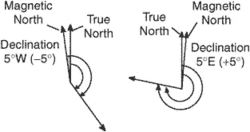
The angle between the magnetic and geographical meridians, expressed in degrees and minutes east or west to indicate the direction of magnetic north from true north. Also known as magnetic declination; variation.
(navigation)
In a system of polar or spherical coordinates, the angle at the origin between a line to a point and the equatorial plane, measured in a plane perpendicular to the equatorial plane.
The arc between the equator and the point measured on a great circle perpendicular to the equator.
McGraw-Hill Dictionary of Scientific & Technical Terms, 6E, Copyright © 2003 by The McGraw-Hill Companies, Inc.

declination

declination
declinationclick for a larger image
i. The angular difference in direction between magnetic north and true north, or between grid north and true north; hence, magnetic declination and grid declination.
ii. The angular distance of a celestial body from the celestial equator along the hour circle of the body. Measured in degrees, or radians, through 90°, and named north or south, depending on whether the body is north or south of the celestial equator. Declination on the celestial sphere is analogous to the latitude of the earth. The value of declination cannot exceed 90°.
An Illustrated Dictionary of Aviation Copyright © 2005 by The McGraw-Hill Companies, Inc. All rights reserved
References in periodicals archive ?
Caption: The equatorial head can be separated into two pieces with the RA axis and polar base (left) weighing 26 pounds, and the declination axis (right) weighing 18 pounds.
This reduction of energy consumption can be achieved, if the pump proportional pressure control is applied in comparison with the constant differential pressure control mode and the declination of pump proportional pressure control curves is up to 90% from the duty point head value.
(Ridpath, 1989: 58) A simple calculation (Fletcher, 2002) to determine the declination of the Sun for each day is given by
The dating via declinations may be illustrated by the observation of 7 June 1596 (De Veer's journal date).
To make the modern calculations, the following information must be available: the selected position of the observer, both latitude and longitude; the declinations and sidereal Hour Angles of both stars, and a table of Greenwich Hour Angles for Aries as a function of time.
Newcomers to astronomy can get thrown for a loop when they first encounter declination and right ascension.
However, the results of many scans at different declinations can be built up until an "image" is formed.
The location of a celestial object is often expressed by right ascension (hours and minutes of time) eastward from the vernal equinox, and declination (degrees and minutes of arc) from the celestial equator.