


Abstract
This paper investigates the long run association between business networks and entrepreneurship and regional development in China. We focus on chambers of commerce, bodies which facilitated networking between businesses until private firms were banned by Mao. Our results suggest that the pre-Mao chamber system is associated with long-lasting patterns of business creation and economic output in China, with this influence surviving until the post-1978 return of the market economy. The associations are strongest in the early reform period but weaken over time. We show evidence that historic chambers density is correlated with later social capital, despite major political change.
Plain English Summary
Places in China which had chambers of commerce - formal business networks - in 1910 have higher rates of entrepreneurship today, even though entrepreneurship was banned for forty years. The study shows that formal business networks matter for entrepreneurship over the long term, and suggests policymakers should encourage their development.
1 Introduction
One of the canonical facts in the entrepreneurship literature is that the geography of entrepreneurship tends to be persistent over time. Studies have shown that this persistence can survive major economic shocks across multiple contexts. For example, Poland, Germany and Russia all saw such persistence which survived world wars and communism (Belitski et al., 2024; Fritsch & Wyrwich, 2018; Fritsch et al., 2022). But while this persistence is now well documented, studies have often been imprecise on the mechanisms behind this. There has been some focus on, for instance, regional stocks of knowledge or the presence of universities (Del Monte & Pennacchio, 2020). But other explanations for this persistence have seen less focus.
Social networks are seen as vital for the geography of entrepreneurship and classic studies of entrepreneurial ecosystems have shown their importance (for example, Saxenian, 1994, on Silicon Valley). These social relationships help explain entrepreneurial outcomes and the geography of entrepreneurship (Sorenson, 2018), but the focus of study has been on informal or social networks. Yet formal business networks also offer important structured mechanisms for economic collaboration and knowledge dissemination (Granovetter, 2005; Storper, 2013). Business organisations such as coalitions, chambers, and guilds play crucial roles in coordinating activities, reducing transaction costs, and opening new markets. Institutionalised networks streamline transactions and provide essential support in terms of job security, access to capital, and market opportunities (Powell et al., 2005). Formal networks create longer-lasting informal networks which influence entrepreneurial activities even after the formal structures have disappeared (North, 1990; Storper et al., 2015).
In this paper, we study how formal business networks influence the geography of entrepreneurship in a country which experienced an extreme and long-lasting economic shock. Our focus is China, where the existence of private sector entrepreneurship was effectively banned during the Mao period from the 1940s to the mid-1970s, and the role of local chambers of commerce in explaining the geography of entrepreneurship when it resumed. These chambers were state-mandated institutions established by the Qing administration in 1904. They had formal, written statutes, cross-sectoral membership and routinised procedures which differentiated them from the merchant guilds (Kirby, 1995). As a result, while they were still elite institutions, they facilitated cross-sector networks beyond those provided by guilds. They saw rapid growth from 1904, with over a thousand chambers established across China by the 1910s (Fig. 1).Footnote 1 This historical variation across prefectures enables us to examine the long-run relationship between this institutionalised business network and enterprise growth.

The rollout of Chambers of Commerce in early twentieth century China
We use historical administrative records on the chamber system dating back to 1915 and manually gathered information on chamber location, membership numbers, types, meeting frequency, resolved disputes, and micro-level income and expenditure. We also compiled firm registry information from 1973 to 2017 to quantitatively evaluate the historical chamber system’s impact on new business creation in the contemporary era.
By drawing on the market economy reform in 1978 and adopting a difference-in-differences (DID) strategy, we first show that after private ownership was reauthorised in 1978, a 1% increase in the original chamber of commerce density is associated with approximately a 0.56% increase in the number of new firms in the respective city. Our event-study results validate the parallel pre-trend. While we cannot conclusively show causality, these estimates are robust to a variety of robustness checks.
We next measure the quality of newly registered firms by using businesses’ self-reported accounting information, including the number of employees and total assets. We find that new enterprises established in prefectures with historically high chamber density tend to invest more assets and hire more employees. This is consistent with newly established companies being of higher quality but also indicates that these firms potentially have a more significant positive impact on job creation and economic development in the region.
To address the concern that the DID estimates may reflect unobserved historical heterogeneity rather than a causal channel, we exploit the fact that telegraph construction facilitated communications between trade groups and promoted local chamber expansion. Qualitative evidence confirms that Chinese merchants in the early twentieth century used the telegraph for information transmission (Baark, 1997). While the expansion of the telegraph network reflected a combination of strategic, administrative, and commercial considerations, we exploit plausibly exogenous variation in prefecture-level proximity to the early telegraph system. Specifically, we construct an instrumental variable based on the shortest distance from each prefecture to the nearest telegraph station in 1903, 1 year before the chamber system began to roll out. Our two-stage least squares (2SLS) regressions yielded estimates consistent with ordinary least squares (OLS) results.
We then evaluate the overall long-term economic effects of original chamber density by cross-sectional regression in 2018. The OLS results, obtained after controlling for a rich set of socioeconomic characteristics, illustrate that a 1% increase in chamber density historically is associated with an increase of 0.18% and 0.40% in GDP and luminosity per capita, respectively in the contemporary era. Our instrumented estimators are consistent with the OLS estimates and remain highly statistically significant, although they rely on an exclusion restriction that, while theoretically motivated, cannot be formally proven. Consistent with this, our event-study estimates further indicate that the historical chamber effect is most pronounced during the early phases of the post-1978 transition and gradually attenuates as later waves of reform and place-based policies become increasingly prominent.
After establishing a positive association between historical chamber density on firm creation and regional development, we explore two mechanisms that can help explain how this organisational legacy persists despite major institutional breaks. First, using two nationwide household surveys, we show that prefectures with denser historical chamber membership exhibit higher bridging social capital, measured by generalised trust towards strangers (Putnam, 2000), without a corresponding decline in bonding trust. To mitigate concerns about the temporal gap in modern surveys, we complement this evidence with historical proxies that can be traced across periods, registered social organisations and genealogies which display consistent patterns before and after 1978. Second, we examine institutional continuity across the Maoist period. Drawing on prefecture-level evidence from local gazetteers, we show that areas with higher historical chamber density saw greater incorporation of entrepreneurs into the All-China Federation of Industry and Commerce (ACFIC) in the early 1950s and a faster re-establishment of chambers in 1978–1990, consistent with organisational remnants lowering the costs of revival when market reforms resumed.
Our paper contributes to two strands of literature. First, we extend the research on business networks from an institutional perspective. Previous empirical evidence has focused on analysing how varying degrees of participation within business networks impact financial performance at the firm level (Giuliani, 2007; Kemeny et al., 2016). Our study systematically compares the structure and nature of specific business organisations across different regions. Second, we provide the first rigorous and comprehensive empirical evidence on the long-term influence of business networks on entrepreneurship and regional development. While there is emerging literature on how local entrepreneurial cultures affect the level of entrepreneurship, these studies have mainly focused on factors driven by geography, culture, and religion (Fritsch & Wyrwich, 2017; Miao et al., 2022).
The rest of this paper proceeds as follows. In Sects. 2 and 3, we discuss the conceptual background and research context. Section 4 elaborates on the sources of data and empirical strategy. Section 5 presents the empirical results pertaining to the influence of the chamber system on firm creation and regional development. Section 6 investigates the mechanisms through which the chamber system could be persistent. The final section concludes the paper.
2 Conceptual background
2.1 Taking business networks to the local level
Inter-firm business relationships, which provide intermediate inputs, information, referrals, and other services, are potentially crucial for economic development (McMillan & Woodruff, 1999). Observational evidence shows that business networks can improve firm outcomes, including access to credit (Haselmann et al., 2018), investment performance (Hochberg et al., 2007), and access to business partners (Bernard et al., 2019). Economists have also adopted experimental evidence to further investigate the causal impact of firm networks. Cai and Szeidl (2018) established exogenous business networks by organising experimental business associations among small and medium-sized enterprises (SMEs). Their findings revealed that business meetings significantly and persistently enhanced firm performance across various domains, with learning and partnering identified as active mechanisms. Additionally, Fafchamps and Quinn (2018) documented the diffusion of certain management practices through connections formed by joint committee membership using an experimental design.
However, firm-to-firm interactions do not operate in a vacuum. Firms use local networks to solve coordination problems and gain information. These networks rely on the coexistence of market, social, and institutional relationships, which develop almost routinely in a cluster context (Giuliani, 2007). Firms within these networks often benefit from reduced transaction costs, as such relationships foster trust between companies (Granovetter, 2005). Examples of these local firm interactions include membership in the same local associations and participation in local industry events, illustrating the embedded nature of these networks within the local context (Giuliani, 2010). Understanding regional economic performance thus hinges on comprehending how networks form, endure, and transform (Padgett & McLean, 2006). Serving as both governance mechanisms and social connectors, regional business networks integrate individuals into cohesive systems (Smith-Doerr & Powell, 2005). Thus, these business networks not only facilitate economic interactions but also play a crucial role in social cohesion within the region.
Local business networks can be shaped by informal interactions. This is because the formation of networks within clusters would be affected by unstructured decision-making processes, with geographic proximity leading to almost serendipitous encounters and interactions (Giuliani, 2010). Professionals or entrepreneurs working within the same cluster frequently meet by chance and engage in work-related interactions. Malmberg (2003) points out that these local interactions are not only unplanned but also dispersed, often providing little immediate practical value. Similarly, Saxenian (1994) describes informal conversations among Silicon Valley engineers as ubiquitous, highlighting that this decentralised and fluid environment accelerates the diffusion of technological capabilities and expertise in the region. Additionally, Andrews (2023) evaluates the disruption of informal networks by examining the impact of prohibition, noting that the implementation of prohibition disrupted social interactions in bars, thereby altering the structure of informal networks and the direction of inventive activities.
2.2 Institutionalised business networks in the region
Although informal interactions are pervasive in business networks, it is useful to distinguish informal networked exchange from institutionalised formal business networks in a way that clarifies their different micro-foundations and implications for entrepreneurship. Informal networks refer to repeated, relationship-based interactions that are largely unwritten, decentralised, and enforced through social norms and reputation, rather than through codified rules or organisational membership (Granovetter, 1985; Coleman, 1988; Uzzi, 1997). Such ties are particularly salient in cluster environments where geographic proximity fosters frequent contact and rapid circulation of tacit knowledge (Saxenian, 1994; Storper & Venables, 2004; Bathelt et al., 2004). Informal interactions can reduce information frictions, facilitate learning, and create trust, but they may also remain fragmented, selective, and hard to scale beyond narrow circles (Burt, 1992; Uzzi, 1997).
By contrast, institutionalised business networks are networks whose interaction and coordination are organisationally scaffolded: they operate through formalised membership, governance arrangements, and explicit rules that enable collective action and service provision beyond dyadic personal ties (North, 1990; Ostrom, 1990; Greif, 1993). Localised business organisations—such as coalitions, chambers, and guild-like associations—can streamline transactions, expand access to information and partners, provide dispute resolution, and coordinate collective investments in market-supporting infrastructure (Granovetter, 2005; Powell et al., 2005). These entities can also shape local entrepreneurial mindsets and decisions by institutionalising shared expectations and routinised interaction spaces, thereby lowering coordination costs and uncertainty for entry and growth (Stenholm et al., 2013; Storper, 1997). Over time, by diffusing rules, norms, and practices and by strengthening knowledge linkages, such organisations can reduce pressures on entrepreneurs and help overcome performance constraints (Amin & Thrift, 1995; Giuliani et al., 2019; Storper, 2013).
Importantly, the formal and informal distinction should not be interpreted as a dichotomy but as a relationship of complementarity. Formal organisations can generate arenas for repeated contact and thereby produce informal trust and reputational enforcement; at the same time, informal ties can support the functioning of formal arrangements by sustaining compliance and information sharing (Granovetter, 1985; Ostrom, 1990). This complementarity helps explain why institutionalised networks may exert systematic effects on entrepreneurship: compared with purely informal interactions, they are better positioned to scale coordination, represent business interests, and organise collective responses when markets or state capacity are incomplete (Amin & Thrift, 1995; Greif, 1993; Saxenian, 2006). Yet the literature also emphasises that their effects are not uniformly positive: organisationally dense networks can entrench incumbents and foster rent-seeking or exclusionary practices (Olson, 1982; Coates & Heckelman, 2003; Ogilvie and Carus, 2014). Even relatively open business networks can suffer from these problems.
2.3 Persistence of institutionalised business network
Institutionalised business networks are deeply rooted in the rules, norms, and values of regions and are likely to change only slowly. These organisations, often regarded as the intangible infrastructure of a region, are costly to establish, enduring, and slow to change (North, 1990). Storper et al. (2015) note that these business networks, through their established norms and practices, shape human interactions and persist over time. Even after formal structures disappear, these networks may continue informally, contributing to the long-term geographical persistence of entrepreneurship.
This persistence is consistent with the economic geography perspective on path dependence, which emphasises that development trajectories reflect historically contingent initial conditions and self-reinforcing dynamics (Martin & Sunley, 2022). Urban economists similarly highlight that historical conditions can shape which spatial equilibria emerge and persist, often through cumulative and self-reinforcing processes (Allen & Donaldson, 2022). However, a conceptual account of the persistence of entrepreneurship requires more than a general appeal to path dependence. In particular, institutionalised business networks can persist because organisations leave enduring “imprints”—stable organisational routines, repertoires of coordination, and shared understandings of legitimate economic action—that continue to structure behaviour long after the originating conditions have changed (Marquis & Tilcsik, 2013). This imprinting logic helps clarify why historically introduced business organisations may have long-run effects on entrepreneurial entry and performance: they shape not only contemporaneous transactions but also the local capacity for coordination, credible commitment, and collective problem-solving, which are central to sustaining entrepreneurial activity over time (Greif, 1993; Padgett & McLean, 2006).
Moreover, persistence can operate through gradual institutional reproduction and adaptation rather than simple lock-in. Historical institutionalist work emphasises that institutions often endure through incremental mechanisms such as conversion, layering, or redeployment, especially when external shocks alter formal rules but do not erase underlying organisational capacities (Pierson, 2004; Streeck & Thelen, 2005). In this view, institutionalised business networks may continue to matter because they provide a locally embedded organisational infrastructure that can be repurposed when political or economic conditions change. This perspective is particularly relevant in settings characterised by large discontinuities, where entrepreneurial activity may be suppressed for extended periods yet later re-emerge in patterned, geographically persistent ways.
Taken together, these perspectives suggest that the persistence of institutionalised business networks reflects not only path dependence in regional development trajectories, but also organisational imprinting and gradual institutional reproduction—processes through which historically formed organisational capacities, coordination routines, and reputational structures remain available and consequential for entrepreneurship.
3 Research context
3.1 Chamber system in China
Our focus is on chambers of commerce as a new form of formalised and territorially based business organisation that emerged in the early twentieth century. Compared with traditional lineage- or native-place-based merchant guilds, chambers introduced written statutes, standardised organisational structures, and more routinised procedures for representation and coordination (Bennett, 1996; Chen, 2001). In this sense, they marked an important institutional shift away from segmented and particularistic merchant associations towards broader, city-wide business networks.
However, unlike their Western counterparts, which often arose organically from business communities, Chinese chambers of commerce were established by state mandate in 1904 and remained deeply embedded within state structures throughout the late Qing and Republican periods. The Qing government promoted chambers as part of its modernisation agenda, viewing them as instruments for economic coordination, local administration, and social control (Kirby, 1995). Chambers were legally chartered by the state, their constitutions required official approval, and they were frequently entrusted with quasi-administrative functions, such as tax collection, bond sales, and policy implementation. This institutional configuration reflects a form of state corporatism, in which business organisations functioned simultaneously as representatives of merchant interests and as agents of state governance.
Although chamber membership was formally open to merchants who could pay the required fees, historical scholarship shows that these organisations could be dominated by merchant elites and gentry-business coalitions. Studies by Bergère (1989) and Rowe (1984) demonstrate that leadership positions and decision-making authority were typically concentrated in the hands of a small group of powerful local businessmen. While chambers differed from guilds in recruiting across sectors and occupations, barriers such as high membership fees, social networks, and reputational capital meant that small-scale traders and artisans can be marginalised.
Beyond their economic functions, chambers of commerce played a complex political role in an era of institutional instability. They operated as intermediary institutions, negotiating with and occasionally resisting state authorities across successive regimes, including the late Qing, the Beiyang government, and the Nationalist state. Köll’s (2003) study of Tianjin illustrates how chamber leaders navigated competing pressures from warlords, central authorities, and foreign powers, mobilising resources for industrial coordination and wartime production while safeguarding commercial interests. In practice, chambers prioritised pragmatic adaptation over ideological advocacy, focusing on survival and continuity in a volatile political environment.
Taken together, these features suggest that Chinese Chambers of Commerce were not civil-society organisations in the modern liberal sense. They were more formalised and broader than the lineage- and native-place-based guilds that preceded them but remained elite-skewed and state-embedded. The type of social capital fostered by these institutions was therefore selective and hierarchical, primarily facilitating coordination among local elites and strengthening vertical linkages between business leaders and the state.
3.2 Fall and rise of the market economy in China
It is known that the market economy began its transformation and gradual phasing out with the founding of the People’s Republic of China in 1949. In 1954, the Chinese government launched the Socialist Reform of Capitalist Enterprises, which aimed to expropriate entrepreneurs and transfer ownership from private to public. This movement profoundly changed the corporate landscape in China. Under pressure, entrepreneurs ceased operations and closed businesses. Others opted for a public–private partnership, and their enterprises were transformed into collective ownership. By 1956, the transformation process was essentially complete. Private enterprises were restructured into joint public–private management entities (Teiwes, 1987). After the enterprises were disenfranchised, entrepreneurs and their family members were further politically labelled and socially suppressed in subsequent political movements such as the Great Leap Forward and the Cultural Revolution (Chen et al., 2016).
Three specific institutional features of this transformation help explain why pre-1949 commercial networks were not entirely severed during the socialist period. First, the CCP’s approach toward the “national bourgeoisie”—those industrialists and merchants without ties to foreign capital or to the defeated Nationalist regime—was officially articulated as a policy of “using, restricting, and transforming”, which explicitly sought to harness their human capital and organisational capacity as a transitional economic resource rather than to eliminate them outright (MacFarquhar & Fairbank, 1991; Meisner, 1999). Second, when private firms were absorbed into joint state-private enterprises between 1955 and 1956, former owners were routinely retained as managers within their old firms because the new socialist state lacked the technical and administrative expertise to operate urban industry at scale (Bian, 2005; Frazier, 2002; Riskin, 1987). Many of these “red capitalists” continued to occupy supervisory roles into the early 1960s, with their pre-1949 commercial networks and managerial routines partially reproduced inside the newly socialised enterprises (Solinger, 1984). Third, the policy of fixed-interest payments—under which expropriated owners received an annual return of five per cent on the assessed value of their confiscated shares from 1956 until 1966—conferred upon the former business class a formally recognised socioeconomic status that combined capitalist origin with state-employee function, sustaining an identifiable stratum throughout the early PRC (Pearson, 1997; Riskin, 1987). Together, the institutional category, the managerial role, and the fiscal entitlement carved out for the former business class meant that the transition to socialism reshaped rather than dissolved the human capital, managerial routines, and personal network ties accumulated during the Republican-era chamber system.
Formal business networks, including chambers of commerce, also experienced heavy regulation from 1953 to 1977. They were systematically restructured by both central and local governments into the ACFIC starting in late 1953. This transition was intended to align these organisations with socialist principles. Although state-owned enterprises and public–private partnerships were obliged to participate, the newly formed ACFIC was primarily dominated by private enterprises. The principal service group consisted of private firms, with representatives from state-owned enterprises and cooperatives included to maintain the leadership of the Communist Party of China (Jing, 2007). As such, these business entities essentially served as a state apparatus, tasked with implementing the directives of the Communist Party and ensuring business operations adhered to state planning and socialist ideology.
It was only with economic reform in 1978 that entrepreneurs started to regain their legitimacy. Since 1978, the market economy and private ownership were reacknowledged by both central and local governments. Applications for business licences were formally opened to individuals, meaning that the formal status of entrepreneurs was recognised for the first time in modern China (MacFarquhar & Fairbank, 1991).
4 Data source and empirical method
4.1 Data source
Historical chamber system data
Our data on the chamber system comes from the Statistics of Agriculture and Commerce, compiled by the Ministry of Agriculture and Commerce of the Republic of China in the 1910s. We manually collected information including chamber name, type, establishment year, the number of members, the frequency of meetings, the number of disputes settled, and the funding conditions. Although local chambers of commerce updated this information annually, the data from 1915 is the most comprehensive as it covered most market towns and cities across China Proper. Figure 1 also shows that the number of chambers and their memberships stabilised during the 1910s, which means that data from 1915 closely approximates the peak numbers. Our primary measure of size is the number of chamber members. Given the varying sizes of prefectures, we normalise the number of chamber members by the population of each prefecture (per 10,000 residents) based on historical population data from 1910, the year closest to our chamber data, compiled by Cao (2000).Footnote 2 To mitigate potential skewness, we also take the natural logarithm of chamber member density. Figure 2 illustrates the geographic distribution of chamber member density across 254 historical prefectures.

The distribution of the chamber membership density in 1915
Business registry data
To capture business creation, we use the business registry data which contains information on businesses registered in China from 1973 to 2017, drawn from the National Enterprise Credit Information Publicity System. Registration in this system is legally required for all firms regardless of ownership type, so our measure of firm creation counts all newly registered legal entities, including state-owned enterprises (SOEs), collective enterprises, and private firms (Bai et al., 2020). Firms that do not register are deemed illegal and cannot operate. The registry records each firm’s registration date, name, registered address, industry classification, and (where applicable) the deregistration/closure date. Importantly, because entrepreneurship in the late 1970s and early reform era was often conducted through institutional affiliation with entrepreneurs registering under collective entities (and in rare cases SOEs) to reduce political and commercial risks, restricting attention to private firms would substantially understate entrepreneurial activity in the pre-reform and early reform years. Consistent with this institutional context, our registry-based measure exhibits meaningful (though smaller) variation prior to 1978 rather than mechanically collapsing to zero.
The system also reports firm-level information on employment and registered capital at the time of registration, which we use to proxy firm quality at entry. These fields are mandatory at registration and are collected under nationally standardised reporting requirements, reducing concerns about selective disclosure across regions. While registry measures may be less informative for tracking firms dynamically if updates are infrequent, this limitation is less relevant here because we use employment and capital only at the moment of firm entry.
Prefecture-level correlates
A set of covariates is likely to impact local business creation conditions. We classify them into two categories. The first is a vector of geographic control variables and the second is a series of historical socio-economic controls. Specifically, we first control for several crucial features of geography including agricultural suitability, elevation, longitude, and latitude. Secondly, our analysis also incorporates several socio-economic variables that are likely correlated with chamber density and business outcomes. Typically, a historically prosperous prefecture was also likely to have more chamber members. In the absence of reliable GDP indicators, we follow Bairoch (1988) and use local population in 1910 as a proxy for historical local economic strength. We also include the development of merchant guilds, a conventional business organisation in ancient Chinese society. Additionally, being a treaty port may have facilitated local business development by easing transportation (Jia, 2014). We use the list of treaty ports in 1915 from Yan (2012). Furthermore, we follow Wang et al. (2021) and collect the official ratings of prefectures from the Veritable Records of the Qing Emperors to capture the level of political importance of each prefecture. We also include distance to the coast and distance to the Grand Canal, which are economically important because prefectures located closer to the coast were more likely to be early beneficiaries of Western trade and commercial influences. We present the summary statistics of these key variables in Table A2.
4.2 Empirical strategy
Our empirical strategy follows the standard DID approach which aims to examine the relationship between chamber system and firm creations before and after the market economy reform launched from 1978. The model specification takes the following form:
where \({{\varvec{Y}}}_{{\varvec{i}},{\varvec{t}}}\) denotes the annual number of newly registered firms (all ownership types) in prefecture i in year t, and the sample runs from 1973 to 2017, with standard errors clustered at the prefecture level. Our variable of interest is chamber density: the logged historical chamber membership normalised per 10,000 population. \({{\varvec{P}}{\varvec{o}}{\varvec{s}}{\varvec{t}}}_{{\varvec{t}}}\) is a dummy variable that equals one for years from the market economy reform in 1978. We allow the time-invariant prefectural covariates \({{\varvec{X}}}_{{\varvec{i}}}\) to vary over time by interacting them with \({{\varvec{P}}{\varvec{o}}{\varvec{s}}{\varvec{t}}}_{{\varvec{t}}}\). Province time trends \({{\varvec{\delta}}}_{{\varvec{p}}}{{\varvec{T}}{\varvec{r}}{\varvec{e}}{\varvec{n}}{\varvec{d}}}_{{\varvec{t}}}\) capture province-specific trends. Prefecture fixed effect \({{\varvec{\gamma}}}_{{\varvec{i}}}\) and year fixed effect \({{\varvec{\vartheta}}}_{{\varvec{t}}}\) capture differences over years and across prefectures.
We also use the event-study method to verify the identification assumption of our DID approach, which is that in the absence of market reform in 1978, a similar number of new firms should enter the market in treated and untreated prefectures. To formally test this assumption, we run the following specification:
where all the variables are the same as Eq. (1). The only difference from Eq. (1) is that in Eq. (2), rather than interacting \({\mathbf{ln}\left(Chamber\;density\right)}_i\) with a post-reform indicator variable, we interact the treatment variable with each of the year fixed effects (relative to 1978). The reference category is one period prior to the market economy reform. The estimated vectors of \({{\varvec{\beta}}}_{{\varvec{\tau}}}\) reveal the differences between the treated and control prefectures during each period. If, for example, historical chamber density is associated with firm creation, we would expect the estimated \({{\varvec{\beta}}}_{{\varvec{\tau}}}\) to be constant over time for years before the market economy reform took effect. We would also expect the coefficients to be positive as the reform has been rolled out. One interpretive point about the dependent variable warrants emphasis. Between 1973 and 1977 China remained a planned economy in which the 1956 socialist transformation had effectively eliminated private ownership; firm registrations recorded during this period predominantly reflect the establishment, reorganisation, or re-registration of state-owned and collectively-owned units rather than private entrepreneurship in the modern sense. We retain these years not to capture pre-reform private entrepreneurship but to anchor a pre-reform baseline of formal-sector entry across prefectures, against which the post-1978 differential can be measured.
5 Effect of business network on firm creation
5.1 OLS results: creation of new business
We first analyse how historical chamber density is associated with new business creation after the market economy reforms in 1978. Our outcome variable is the annual number of newly registered firms of all ownership types. We estimate Eq. (1) by adopting the log number of businesses created in prefecture i in year t. The estimated results are reported in Table 1. For column (1), we control for prefecture and year fixed effects. This specification allows us to rule out all time-invariant unobservable factors and year shocks that affect all prefectures equally. The coefficient, 0.47, is statistically significant at the 1% level, indicating that the number of new firms is positively associated with the historical chamber system since the rollout of the market economy. Columns (2) and (3) include a set of prefecture-level geographic and socio-economic covariates, confirming that prefectures with higher chamber density saw significantly larger increases in business creation after the reform. For column (4), we add province-specific year trends to account for differences in regional trends. The parameter estimates imply that a 1% increase in historical chamber density is associated with an approximately 0.56% increase in the number of businesses created. Given that the sample average of the yearly newly created businesses in each prefecture is approximately 7398.4, this indicates 41.2 more businesses created with a 1% increase in chamber density in 1915.
The identification assumption of our DID design requires that business creation between treated and untreated groups trends in a similar way in the absence of the market economy reform. We thus adopt an event study analysis to test the pre-parallel trend assumption. Drawing on Eq. (2), Fig. 3 plots the event-study coefficients, \({{\varvec{\beta}}}_{{\varvec{\tau}}}\), with 95% confidence intervals under two specifications: a baseline model with prefecture and year fixed effects (triangles), and a more conservative model that additionally controls for time-varying covariates and province-specific trends (dots). Across both specifications, the estimated coefficients in the pre-reform period are close to zero and statistically insignificant, providing no evidence of differential pre-trends. After 1978, the estimated effect rises sharply and peaks around the mid-1990s. The magnitude subsequently moderates from the 2000s onward, consistent with further market liberalisation and place-based industrial policies. Importantly, the post-reform dynamics and long-run persistence are qualitatively similar across the two specifications, and the effect remains economically meaningful in the later years.

Dynamic effect of historical chamber system on firm creations
Our DiD coefficient should accordingly be read as the differential change in total market entry after the 1978 reform, rather than as a within-period comparison of private versus public entry. To clarify the ownership composition underlying the aggregate pattern in Fig. 3, we replicate the event-study analysis separately by firm ownership type. Figure A3 uses SOE firm creation as the outcome, while Figure A4 focuses on non-SOE firm creation (collective and private firms). This decomposition is institutionally motivated: in the early reform period, market-oriented entry was more likely to be channelled through collective entities than SOEs, reflecting substantially lower organisational and political barriers to affiliation. The disaggregated results align with this institutional interpretation. Figure A3 indicates that SOE firm creation displays only limited post-reform changes associated with historical chamber density. In contrast, Figure A4 shows a persistent and strongly positive post-reform effect for non-SOE firm creation, closely mirroring the baseline dynamics in Fig. 3.
To complement current visual pre-trend checks, we further assess the parallel trends assumption using recent power- and sensitivity-based approaches. Following Roth (2022), we implement a power-based assessment of pre-trends and plot the event-study coefficients alongside a hypothesised linear pre-trend calibrated to have 50% power to reject parallel trends (Figure A5). The implied conditional path given failure to reject lies near the lower bound of the post-reform confidence intervals, suggesting that the main post-treatment effects remain substantial under conservative, power-aware pre-trend scenarios. We also conduct a formal sensitivity analysis following Rambachan and Roth (2023), allowing for bounded deviations from parallel trends. Figure A6 shows that our estimated effects remain intact for \(\overline M\) up to 2, corresponding to deviations comparable in magnitude to the largest pre-treatment fluctuation.
One possible question may arise as to whether discrepancies in chamber capacity, determined through the utilisation of chamber membership, can result in measurement errors. Figure A2 shows that chamber membership is highly correlated with other features of chambers, such as frequency of meetings, number of disputes resolved, revenue, and expenditure. To further alleviate this concern, we use these characteristics of the chamber system as proxies for the historical chamber system. All the estimates from Figures A7 to A10 made by the alternative proxies support our baseline finding in Fig. 3. Furthermore, to ensure our estimate is not sensitively triggered by the transformation approach of our outcome variable, we adopt the inverse hyperbolic sine transformation and construct an alternative outcome. Table A3 shows that our estimate is robust to the alternative transformation of the number of new firms. In Table A4, we use land size as the denominator of density, and our results remain the same. Furthermore, we also examine whether our significant coefficients are driven by geographic standard error. We test this in Table A5, and the results remain solid.
In addition, we perform a placebo test by randomly reassigning chamber density across prefectures and re-estimating the DID model. This allows us to assess whether significant estimates could also arise under false treatment assignments, potentially due to model structure or noise rather than a true event effect. Specifically, we randomly assign chamber density and repeat the DID estimation 5000 times. The distribution of these placebo estimates is centred around zero, with few exceeding the conventional 5% significance level. Comparing the t-value from our actual estimate with the distribution of t-statistics from the placebo tests (Figure A11) shows that the observed treatment effect is not only statistically significant but also substantially larger than the vast majority of placebo estimates.
5.2 OLS results: quality of new businesses
Our estimations have shown that the historical chamber system is associated with significantly higher firm creation in local areas after the return to a quasi-market economy in China. Next, we consider the quality of newly established firms. To do this, we use the average employment count and assets of newly established businesses as proxies for quality. Our results are presented in Table 2. Columns (1) to (3) show that after the reform, places with higher density developed start-ups with significantly more employees. A 1% increase in historical chamber density is associated with an average 0.34% higher employment in new firms. We also use firm information on average firm assets to further confirm our findings on the quality of firm creation. Similarly, columns (4) to (6) show that the total assets in newly created businesses increase by over 1.36% with a 1% increase in historical chamber density.
Figure 4a and b present the dynamic effects of historical chamber conditions on the quality of newly established firms. Figure 4a shows that in the initial stage of the reform, a higher chamber density was associated with no greater firm growth. However, high historical chamber density cities experienced a relative surge from 1984 and the process of take-off has persisted up to the present day. The results for total capital, as depicted in Fig. 4b, exhibit a similar trend. During the initial stages of the reform, the capital disparity among newly established companies was sporadically influenced by the historical chamber system. However, since the 1990s, cities with a high density of chambers have consistently demonstrated an advantage in terms of capital for newly established companies. Thus, according to our findings, the association with firm quality emerges less immediately than that with firm numbers. However, after a brief period of maturation, prefectures with higher chamber density exhibit a distinct advantage in terms of the quality of new businesses as well.

Dynamic effect of the historical chamber system on quality of new firms
5.3 IV results
The DID strategy allows us to difference out time-invariant omitted factors whose effects do not change before and after the economic reforms. However, chamber density may still be endogenous if unobserved historical characteristics shape both early chamber formation and contemporary entrepreneurship. Although we control for a rich set of observable prefecture attributes, it remains difficult to fully rule out unobservable confounders which could bias the estimates.
To address this, we use an instrument based on the Qing telegraph map that documents the telegraph network as of 1903, i.e., immediately before the formal rollout of the chamber system in 1904. This timing helps rule out reverse causality from chamber development to telegraph expansion. We compute each prefecture’s distance to the nearest telegraph line depicted on the 1903 map and use this distance as an instrument for historical chamber density. A concern is that telegraph placement may itself be correlated with local economic conditions. Importantly, however, the late Qing telegraph system emerged from a combination of foreign commercial initiatives and state-led expansion, with the dominant impetus for the state’s inland network tied to strategic defence, political control, and communications sovereignty, even if commercial traffic and revenue also mattered. Early submarine cables were laid by foreign companies and served treaty-port commerce, whereas the Qing government’s landline expansion responded to military crises and administrative imperatives and was implemented through a state-run administration (Baark, 1997; Gao & Lei, 2021). In sum, the overall network inevitably connects politically and commercially important nodes. Yet the intermediate coverage along those routes was substantially shaped by state priorities and practical constraints not economic considerations (Baark, 1997). Our identification relies on the premise that, conditional on geography and other observed characteristics, distance to the pre-chamber telegraph network primarily captures exogenous variation in communication accessibility, which facilitated chamber formation but does not directly predict post-reform firm creation through other channels.
Before turning to the IV results, we assess whether proximity to the 1903 telegraph network is systematically related to baseline prefecture confounders. Appendix Table A6 regresses distance to the telegraph on a broad set of time-invariant geographic and historical covariates (including terrain, coastal access, population, treaty-port status, and guild presence). We find no systematic correlations, aside from a weak association with political importance. In all the following DID–IV specifications, we further interact these time-invariant covariates with the post-reform indicator, so that identification is conditional on flexible post-reform differences by baseline characteristics.
Table 3 reports the IV estimates. Panel B shows that the excluded-instrument first-stage F-statistics are consistently above the conventional threshold of 10 across specifications, indicating a strong first stage. Distance to the telegraph network is a powerful predictor of chamber density: a one-unit reduction in distance increases chamber density by approximately 12.8%. In Panel A, the instrumented coefficients remain positive and statistically significant across alternative control sets, implying that prefectures with higher historical chamber density experienced greater post-reform new business formation.
To further examine the dynamic IV effects, we extend the specification to an instrumented event-study design. Figure 5 plots the IV event-study coefficients (and 95% confidence intervals) for the effect of chamber density on firm creation, where chamber density is instrumented by distance to the 1903 telegraph network. The pre-reform coefficients are small and statistically indistinguishable from zero, consistent with the absence of differential pre-trends. After 1978, the estimated effect rises sharply and peaks in the early 1990s, before gradually attenuating thereafter. Importantly, while the effect remains statistically significant in later years, its declining magnitude suggests that the contribution of historical chambers becomes progressively diluted as subsequent waves of reform, global integration, and local policy experimentation gain prominence. We therefore interpret the IV event-study pattern as consistent with an important but not immutable historical legacy. Chambers appear to have mattered most during the earlier phases of market transition, with their relative influence fading as new economic and institutional forces increasingly shape firm creation.
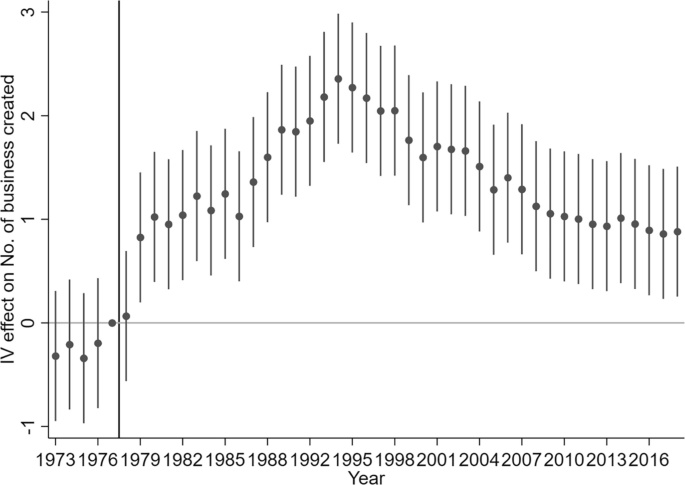
Dynamic effect of the historical chamber system on firm creations: IV estimates using distance to telegraph lines
We further address the possibility of unobservable economic endogeneity using a set of falsification-style comparisons and robustness exercises reported in the Appendix. The central intuition is simple: if telegraph placement primarily reflected unobserved commercial strength, the IV effects should be strongest in the most economically central telegraph-connected prefectures. We compare estimates between telegraph terminal and non-terminal prefectures (Figure A13), and then between telegraph node and non-node prefectures (Figure A14). Contrary to the commercial selection interpretation, the estimates are not larger in terminal or node prefectures. Instead, the positive effects are stronger in non-terminal and non-node prefectures.
We also conduct robustness and heterogeneity checks designed to isolate channels through which telegraph proximity could proxy for commercial development. Excluding treaty-port prefectures yields similar estimates (Figure A12). Splitting the sample by pre-reform population (Figure A15) and by historical guild presence (Figure A16) shows that the effects are not concentrated in initially larger or more commercially organised prefectures. Splitting by political importance (Figure A17) indicates that the estimates are not driven by administratively central prefectures. Finally, to address the related concern that the instrument may proxy for transport-infrastructure path dependence—early telegraph corridors having later evolved into rail, road, and air networks—we also split the sample by whether the prefecture was already traversed by an operational railway line by the end of 1911 (Figure A18); the chamber effect’s long-run persistence is concentrated in prefectures without 1911 railway access, the opposite of what transport path dependence would predict. Taken together, these patterns suggest that, although the late Qing telegraph system reflected a mix of state and commercial forces at the macro level, our distance-based instrument is unlikely to operate primarily through unobserved local commercial potential that would violate the exclusion restriction.
We also address the possibility that chamber density reflects endogenous formation in already more economically vibrant prefectures by exploiting the information on chamber establishment timing. The chamber records report establishment dates alongside membership and financial accounts, which enables us to test whether earlier chamber founding is systematically associated with baseline local conditions. Table A7 regresses establishment timing on our observed geographic and socio-economic characteristics and finds little systematic correlation with proxies for local commercial strength. Building on this evidence, we use establishment timing as an alternative instrument for chamber density, earlier founding mechanically implies greater accumulated density by 1915, and the first stage is strong (Table A8, Panel B). The corresponding IV estimates and IV event-study closely track the baseline instrumented results (Table A8, Panel A; Figure A19).
5.4 Long term impact of business network
One limitation of panel analysis is that firm creation data cannot provide information on overall regional development levels. To understand its long-term economic impact, we therefore use cross-sectional information on GDP per capita in 2018 as an outcome variable. GDP statistics are aggregated based on the boundaries of modern prefectures in 2018. However, geographic divisions of prefectures have undergone changes from the 1910s to the 2010s. To resolve this issue, we first estimate the GDP per capita through modern prefecture boundaries and then divide it using historical boundaries. Assuming they are evenly distributed, we derive GDP per capita for each segment and aggregate to the historical prefectural level. We acknowledge that this even-distribution assumption is a simplification: economic activity within a prefecture is typically concentrated in urban cores and along transport corridors rather than spread uniformly across the territory, and an area-proportional allocation can therefore misallocate output across historical boundary segments. To address this concern directly, in columns (3)–(4) of Table 4 we report nighttime luminosity per capita as an alternative outcome variable; because VIIRS data are observed at high pixel-level spatial resolution, the luminosity-based outcome can be aggregated to historical prefecture boundaries without requiring any within-prefecture distribution assumption, and therefore provides a spatial-robustness check on the GDP-based estimates. Specifically, for prefecture i in the province p, we run the following regression:
where \({{\varvec{Y}}}_{{\varvec{i}}{\varvec{p}}}\) is the GDP per capita or luminosity per capita in 2018. \({{\varvec{X}}}_{{\varvec{i}}{\varvec{p}}}\) is the same as in the DID specification. We also include province fixed effects, \({{\varvec{\gamma}}}_{{\varvec{p}}}\), to capture unobservable province-level characteristics. Columns (1) and (2) of Table 4, with all the control variables, report the results with GDP per capita as the outcome variable. Our OLS results suggest that a 1% increase in chamber density historically is associated with a 0.184% increase in the average economic output per person in 2018. Our estimated coefficient of the 2SLS results in column (2) remains positive and statistically significant. More importantly, this IV estimation indicates that our previous result in column (1) may have underestimated the actual coefficient, which is three times larger than the OLS estimate, although this interpretation depends on assumptions of the validity of the exclusion restriction. Columns (3) and (4) have replaced our outcome variable with the nighttime data to further validate our findings. The results obtained from both OLS and IV estimation methods are consistent with previous findings both in terms of statistical and economic significance when GDP is considered as the dependent variable.
6 Mechanisms
Thus far, we have shown that areas with higher historic chamber density saw greater entrepreneurial activity and regional development after the return of the market economy. In this section, we evaluate two potential mechanisms for this. First, we consider social capital on the basis that chambers may have facilitated norms of associational activity which persisted beyond the networks. Second, we consider institutional continuity: the channels through which business networks were preserved within state-corporatist organisations under Mao and reactivated after the 1978 reforms. These are not mutually exclusive but may work in parallel and even reinforce each other.
6.1 Social capital
One potential mechanism is that chambers fostered norms and associational practices that persisted over time and are associated with higher entrepreneurship today. We consider two types of social capital: bonding and bridging (Putnam, 2000). Bridging social capital connects different groups and promotes openness, while bonding social capital strengthens within-group connections, promoting solidarity and support. Both contribute to the overall functioning and well-being of society. Putnam (2000) shows that social networks and the trust inherent in them are the dominant source of community social capital that facilitate access to resources for entrepreneurs.
Bonding and bridging social capital are not mutually exclusive: the same institutional environment can simultaneously sustain dense within-group ties and broader cross-group norms (Putnam, 2000). While early twentieth-century chambers were elite-led organisations, the formal norms they institutionalised—including written statutes, routinised procedures, cross-sector reputation, and codified arbitration of commercial disputes—may have become part of local commercial culture and were gradually learned by employees, suppliers, and customers who transacted with chamber-affiliated firms, diffusing beyond the chambers themselves. This diffusion was reinforced by institutional continuity: although chambers were formally dissolved during the Maoist period, the chamber-based business class was partially absorbed into successor state-corporatist organisations and the chamber system was reactivated as market reforms resumed, providing a vehicle through which the original norms could carry forward into wider local commercial life. Comparable long-run cultural-transmission patterns are documented in the literature on European institutional persistence, where medieval city-states and communes, themselves elite-led, shaped generalised trust and civic engagement centuries later (Guiso et al., 2016; Tabellini, 2010), and where modern measures of bridging social capital remain among the strongest predictors of broad economic outcomes such as upward mobility (Chetty et al., 2022). Consistent with this view, our empirical design measures both forms of social capital: Table 5 reports CHFS- and CGSS-based trust toward strangers (a bridging measure) alongside trust toward fellow townsmen (a bonding measure), and Tables A9 and A10 use prefecture-level social organisations and genealogies as historical bridging and bonding proxies respectively. The historical chamber system contributes one such pathway, alongside many other determinants of modern social capital; we view our estimates as identifying a contributory channel rather than a deterministic chain from elite coordination a century ago to present-day generalised trust.
To examine bridging social capital, we use the China Household Finance Survey (CHFS) question: “How much do you trust strangers in society?” The responses on a 1 to 5 scale reflect households’ general trust, ranging from ‘not at all’ to ‘strongly’ trusting. To avoid individual characteristics affecting our estimations, the aforementioned controls are supplemented with demographic controls including age, gender, education, marital status, health condition, and residential area. Columns (1) and (2) of Table 5 show OLS and IV results. Both estimations show that historical chamber density is associated with higher social trust among unfamiliar individuals. Our IV result shows that a 1% improvement in historical chamber density is associated with higher trust among people from different backgrounds by 0.064%. The Chinese General Social Survey (CGSS) survey asks the exact same question. To check our results, we use this in columns (3) and (4). Our results support this positive and significant finding with a larger coefficient, likely due to sampling differences.
Is chamber density associated with increasing bridging capital but reducing bonding capital? To answer this question, we further draw on the question from the CGSS: “How much do you trust people from the same hometown?” The fellow townsmen constitute a significant social group in Chinese society, united by a shared background. Columns (5) and (6) show that the development of chamber density is not associated with lower bonding social capital; if anything, the association is also positive.
While the CHFS and CGSS provide direct individual-level measures of trust, they are only available in the 2000 s and have a long gap from the early twentieth-century chamber institutions. As a result, these variables might not fully distinguish long-run persistence from social and institutional changes that occurred after 1978. To strengthen the temporal link, we complement the survey evidence with historical proxies for social capital that can be traced both before and after the reform. Following Putnam (2000), we proxy bridging social capital using the prefecture-level number of registered social organisations, capturing formal associational activity and cross-group interaction. Because social organisations in China must register as legal entities, these data can be compiled from administrative registry records over a long horizon. We proxy bonding social capital using the number of genealogies compiled at the prefecture level, drawn from Comprehensive Catalogue of Chinese Genealogies, which reflects dense within-group ties and lineage-based networks.
A key advantage of these measures is their temporal continuity: they span the Maoist period (1950–1977) as well as the post-reform era, allowing us to assess whether the association between chamber density and social capital changes smoothly rather than exhibiting a discrete break around 1978. Tables A9 and A10 show that historical chamber density is positively and significantly associated with both bridging and bonding proxies in both periods, with no evidence of a sharp discontinuity at the reform boundary. These administrative patterns are consistent with, and lend additional support to, the survey-based results reported in Table 5. Overall and with caveats, our observation confirms that chambers of commerce seem to impact trust both between and within different groups in society. One interpretation is that this happened because chambers spread formal norms of behaviour.
6.2 Institutional continuity
The second potential mechanism is institutional continuity across the Maoist break, rather than cultural transmission. As discussed above, the CCP pursued a strategy of incorporating and managing parts of the former business class through state capitalism and united-front style organisations during the transition to socialism (Meisner, 1999; Riskin, 1987). Former business leaders were incorporated into the new socialist governance structure through the All-China Federation of Industry and Commerce (ACFIC), established in 1953, which functioned as a CCP-led mass organisation within the united front for engaging and supervising the former business class. While ACFIC was embedded in a state-corporatist architecture of political incorporation and representation, it also provided a formal organisational vessel through which pre-1949 commercial networks and leadership repertoires could be selectively preserved, repurposed, and sustained under socialist rule (Groot, 2004; Pearson, 1997).
To empirically assess this, we manually collected prefecture-level evidence from local gazetteers on the number of entrepreneurs incorporated into ACFIC in the early 1950s. Table 6, Columns (1)–(2), relate pre-1949 chamber density to this ACFIC-based measure of institutional continuity. Column (1) presents OLS estimates and shows a strong positive association: prefectures with higher historical chamber density exhibit significantly larger ACFIC incorporation. Column (2) instruments chamber density using our baseline IV strategy and yields an even larger estimate. Together, these results provide direct evidence that the Republican-era chamber system was not entirely severed after 1949. Instead, it was partially carried forward through a state-recognised organisational channel that preserved elite ties and routines of coordination under a new political guise.
We then examine whether this institutional legacy also facilitated the reactivation of business organisation once market reforms resumed. Table 6, Columns (3)–(4), use the number of newly established chambers during the early reform period (1978–1990) as the outcome. We again find a positive and statistically significant relationship between historical chamber density and the speed of re-establishment. In Column (3), the OLS coefficient is 0.14 and in Column (4) the IV estimate is 0.442. This pattern suggests that places with denser pre-1949 chamber infrastructure not only maintained more extensive organisational carryover within the socialist system, but also reconstituted chambers more rapidly when policy space for organised business reopened. Put differently, institutional remnants appear to have lowered the fixed costs of organisational revival by providing reputational anchors, leadership pools, and relational linkages that could be re-mobilised early in the reform era.
Overall, the evidence in Table 6 supports an interpretation in which chamber influence persisted through a formal channel. While social capital remains a plausible mechanism, the institutional continuity results highlight a simultaneous pathway: networks were preserved and managed within a state corporatist framework under Mao and then reactivated after 1978.
7 Conclusion
This paper considers the long-term relationship between business organisations and entrepreneurship, using China’s historical chamber system as an example. This is a particularly interesting case, as private enterprise was effectively banned for a period until 1978. Yet, despite this break we find that prefectures with historically high chamber density saw higher business creation. Meanwhile, the increase in the number of new firms in these areas did not come at the expense of firm quality. In fact, we observe that these newly established firms also generated more employment and attracted more capital investment in their regions. Our long-term economic analysis further supports our findings, showing that regions with historically high chamber density have higher modern per capita GDP and greater nighttime luminosity.
To shed light on why these associations persist, we provide evidence on two mechanisms. First, historical chambers are associated with higher social capital after the return of the market economy. Survey evidence indicates higher generalised trust in high-chamber prefectures, and this pattern is corroborated by historical proxies that can be traced across periods: more registered social organisations (bridging ties) and more genealogies (bonding ties). Together, these patterns are consistent with network persistence in areas with higher historical chamber density.
Second, we document an institutional continuity channel across the Maoist break. Prefectures with higher historical chamber density show greater incorporation into this organisational channel and a faster re-establishment of chambers in the early reform period, consistent with the idea that institutional remnants reduced the fixed costs of organisational revival when policy space reopened.
These findings suggest that, alongside formal pro-market reforms, policies that foster broad-based business networks and associational capacity may help strengthen the social and organisational foundations of entrepreneurship. Lowering barriers to participation and supporting intermediary organisations may therefore help promote economic dynamism.
Data availability
The datasets generated during and/or analysed during the current study are available from the corresponding author on reasonable request.
Notes
Figure A1 shows that chamber membership is also stable at the provincial level between 1912 and 1920.
Prefectures refer to cities in China’s context. It is the second hierarchy of regional government. Our population data shows that the average prefecture population was 1.57 million in 1910.
References
Allen, T., & Donaldson, D. (2022). Persistence and path dependence: A primer. Regional Science and Urban Economics, 94, Article 103724.
Amin, A., & Thrift, N. (1995). Globalization, institutions, and regional development in Europe. Oxford university press.
Andrews, M. J. (2023). Bar talk: Informal social networks, alcohol prohibition, and invention. SSRN Working Paper No.3489466 (version of 25 June 2023). https://doi.org/10.2139/ssrn.3489466
Baark, E. (1997). Lightning wires: The telegraph and China's technological modernisation, 1860-1890. Greenwood Press.
Bai, C.-E., Hsieh, C.-T., Song, Z. M., & Wang, X. (2020). Special deals from special investors: The rise of state-connected private owners in China. NBER Working Paper No. 28170. National Bureau of Economic Research.
Bairoch, P. (1988). Cities and economic development: From the dawn of history to the present. University of Chicago Press.
Bathelt, H., Malmberg, A., & Maskell, P. (2004). Clusters and knowledge: Local buzz, global pipelines and the process of knowledge creation. Progress in Human Geography, 28(1), 31–56.
Belitski, M., Tsareva, Y., & Zemtsov, S. (2024). Geography and persistence of entrepreneurship in Russia. Regional Studies, 58(5), 1076–1095.
Bennett, R. J. (1996). Can transaction cost economics explain voluntary chambers of commerce? Journal of Institutional and Theoretical Economics, 152(4), 654–680.
Bergère, M.-C. (1989). The golden age of the Chinese bourgeoisie, 1911-1937 (J. Lloyd, Trans.). Cambridge University Press.
Bernard, A. B., Moxnes, A., & Saito, Y. U. (2019). Production networks, geography, and firm performance. Journal of Political Economy, 127(2), 639–688.
Bian, M. L. (2005). The making of the state enterprise system in modern China: The dynamics of institutional change. Harvard University Press.
Burt, R. S. (1992). Structural holes: The social structure of competition. Harvard University Press.
Cai, J., & Szeidl, A. (2018). Interfirm relationships and business performance. Quarterly Journal of Economics, 133(3), 1229–1282.
Cao, S. (2000). Zhongguo Renkou Shi, Diwu Juan (History of Population in China, Volume 5). Fudan University Press.
Chen, Y., Wang, H., & Yang, D. Y. (2016). Salience of history and the preference for redistribution. SSRN Working Paper No. 2717651. https://doi.org/10.2139/ssrn.2717651
Chen, Z. (2001). The origins of Chinese chambers of commerce in the lower Yangzi region. Modern China, 27(2), 155–201.
Chetty, R., Jackson, M. O., Kuchler, T., Stroebel, J., et al. (2022). Social capital II: Determinants of economic connectedness. Nature, 608(7921), 122–134.
Coates, D., & Heckelman, J. C. (2003). Interest groups and investment: A further test of the Olson hypothesis. Public Choice, 117, 333–340.
Coleman, J. S. (1988). Social capital in the creation of human capital. American Journal of Sociology, 94(Supplement), S95–S120.
Del Monte, A., & Pennacchio, L. (2020). Historical roots of regional entrepreneurship: The role of knowledge and creativity. Small Business Economics, 55(1), 1–22.
Fafchamps, M., & Quinn, S. (2018). Networks and manufacturing firms in Africa: Results from a randomized field experiment. World Bank Economic Review, 32(3), 656–675.
Frazier, M. W. (2002). The making of the Chinese industrial workplace: State, revolution, and labor management. Cambridge University Press.
Fritsch, M., Pylak, K., & Wyrwich, M. (2022). Historical roots of entrepreneurship in different regional contexts—The case of Poland. Small Business Economics, 59(1), 397–412.
Fritsch, M., & Wyrwich, M. (2017). The effect of entrepreneurship on economic development—An empirical analysis using regional entrepreneurship culture. Journal of Economic Geography, 17(1), 157–189.
Fritsch, M., & Wyrwich, M. (2018). Regional knowledge, entrepreneurial culture, and innovative start-ups over time and space—An empirical investigation. Small Business Economics, 51(2), 337–353.
Gao, P., & Lei, Y. H. (2021). Communication infrastructure and stabilising food prices: Evidence from the telegraph network in China. American Economic Journal: Applied Economics, 13(3), 65–101.
Giuliani, E. (2007). The selective nature of knowledge networks in clusters: Evidence from the wine industry. Journal of Economic Geography, 7(2), 139–168.
Giuliani, E. (2010). Clusters, networks and economic development: An evolutionary economics perspective. In R. Boschma & R. Martin (Eds.), The handbook of evolutionary economic geography (pp. 261–279). Edward Elgar.
Giuliani, E., Balland, P. A., & Matta, A. (2019). Straining but not thriving: Understanding network dynamics in underperforming industrial clusters. Journal of Economic Geography, 19(1), 147–172.
Granovetter, M. (1985). Economic action and social structure: The problem of embeddedness. American Journal of Sociology, 91(3), 481–510.
Granovetter, M. (2005). The impact of social structure on economic outcomes. Journal of Economic Perspectives, 19(1), 33–50.
Greif, A. (1993). Contract enforceability and economic institutions in early trade: The Maghribi traders' coalition. American Economic Review, 83(3), 525–548.
Groot, G. (2004). Managing transitions: The Chinese Communist Party, united front work, corporatism and hegemony. Routledge.
Guiso, L., Sapienza, P., & Zingales, L. (2016). Long-term persistence. Journal of the European Economic Association, 14(6), 1401–1436.
Haselmann, R., Schoenherr, D., & Vig, V. (2018). Rent seeking in elite networks. Journal of Political Economy, 126(4), 1638–1690.
Hochberg, Y. V., Ljungqvist, A., & Lu, Y. (2007). Whom you know matters: Venture capital networks and investment performance. Journal of Finance, 62(1), 251–301.
Jia, R. (2014). The legacies of forced freedom: China’s treaty ports. Review of Economics and Statistics, 96(4), 596–608.
Jing, S. (2007). Listen to Mr. Jing tell the story of the Federation of Industry and Commerce. Available at: http://www.tongxin.org/llyj/tzll/content/post_134208.html. Accessed 5 Jul 2024
Kemeny, T., Feldman, M., Ethridge, F., & Zoller, T. (2016). The economic value of local social networks. Journal of Economic Geography, 16(5), 1101–1122.
Kirby, W. C. (1995). China unincorporated: Company law and business enterprise in twentieth-century China. Journal of Asian Studies, 54(1), 43–63.
Köll, E. (2003). From cotton mill to business empire: The emergence of regional enterprises in modern China. Harvard University Asia Center.
MacFarquhar, R., & Fairbank, J. K. (Eds.). (1991). The Cambridge history of China, Vol. 15: The People's Republic, Part2: Revolutions within the Chinese Revolution, 1966-1982. Cambridge University Press.
Malmberg, A. (2003). Beyond the cluster: Local milieus and global connections. In J. Peck & H. W.-C. Yeung (Eds.),Remaking the global economy: Economic-geographical perspectives (pp. 145–159). Sage.
Marquis, C., & Tilcsik, A. (2013). Imprinting: Toward a multilevel theory. Academy of Management Annals, 7(1), 195–245.
Martin, R., & Sunley, P. (2022). Making history matter more in evolutionary economic geography. ZFW–Advances in Economic Geography, 66(2), 65–80.
McMillan, J., & Woodruff, C. (1999). Interfirm relationships and informal credit in Vietnam. Quarterly Journal of Economics, 114(4), 1285–1320.
Meisner, M. (1999). Mao’s China and after: A history of the People’s Republic. Simon and Schuster.
Miao, C., Gast, J., Laouiti, R., & Nakara, W. (2022). Institutional factors, religiosity, and entrepreneurial activity: A quantitative examination across 85 countries. World Development, 149, Article 105695.
North, D. C. (1990). Institutions, institutional change and economic performance. Cambridge university press.
Ogilvie, S., & Carus, A. W. (2014). Institutions and economic growth in historical perspective. Handbook of Economic Growth, 2, 403–513.
Olson, M. (1982). The rise and decline of nations: Economic growth, stagflation, and social rigidities. Yale University Press.
Ostrom, E. (1990). Governing the commons: The evolution of institutions for collective action. Cambridge University Press.
Padgett, J. F., & McLean, P. D. (2006). Organizational invention and elite transformation: The birth of partnership systems in Renaissance Florence. American Journal of Sociology, 111(5), 1463–1568.
Pearson, M. M. (1997). China’s new business elite: The political consequences of economic reform. Univ of California Press.
Pierson, P. (2004). Politics in time: History, institutions, and social analysis. Princeton University Press.
Powell, W. W., White, D. R., Koput, K. W., & Owen-Smith, J. (2005). Network dynamics and field evolution: The growth of interorganizational collaboration in the life sciences. American Journal of Sociology, 110(4), 1132–1205.
Putnam, R. D. (2000). Bowling alone: The collapse and revival of American community. Simon and schuster.
Rambachan, A., & Roth, J. (2023). A more credible approach to parallel trends. Review of Economic Studies, 90(5), 2555–2591.
Riskin, C. (1987). China’s political economy: The quest for development since 1949. Oxford University Press.
Roth, J. (2022). Pretest with caution: Event-study estimates after testing for parallel trends. American Economic Review: Insights, 4(3), 305–322.
Rowe, W. T. (1984). Hankow: Commerce and society in a Chinese city, 1796-1889. Stanford University Press.
Saxenian, A. (1994). Regional advantage: Culture and competition in Silicon Valley and Route 128. Harvard University Press.
Saxenian, A. (2006). The new argonauts: Regional advantage in a global economy. Harvard University Press.
Smith-Doerr, L., & Powell, W. W. (2005). Networks and economic life. In N. J. Smelser & R. Swedberg (Eds.), The handbook of economic sociology (2nd ed., pp. 379–402). Princeton University Press.
Solinger, D. J. (1984). Chinese business under socialism: The politics of domestic commerce, 1949-1980. University of California Press.
Sorenson, O. (2018). Social networks and the geography of entrepreneurship. Small Business Economics, 51(3), 527–537.
Stenholm, P., Acs, Z. J., & Wuebker, R. (2013). Exploring country-level institutional arrangements on the rate and type of entrepreneurial activity. Journal of Business Venturing, 28(1), 176–193.
Storper, M. (1997). The regional world: Territorial development in a global economy. Guilford press.
Storper, M. (2013). Keys to the city: How economics, institutions, social interaction, and politics shape development. Princeton University Press.
Storper, M., & Venables, A. J. (2004). Buzz: Face-to-face contact and the urban economy. Journal of Economic Geography, 4(4), 351–370.
Storper, M., Kemeny, T., Makarem, N., & Osman, T. (2015). The rise and fall of urban economies: Lessons from San Francisco and Los Angeles. Stanford University Press.
Streeck, W., & Thelen, K. (2005). Beyond continuity: Institutional change in advanced political economies. Oxford University Press.
Tabellini, G. (2010). Culture and institutions: Economic development in the regions of Europe. Journal of the European Economic Association, 8(4), 677–716.
Teiwes, F. C. (1987). Establishment and consolidation of the new regime. In R. MacFarquhar & J. K. Fairbank (Eds.),The Cambridge history of China, Vol. 14: The People's Republic, Part 1: The emergence of revolutionary China, 1949-1965 (pp. 51–143). Cambridge University Press.
Uzzi, B. (1997). Social structure and competition in interfi rm networks: The paradox of embeddedness. Administrative Science Quarterly, 42(1), 35–67.
Wang, H., Rodríguez-Pose, A., & Lee, N. (2021). The long shadow of history in China: Regional governance reform and Chinese territorial inequality. Applied Geography, 134, Article 102525.
Yan, Z. (2012). Zhongguo Jindai Jingjishi Ziliao Xuanji (Selected Statistics of the Early Modern China). China Social Sciences Press.
Author information
Authors and Affiliations
Contributions
All authors contributed to the study conception and design. Han Wang contributed 75%, including data analysis and ideation; Neil Lee contributed 25%, focusing on framing, results.
Corresponding author
Ethics declarations
Ethical standards
The paper accords with the research ethics policy of the London School of Economics and Political Science.
Conflict of interest
The authors declare no competing interests.
Additional information
Publisher's Note
Springer Nature remains neutral with regard to jurisdictional claims in published maps and institutional affiliations.
Supplementary Information
Below is the link to the electronic supplementary material.
ESM 1 (download DOCX )
Supplementary Material 1 (DOCX 2.05 MB)
Rights and permissions
Open Access This article is licensed under a Creative Commons Attribution 4.0 International License, which permits use, sharing, adaptation, distribution and reproduction in any medium or format, as long as you give appropriate credit to the original author(s) and the source, provide a link to the Creative Commons licence, and indicate if changes were made. The images or other third party material in this article are included in the article's Creative Commons licence, unless indicated otherwise in a credit line to the material. If material is not included in the article's Creative Commons licence and your intended use is not permitted by statutory regulation or exceeds the permitted use, you will need to obtain permission directly from the copyright holder. To view a copy of this licence, visit http://creativecommons.org/licenses/by/4.0/.
About this article

Cite this article
Wang, H., Lee, N. Business networks and the persistence of entrepreneurship: evidence from China. Small Bus Econ (2026). https://doi.org/10.1007/s11187-026-01292-7
Received:
Accepted:
Published:
Version of record:
DOI: https://doi.org/10.1007/s11187-026-01292-7