


Abstract
Sports and physical activities are common behind bars and may be linked to health benefits and positive behavioral changes. As many people with criminal records carry on their training after release and start sport-related small businesses, it is important to examine what may influence potential consumers’ choices. Drawing on existing research on prison sport and recent interest in entrepreneurship among people with criminal records, we administered a novel survey with an embedded conjoint experiment to a national sample of 1,100 U.S. adults in 2025 to determine what factors shape choices for personal trainers and whether factors driving overall preferences—such as trainer credentials and references, mode of instruction (in-person vs. online), session price, and trainer race—operate differently when the trainer is presented as having a prison record. Consistent with prior research on reentry, employment, and prison stigma, respondents preferred trainers with other workout backgrounds (as an after-work gym member, former college athlete, or member of the military) over those who began their training in prison. Respondents also generally preferred Black trainers and training sessions that were less expensive, in-person, and from qualified trainers. However, when assessing trainers with criminal records, the positive effects of in-person classes and cheaper instruction were attenuated. Our results suggest that barriers still remain for formerly incarcerated individuals who would like to work as personal trainers. Prison educational and vocational training should include courses on sports and fitness as well as developing, marketing, and managing small businesses.
Introduction: Prison, Physical Training, and Potential Business Opportunities
For individuals who are detained behind bars and deprived of liberty, sports and physical activitiesFootnote 1 become one of the few choices that they can actively engage in during incarceration (Baldonado et al., 2022). Individuals may choose to exercise to adjust to prison life (Norman, 2017) or signal power and toughness through strength training (Müller & Mutz, 2022). Many people are also highly motivated to participate in the sports programs offered by the correctional institutions (Wicker et al., 2023), to develop structured daily routines, shift attention away from delinquent habits, and find alternative means to achieve excitement, as well as boost confidence and self-esteem (Parker et al., 2014). Sports and physical activities behind bars have become a popular choice for detainees as well as an effective management tool for correctional officers (Gallant et al., 2015).
Engagement in physical activities is related to improved mental and physical health conditions and quality of life among individuals behind bars (Mannocci et al., 2018). In 1982, the American Medical Association issued a Manual on Exercising for the Incarcerated to provide practical training advice for inmates who have limited space and equipment.Footnote 2 Correctional institutions around the world have experimented with a variety of physical activities, along with nutrition, education, and substance abuse interventions, to explore effective ways to improve physical health outcomes among inmates (Mohan et al., 2018), reduce their use of substances (Wimberly et al., 2018), alleviate mental illness symptoms, support cognitive functions (Maity et al., 2025), and boost psychological wellbeing (Moscoso-Sánche et al., 2017). These health benefits are important to many individuals who have had health issues and lived unhealthy lifestyles prior to incarceration (Cashin et al., 2008).
Beyond health benefits, sports and physical activities also contribute to more positive behaviors during incarceration (Newson et al., 2024) and less offending after release (Kovalsky et al., 2021). Participation in prison sports may facilitate social interactions and improve social relationships, making individuals more supportive of each other (Meek & Lewis, 2014). Through training, participants may build a pro-social relationship with the coaches, who may help them grow confidence and develop a positive sense of self (Harrison et al., 2025). Participants can also learn new sports and communications skills (Gallant et al., 2015) and emotional regulation skills (Middleton et al., 2019). Physical training further helps people reduce impulsivity and aggression, which are key criminological factors predicting future offending (Muirhead & Fortune, 2016). Overall, sports programs protect incarcerated individuals from future criminality and crime-related attitudes (Jugl et al., 2023). The consistent research findings rebut common misbeliefs that competitive sports lead to more aggression (Moscoso-Sánche et al., 2017) and physical activities are disruptive to prison management (Norman, 2017). While the individual benefits of physical activity during incarceration are well-documented, it is less clear how well these activities may translate to post-release careers.
As they reenter society, people with criminal records may carry over their physical training routines started behind bars as they see sports engagement as an effective way to challenge criminal record stigma and reconnect with the community (Newson et al., 2024). Individuals who have participated in prison sports activities may find employment opportunities such as coaches in sports clubs after release or convince employers in other areas that they could be committed and prosocial by demonstrating their involvement in sports during incarceration (Meek & Lewis, 2014). Some of them may even take advantage of their prison training routine and start coaching businesses based on physical training. For example, CONBODY provides interested customers with private physical training sessions as well as fitness products. On their website, they brand themselves as “founded by an inmate, managed and run by former inmates” and promote their robust fitness model as “prison-style.”Footnote 3 These entrepreneurship opportunities align with the interest of many inmates who would like to start their own businesses after release (Hwang & Phillips, 2024), with entrepreneurship courses among the most popular offerings on tablet-based educational platforms available to incarcerated learners (Edovo, n.d.).
While CONBODY may have provided new business ideas for people with criminal records, the public and potential customers may or may not be supportive of hiring trainers with criminal records. That is, “the mark of a criminal record” may extend from hiring managers (Pager, 2003) to consumer preferences—yet the personal training context is a unique space for several reasons. Popular media presentations often portray individuals behind bars, especially Black and Hispanic men, as physically fit and masculine but dangerous (O’Sullivan, 2001). A typical incarcerated individual in popular culture may look like “bare-chested, with bulging muscles and gleaming tattoos” (Novek, 2009: 380). Although such media representation may have promoted and normalized the idea that physical training, such as weightlifting, is common among inmates (Tepperman, 2014), it may also mean that the public views and links leisure activities among people with criminal records to violence, brutality, and dangerousness (Milićević & Drndarević, 2023). Therefore, it is important to understand how and under what conditions the public is willing to hire the services of entrepreneurs with prison records. If only a niche customer base is willing to work with individuals with prison records as personal trainers, the acknowledged benefits of physical exercise during incarceration may not extend to career opportunities. However, if the public is willing to accept individuals with prison records in the fast-growing fitness industry, prisons could provide opportunities to earn fitness certifications and programming to help with running a small business to help support a path to self-sufficiency post-release.
In the current study, we use a conjoint experiment embedded in a national YouGov survey of a sample of American adults and an open-ended question to explore the public’s attitudes toward fitness businesses offered by people with criminal records. Findings suggest that while trainers who disclose a past prison sentence still face stigma when attempting to secure a clientele for their business, there are circumstances under which they can increase their likelihood of being selected by customers. Respondents’ selections suggest that prisons should implement programming so individuals can earn recognized certifications and credentials and gain the skills to manage and deliver their services in the digital space, as well as market the uniqueness of their services to increase their likelihood of success. As detailed further below, several factors may be relevant in this entrepreneurship space.
Factors Influencing Customers’ Decisions
Prior research examining hiring decision-makers’ and potential customers’ choices shows that people are less willing to hire applicants with criminal records (Holzer et al., 2003). Many employers have legal barriers that restrict job applicants from formerly incarcerated individuals (Harris & Keller, 2005). Concerns over people with criminal records in the labor market relate to perceived risk of recidivism but are also driven by aversion to formal contact with the crime control system (Sugie et al., 2020). People with criminal records are often stereotyped as workers with low productivity and reliability (Hunt et al., 2018). Nonetheless, researchers have identified a few factors that may signal desistance and job qualifications and improve the prospect of employment opportunities for people with criminal records (Santos et al., 2023).
Vocational Training Credentials
Employment and vocational training provides individuals with job skills needed in the labor market; this is particularly important considering many people with criminal records often come from low-education background (Duwe & Henry-Nickie, 2021). Employers who accept employees with criminal records often prefer those who are more likely to signal desistance from future offending (Bushway & Apel, 2012). Vocational training certificates held by people with criminal records may imply licensing decision-makers’ trustworthiness toward them and belief that they will not reoffend (Denver & Ewald, 2018). Employers also value the soft and hard work skills, such as motivation and technical work competence, conveyed through complete vocational training and credentials (Reich, 2017).
Research shows that vocational training credentials improved potential employers’ callback rates among people with prison records (DeWitt & Denver, 2020; Leasure & Andersen, 2016; Lindsay, 2025) and lowered their recidivism rates (Hill et al., 2017). The investment in vocational training is likely to lead to a return of reduced reoffending risks as well as future employment opportunities (Stickle & Sprick Schuster, 2023). However, some studies also found that formerly incarcerated individuals did not receive more callbacks from employers compared to those who did not have training credentials (Leasure & Kaminski, 2021). The null effect of vocational training might be explained by selection bias into the programs, especially when the training happens during incarceration (McNeeley, 2023). Together, existing evidence suggests that training credentials should be beneficial for people leaving prison to find work, but perhaps not universally.
References
Similar to vocational training credentials, references provide positive signals of desistance by showing trustworthiness (DeWitt & Denver, 2020). References can also serve as proof of ties to a prosocial network (Santos et al., 2023). Organizations that help job seekers with criminal records recommend that they include a reference letter in job applications, preferably from a previous employer, or at least a personal reference to prove their talent and skills.Footnote 4 This recommendation is believed in practice as an effective way to honestly communicate past criminal histories to future employers, as others could attest to the job applicant’s character.Footnote 5
Recent results from experimental studies show that survey respondents are more likely to call back applicants with criminal records when they have references from previous employers (DeWitt & Denver, 2020). And hiring professionals prefer job applicants who have references, especially when the references speak to the applicant’s previous work or education experiences (Santos et al., 2023). However, audit studies found that although many employers require reference letters, they rarely pay attention to and verify the references submitted by job applicants with criminal records (Pager, 2003). The value of a reference letter for people with criminal records remains unclear.
(Close) Contact with Customers
Because a criminal record is often stigmatized with negative qualities such as danger, violence, and dishonesty (Shi et al., 2022), the type of work position that job applicants with criminal records seek also matters to the potential customers and employers—as close contact may be particularly concerning for personal and public safety. Shi and Denver (2025: 16) asked respondents to choose between restaurants that hire or not hire employees with criminal records, and one of their respondents remarked that “I don’t like to be stabbed by a utensil.” Furthermore, many people with criminal records lack social skills (Hagan, 1993), which may further limit their ability to obtain employment that involves close communication with others.
In a nationwide survey experiment, Denver and coauthors (2017) found that respondents were more supportive of employers denying job applicants on the basis of a previous criminal record if the target job involves health care (as compared to construction) and close contact with patients. More broadly, stigma toward the formerly incarcerated often entails that people prefer to keep some social distance from them, including reluctance to have them as coworkers (Reysen, 2005), neighbors, and family relationships (Melvin et al., 1985). Many second-chance employers are in industries (e.g., manufacturing, warehouse, and distribution) that do not require close contact with customers (Bumiller, 2015). And many employers had no social contact with the workers with criminal records themselves (Giguere & Dundes, 2002). In sum, people with prison records may be preferred if they provide services in a way that allows for more social distance from the public.
Price/Wage
Compared to the factors reviewed previously, the wage that job applicants with criminal records ask for has been less studied, possibly because most of the reentry and employment research has focused on entry-level jobs (Lindsay, 2025). For people with criminal records, what they charge can be a strategic choice: choosing low-paid jobs may be seen as a way to climb up in the labor market and pay rank one step at a time (Santos et al., 2023). Employers may only consider offering the “crappiest” jobs at the bottom to job applicants with criminal records, even if the applicants are considered good workers (Bumiller, 2015). Earnings of workers with criminal records are lower on average compared to those without (Holzer et al., 2003).
The only experimental study to our knowledge that directly assessed the impact of wage on hiring probability by Santos and coauthors (2023) showed that the impact of increases in wage charged for an entry-level job (from $0 to $15 per hour) on the odds of being hired seemed nonlinear and inconsistent. Shi and Denver (2025) found that when choosing between restaurants that hire people with criminal records, survey respondents preferred low-cost places. Hickert and coauthors (2025) compared if the public would prefer low-cost versus high-cost products sold by small business owners with criminal records and found the price of the product did not consistently influence the potential customers’ choices. While the evidence is equivocal, most research suggests that people with prison records are likely to work in low-wage positions.
Race & Ethnicity
Black people with criminal records are often subject to “compounded discrimination” in the labor market due to stigma toward incarceration and racial discrimination (Lindsay, 2025: 428). Whether they reveal their criminal records or not, African American men are discriminated against due to widespread racial typification of criminality (Denver & Pickett, 2022). For example, employers may view Black men without criminal records and White men with criminal records similarly in the labor market (Pager, 2003). Racial resentment may predict the public’s support for using criminal record information in making hiring decisions (Lehman et al., 2020). The positive effect of qualifications for employment on hiring outcomes seems more pronounced for White job applicants with criminal records than their Black counterparts (Leasure & Andersen, 2016).
However, some recent experimental studies show that the race effect in hiring consideration for people with criminal records is nonsignificant (Sugie et al., 2020). The effect of positive credentials and reference letters on employment outcomes is similar among Black and White job applicants with criminal records (DeWitt & Denver, 2020). Researchers suspect that the sometimes nonsignificant racial difference might be due to differences in research design (Leasure & Andersen, 2020). Still, survey respondents’ racial resentment remains a consistent predictor of lack of reentry support (Hickert et al., 2025; Silver et al., 2025). As such, it remains an open question whether individuals with criminal records experience differential challenges in the labor market by race.
Current Study
While prior studies on reentry and employment provide important insight into what factors improve the employability of job applicants with criminal records, most studies focus on job opportunities provided through employers, especially those in the low-wage market (e.g., Santos et al., 2023). Given the interest of formerly incarcerated individuals to start their own businesses (Hwang & Philips, 2024) and the popularity of sports and physical activities behind bars (Baldonado et al., 2022), the current study uses a novel conjoint experiment embedded in a national online survey to examine the willingness of the public to recommend hiring a personal trainer with a prison record. We also include an open-ended follow-up question to investigate what influenced respondents’ choices. We test the following pre-registered hypothesesFootnote 6:
-
H1: Compared to trainers with prison records, respondents are more likely to recommend hiring trainers without prison records.
-
H2: Among trainers with prison records, respondents are more likely to recommend hiring those (a) with training credentials, (b) with reference letters, (c) who provide online training options, (d) who charge a lower price, and (e) who are presented as White.
Methods
Data
Data for the current study were collected via YouGov in summer 2025. YouGov is a survey platform that maintains a pool of online panelists recruited into study samples designed to mirror the demographic composition of the U.S. population, based on the American Community Survey and voting information from recent nationwide election polls conducted. For this study, YouGov contacted 1,205 respondents and matched them to the target sampling frame based on gender, age, race, and education. The matched cases were then weighted to the sampling frame using propensity scores incorporating age, gender, race/ethnicity, years of education, and region to include 1,100 respondents. These weights were subsequently post-stratified on the 2020 and 2024 presidential vote choice by gender, age, race, and education to produce the final analytic weights that we use in the current study. After dropping 1 case that missed on the experimental tasks described below, the analytic sample has 1,099 respondents. Table 1 presents the weighted and unweighted demographic information of the survey respondents in comparison to the 2024 American Community Survey (ACS).
Conjoint Experimental Design
The current study uses a conjoint experimental design, where respondents were asked to choose between two hypothetical trainers for a 20-year-old family member. The introductory text reads as follows: “Please imagine that you have a family member who is about 20 years old. During his summer break, he wants to work out more and hire a personal trainer, who offers instruction either online or at a community recreational facility. He looks up the profiles of several personal trainers on social media and wants your opinion on selecting one. All of them look fit in the pictures and have maintained strict routine and self-discipline for about five years, albeit in different settings. Over the next five pages, we will ask you which of the two profiles you would recommend your family member selects as his trainer.”
Following the survey prompt, each respondent was presented with five paired comparisons of hypothetical trainers, with varying characteristics on (1) demographic background, (2) price per hour, (3) training certificate, (4) where they began their fitness experiences, (5) client references, and (6) teaching mode.Footnote 7 The full manipulation for each variable is presented in Table 2. As shown in Table 2, demographic background has two levels: 30-year-old White male and 30-year-old Black male; we used this variable to manipulate the hypothetical trainer’s race, while keeping it embedded in a general and broad demographic description to avoid potential social desirability biases of not wanting to reveal explicit racial biases in self-reports. Price per hour has two levels: $80 per hour and $30 per hour. Since many people with criminal records are typically offered only “jobs at the bottom,” we hypothesized that respondents would prefer the low price, especially for people with criminal records (Bumiller, 2015). Training certificates has two levels: the trainer either was not accredited or was accredited by the National Academy of Sports Medicine, which is a widely recognized institution for receiving personal training credentialsFootnote 8. We varied the hypothetical trainer’s fitness experience history to test the effect of a prison record. We contrasted the stigmatized incarceration experience with a positive experience of a veteran, a neutral but more professional choice of a college student athlete, and a neutral choice of a gym member after work. These variations allow us to test the effect of prison records relative to scenarios of hiring a personal trainer with other common backgrounds (e.g., Shi & Denver, 2025). Client references has two levels: the hypothetical trainer either had or lacked references from previous clients. Teaching mode has two levels: online or in-person. We hypothesized that respondents would prefer online classes with trainers who had criminal records out of safety concerns, although in reality, many people prefer in-person training as it provides stronger engagement with the trainer and can provide immediate advice on form adjustment.Footnote 9 All manipulations are also common considerations when people choose personal trainers in real life.Footnote 10
Following each paired comparison task, respondents were asked: “Which of these two trainers would you recommend to your family member?” Selected sample tasks, as shown to the respondents, are presented in Fig. 1. The order of the variables presented between respondents was randomized to avoid any potential ordering effect on the outcome, but the order of the variables remained the same across the five tasks within each respondent to avoid confusion (Bansak et al., 2021).
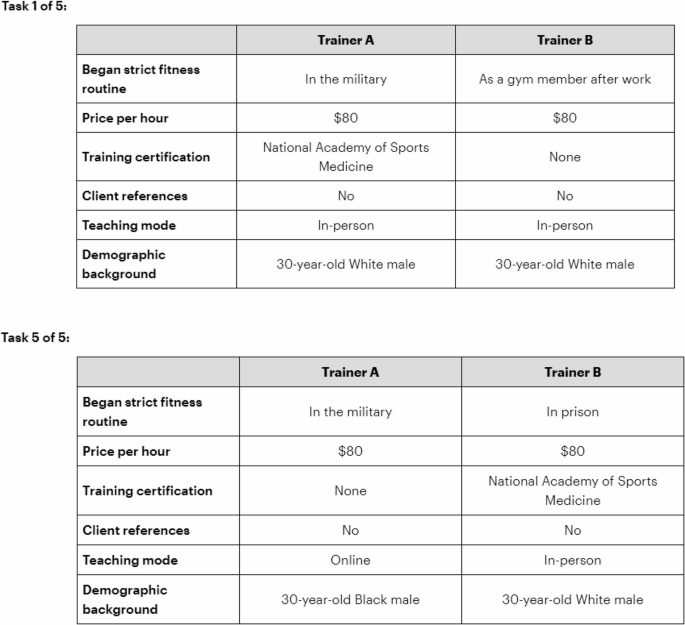
Sample conjoint experiment tasks
We used linear regression models with standard errors clustered by respondent to analyze responses to these forced-choice questions to calculate the average marginal component effect (AMCE) of changing one variable’s attribute while averaging over the distribution of the other attributes. As noted in the Data section, our main models also include survey weights (please see the online appendices for results from unweighted data). In the regression model, we coded experimental manipulations with two levels into binary independent variables: Black Trainer (Black Trainer = 1; White Trainer = 0), Expensive Lesson ($80 per hour = 1; $30 per hour = 0), Certified Trainer (NASM certified = 1; no certification = 0); Has References (has client references = 1; no client reference = 0), and Online Class (online = 1; in-person = 0). Fitness Experience was coded into a four-category variable (1 = in prison; 2 = in the military; 3 = as a college student athlete; 4 = as a gym member after work – reference category).
Open-Ended Follow-Up Question
After each respondent completed their five comparison tasks, they were asked one open-ended follow-up question: “What MOST influenced your trainer choices in the previous questions?” The lead author of the study independently coded all open-ended responses with mentions to the manipulations in the conjoint experiment (e.g., “online,” “price,” “in-person,” “military”), adding categories as necessary (e.g., “fitness experience – vague” for mentions of training routine, but not a specific one, such as prison or military). Within each code, the author then summarized the themes based on respondents’ positive and negative attitudes toward the code and reasons for their attitudes (e.g., chose the veteran trainer because they felt military training was rigorous, or not choosing the veteran trainer because they felt military-style training was not appropriate for personal fitness). The second author selected a random one-third of respondents (n = 363) and independently coded the open-ended responses using the codes developed by the first author. Interrater reliability was in the “almost perfect” range (kappa 0.80 − 1.0; Landis & Koch, 1977) for seven of the nine most frequently used codes.Footnote 11
Results
Conjoint Experiment
Figure 2 presents the average marginal component effects (AMCEs) of the experimentally manipulated trainer attributes on respondents’ probability of recommending a hypothetical trainer, with Table 3 reporting the corresponding regression estimates. Because the outcome was a forced choice between two trainer profiles, the AMCEs can be interpreted as average changes in the probability of a trainer being recommended, expressed in percentage points. Compared to trainers who began their fitness experience as a gym member after work, trainers who began their fitness experience in prison were 19.9% points less likely to be recommended (b = − 0.199, p <.001), supporting H1. Respondents also showed lower probabilities of recommending trainers who charged $80 rather than $30 per hour, as the more expensive option was associated with a 16.3%-point decrease in the probability of being recommended (b = − 0.163, p <.001). Online classes, compared to in-person classes, were associated with a 12.2%-point decrease in the probability of being recommended (b = − 0.122, p <.001). Having NASM certification was associated with a 22.1%-point increase in the probability of being recommended compared to having no vocational credential (b = 0.221, p <.001), while having client references was associated with a 12.3%-point increase compared to having no references (b = 0.123, p <.001). Black trainers were 3.7% points more likely to be recommended than White trainers (b = 0.037, p <.001), suggesting potential positive stereotyping and racial cues when considering sports- and athletic-related positions among the respondents (Kay et al., 2013).

Average marginal component effects of trainer attributes on respondents’ preferences. Note. This figure presents the average marginal component effects (AMCEs) from a linear regression model with 95% confidence intervals. The model includes sample weights and robust standard errors clustered by respondent. There are 10,990 profile choices: each of the 1,099 respondents evaluated two choices in their five tasks. The reference category for Black Trainer is White trainer; the reference category for Expensive Lesson ($80 per hour) is $30 per hour; the reference category for Certified Trainer is no certification; the reference category for Fitness Experiences is “a gym member after work”; the reference category for Has Reference is no client references
Next, to examine the effects of vocational credentials, client references, teaching mode, price, and race on trainers with prison records, we coded Fitness Experience into a binary variable Prison Record, where the trainer who began his fitness experience in prison was coded as 1, and veteran, student athlete, and gym member after work were coded as 0. We then created interaction terms between Prison Record and other binary variables to include in the regression model. Table 4 presents the results. After including the interaction terms, the main results remained the same: trainers with prison records had a 28.5%-point lower probability of being recommended than trainers without prison records (b = − 0.285, p <.001). Respondents, overall, still were more likely to recommend trainers with credentials (b = 0.226, p <.001) and references (b = 0.125, p <.001), as well as Black trainers (b = 0.037, p =.002). There remained main effects for in-person over online instruction, with online classes associated with a 14.1%-point decrease in the probability of being recommended (b = − 0.141, p <.001). Similarly, increasing the lesson price from $30 to $80 per hour was associated with a 17.8%-point decrease in the probability of being recommended (b = − 0.178, p <.001) in the main effects.
Among trainers with prison records, neither vocational training (b = − 0.019, p =.411) nor client references (b = − 0.008, p =.754) significantly improved their likelihood of being recommended beyond the main effects. Nonetheless, the main effects remained, supporting our hypothesis that trainers with records would be more desirable if they had credentials or references (H2a and H2b supported). The general aversion to online classes was less severe for trainers with prison records than for trainers without prison records (b = − 0.077, p =.002). This suggests that some respondents would rather work with trainers with prison records remotely than in person, but not so many as to negate the general preference for in-person training (H2c not supported).Footnote 12 Similarly, although there was a significant interaction between price and trainer prison record (b = 0.060, p =.009), this only attenuated the relationship between price and trainer recommendation. That is, among trainers with prison records, increasing the price from $30 to $80 per hour was associated with an estimated 11.8%-point decrease in the probability of being recommended (−0.178+0.060) (H2d supported). Finally, there was not a significant interaction between prison record and race (b = 0.001, p =.960), with a 3.6%-point higher probability of a Black trainer with prison records being recommended over White trainers with prison records (0.037 − 0.001 = 0.036) (H2e not supported). To explore why respondents may have reacted to the profile choices in the conjoint experiment, we turn to their open-ended responses to the follow-up question for further investigation.
Open-Ended Responses
Instrumental rationale for choosing a trainer
Like the results from the quantitative models, the overwhelming deciding factors for respondents’ choices center around their evaluation of prices, qualification of the trainer (as signaled by certification, references, and experience), and if the classes were in person. One respondent explained the economic rationale behind it as “Price Is always my reason when I’m using my money.” While price and certification were the most commonly mentioned rationales for choosing a trainer, references to prior experience were less common and more vague, with specific mentions to the experience setting (prison, military, college, or after-work) less frequent. In general, respondents were focused on the features that would apply to all trainers when given a chance to explain their reasoning—or, when mentioning prison directly, it was to note that other factors were more important:
The training credentials. I don’t care if they were in prison or their race. I would base my decision on their credentials and reviews.
In person training. It doesn’t matter where they started. Everyone makes mistakes. Also price range and references.
I think references are better. It doesnt matter the race or if the background.
That said, several of the vague mentions of prior fitness experience could be alluding to the fact that respondents do not want a trainer with a prison record without explicitly stating that, which would align with the strong preference for trainers without a prison record in the quantitative models.
Prison stigma
When the specific trainer experience setting was explicitly mentioned as most influencing respondents’ selections, prison was noted more often than the other conditions (military, college, gym member), and generally in the context of concerns with safety and risk. Someone specifically pointed out that “A convict could be dangerous after all,” implying the dangerousness stigma associated with criminal records. Similar comments included “the prison thing was a big deal,” “I don’t really want to hire someone that was in prison,” “avoid felons,” and “prison inmates was a disqualifier.” Danger was especially at the forefront when respondents considered the welfare of others: “prison is a no for my family,” and “Questionable about trainers prison time, might select for myself but not expose family members.”
Still, some respondents mentioned that they may change their mind after learning what the person was incarcerated for and that they might personally check the trainer’s criminal record, which suggests that negative attitudes and stigma are contingent on the crime. As shown in the quantitative results, online teaching modes may attenuate any concerns for dangerousness. One respondent mentioned that “Online seems like maybe less risk to a family.” While another respondent specified: “Online then some prison time ok. In person then no prison time.”
There might be concerns for legal risks other than concerns for personal safety. For example, one respondent mentioned:
I would always recommend someone who was not in prison over in prison just because I work with people who have backgrounds currently and while many of them are not bad or dangerous people it is always a higher risk than working with someone who has never been in prison.
This thought corresponds to the employment and reentry literature on the legal risks raised by hiring professionals. The same person also followed up that “references were not a factor because people are likely not stupid enough to give you a bad reference,” possibly explaining the nonsignificant interaction of references with prison records we see in the quantitative analysis.
Finally, people may not view training in prison as legitimate or rigorous as other settings, as evidenced by this respondent:
Where they got fit - preference for those who started after work - least preference for those who started in prison. While being in prison isn’t necessarily the worst for me, starting to get fit in prison makes it feel like more of a forced choice to pass time and less like they have the discipline to get and stay fit.
Social justice awareness
Although prison experiences may seem a deal-breaker for some respondents, it still seemed that trainers with criminal records are not completely rejected by other community members. In particular, some respondents suggested that awareness of injustices associated with the criminal legal system, such as those related to collateral consequences or minority overrepresentation, factored into their selections:
I am also open to supporting ex-prisoners who turned their lives around because of their past mistakes and are attempting to live and work well within the laws of society. I am also attempting to be aware of any unconscious racial bias that my white privilege may harbor and would consider choosing a black man as a show of alliance for the black community.
I’m also not willing to recommend someone take a chance on particularly a white man who went to jail; with the structural/societal advantages white men get in general, knowing one went to prison despite that is even more concerning than average, and certainly not something I’d be willing to risk with an otherwise-stranger.
Likewise, some respondents expressed frustration with the forced choice between trainers presented as Black and White. One respondent mentioned that they were presented with a choice where “literally EVERYTHING was the same between the 2 trainers besides their race” and that they did not “appreciate being made to pick one race over the other as if that matters anymore [sic] than one has blonde hair and the other brown.” Although race was rarely mentioned explicitly in the open-ended responses or as a non-issue (“All points considered, race was not a factor”), the quantitative results showed an overall preference for Black trainers (regardless of prison experience), perhaps succinctly explained by one respondent’s logic for their selections, “That the trainer was black and had qualifications.”
Discussion
Although stigmatized to be less than capable (Shi et al., 2022), many people with criminal records continue to look for expanded job opportunities beyond the low-wage labor market (Lindsay, 2025) and are interested in starting their own businesses (Hwang & Phillips, 2024). Given the well-documented interest in participation in sports and physical fitness during incarceration, as well as individual-level benefits of participation (Amtmann & Kukay, 2016; Frey & Delaney, 1996; Jugl et al., 2023; Videla, 2025), opportunities such as personal training offer formerly incarcerated individuals another option for employment and entrepreneurship. While there are several potential upsides to people with prison records going into the fitness industry, results from our conjoint experiment suggest that barriers remain.
We find that the public prefers to recommend hiring the services of personal trainers who do not have a prison record. This finding concerning the “gig” economy is consistent with prior research on employability in more traditional sectors for people with criminal records, like low-wage jobs (Pager, 2003; Santos et al., 2023) or in the service industry (Shi & Denver, 2025)—as well as recent experimental work on entrepreneurship (Hickert et al., 2025). As such, the mark of a criminal record appears pervasive across the economy, and specific strategies must be employed to overcome this stigma. Our findings suggest a few specific policy and practice recommendations to help overcome the prison stigma barrier.
First, we find that survey respondents prefer in-person classes overall, but such preference was attenuated significantly for trainers with prison records. If offering services remotely (increasing social distance) can become an effective strategy for people with prison records to overcome the stigma of dangerousness to some potential consumers, prison programming should help inmates understand essential ways to use the internet and electronics. This is especially imperative given that many returning citizens face barriers when using technology and need assistance navigating through the fast development of social media and smartphones while they have been isolated from the outside world during incarceration (Sanders, 2025).
The digital community is fast becoming a place where the formerly incarcerated can network and become entrepreneurs (Haldipur & Smiley, 2026). Additionally, giving online instruction also requires elevated social interaction and communication skills that many people behind bars lack (Hagan, 1993). Prison and reentry programs should also consider strategies to develop stronger interpersonal skills. Delivering online services requires a specific set of skills, while running and managing one’s own business requires even more. Courses on entrepreneurship and managing a small business will be vital for preparing people in prison to navigate the changing labor market. While prison education and vocational offerings are often limited by practical constraints (e.g., limited finances and staffing), expansions in self-directed tablet-based learning provide a valuable pathway for people to learn these skills while incarcerated. For example, “Professional Soft Skills” and “Start or Grow Your Small Business” are among the most popular courses among incarcerated learners nationwide (Edovo, n.d.). In sum, prison systems should explore programming options (in person and tablet-based) that expand skills in internet/digital literacy, communication skills, and entrepreneurship.
Second, for trainers with prison records, customers’ preferences for cheaper classes were also attenuated. This may show that when the price is set high, a subset of potential customers may feel the service is distinguished and differentiated from other similar services, alleviating concerns about people with prison records being dangerous or under skilled. For example, the CONBODY gym that highlights their founder’s and trainers’ prison experiences uses the same glossy and premium presentation to the public on their website as other high-end gyms like SoulCycle and Barry’s.Footnote 13 By packaging their prison training experience as distinguishing rather than stigmatizing, trainers with prison records can compete with other trainers and possibly draw more clientele. Relatedly, some of our survey respondents commented in the open-ended responses about wanting to give people with prison records a second chance.
Another marketing option could be to promote businesses owned and operated by former prisoners as having a social justice or redemption aim, as some respondents expressed support for reentry and redemption in their open-ended responses. Recent business studies show that consumers would like their values to be reflected in the marketing of products and brands (Kronthal-Sacco & Whelan, 2025). The emphasis and promotion of social justice may thus resonate with potential consumers who would like to contribute to supporting people with criminal records. In sum, courses on marketing will further support entrepreneurship related to skills gained behind bars. Individuals leaving prison with both a skillset to market and means of communicating their services and their value, which may include premium packaging and pricing to distinguish themselves in the marketplace, should be more successful.
Third, although we do not find larger positive effects for formerly incarcerated individuals compared to the universal positive effects of references and credentials in the full sample, prison vocational and educational programming should still offer opportunities for credentials in specific careers that are of interest to incarcerated people. We still find an overall benefit of credentials (certificates and references) in our sample, and previous research shows that references from previous work (Santos et al., 2023) and vocational training credentials (Lindsay, 2025) improve chances of being hired for job applicants with criminal records. The general positive effect of those factors among the public when selecting a trainer suggests that more vocational training and credentialing options in prison remain a good investment (Stickle & Sprick Schuster, 2023). It is also possible that the general public may view the credentials and references from people with criminal records as more credible and convincing after stigma against criminal records is further reduced at the societal level. At a minimum, prison officials should provide opportunities for the incarcerated population to engage in routine and structured fitness and sports activities, as these activities provide multiple benefits for physical and mental health, positive behavioral change, and reentry prospects.
Some limitations of the current study suggest directions for future research. First, due to space restrictions, we were unable to include every factor identified in prior literature that may influence employability, such as education (Santos et al., 2023) or offense type (DeWitt & Denver, 2020). Likewise, our limited set of factors presented on the two trainers was noted by respondents in the open-ended item. Some mentioned that the information was not sufficient for them to make a final decision. One respondent commented that “I would meet in person before I made a real life choice.” Future studies should consider additional factors that make people with prison records more marketable in entrepreneurship, including in different careers and service sectors.
Second, our study design used a conjoint experiment task completed five times by each survey respondent, which allows us to explore the causal relationship between the manipulated factors and consumer preferences across the 10,990 profile choices, but we did not explore which respondent-level factors influenced choice. Future research could explore which individual traits correspond with preferences for or aversion to hiring the services of an individual with a criminal record. For example, our open-ended responses suggest some individuals may be more open to giving second chances than others, regardless of the options presented to them in the conjoint experiment. Understanding which segments of the public are open to hiring or working with people with criminal records could help in marketing these businesses.
Third, our experiment focused on selecting a personal trainer, and respondents of different gender and age groups may have different needs for a personal trainer. Instead of asking respondents to choose a trainer for themselves, we asked respondents to select a preferred trainer for a family member with the same age and gender specification across all respondents. While this design aimed to reduce variations related to demographic backgrounds, it may have nonetheless made the decision less relatable. Future researchers may design experiments that ask respondents to pick a product/service for themselves, to make the choice more intentional, involving a higher stake of self-interest.
Future researchers should continue to explore the nuanced effect of race in the context of criminal records and reentry. Our finding that respondents preferred Black personal trainers over White trainers, regardless of criminal record, further shows the complexity of the relationships between race, criminal record, and stigma—and the need for future research. Our finding may be explained by “positive biases” that racial minorities are more athletic (Kay et al., 2013) and therefore more likely to succeed in this position, although there is also evidence of racial minority individuals with criminal records experiencing double discrimination (Lindsay, 2025). Other experimental studies conducted recently have mixed results regarding race and employment in the context of a criminal record—with some showing positive outcomes for racial and ethnic minorities like our study. For example, Lageson and Apel (2025) found that the criminal record penalty seemed to be larger for White job applicants than for Black job applicants, with the authors suggesting that respondents might have become more aware of racial equality and social justice issues in recent years. Shi and Denver (2025), in examining restaurants hiring individuals with criminal records, found that respondents preferred the restaurants with mostly minority staff, although the support was largely driven by preferences from Black and Hispanic respondents. Other work has found nonsignificant race effects regarding aspects of hiring individuals with criminal records (e.g., DeWitt & Denver, 2020; Sugie et al., 2020). It warrants further research to untangle the relationship between race and stigma and policy efforts to reduce barriers to reentry faced by racial and ethnic minority individuals with criminal records.
In conclusion, sports and physical fitness behind bars have many potential benefits both during and after release—and may provide a pathway to entrepreneurship (e.g., CONBODY). People leaving prison are interested in working for themselves (Edovo, n.d.; Hwang & Phillips, 2024) and entrepreneurship may be a viable path for reentry success given the changing economic landscape (shift to “gig” economy) and persistent barriers to employment for people with criminal records (Holzer et al., 2003; Hunt et al., 2018; Pager, 2003). Consistent with prior work, we found prison stigma to play a role in public preferences for personal trainers. The trainers with all other backgrounds were preferred over those who had been in prison. Our general finding of positive effects of credentials and client references suggests that people in prison should continue to earn career-specific certifications to assist with post-release employment (Stickle & Sprick Schuster, 2023). However, among trainers with prison records, some respondents preferred those who provided online instruction and charged a higher price—suggesting pathways for entrepreneurs with prison records to market and deliver their services in ways that are more palatable to the public.
Notes
The literature review discusses studies that examine a broad variety of physical, sport, and fitness activities, including weightlifting, yoga, resistance training, flexibility training, cardio programs, team sports such as soccer and rugby, which may lead to improved physical and mental health outcomes (Woods et al., 2017). While these programs tend to lead to overall positive outcomes for participants, recent studies have begun to differentiate the effects of various programs (for a review, see Herold et al., 2023).
Interested readers could read more about the manual here: https://www.ojp.gov/ncjrs/virtual-library/abstracts/manual-exercising-incarcerated.
Interested readers may find more information about this business here: https://conbody.com/about/.
For example, the nonprofit organization Jails to Jobs discussed the importance of references here: https://jailstojobs.org/job-references-key-helping-ex-offenders-find-job/.
This recommendation comes from a reentry-support institution Elevate Recovery Homes: https://elevaterecoveryhomes.com/how-to-address-your-criminal-record/.
These hypotheses, with slightly different wording, were pre-registered via OSF: https://osf.io/e42kh/overview?view_only=468340db20554f7b889962d53feffe06.
With 1,099 respondents each completing five tasks, an expected effect size of 0.05, and variable levels at 4 at the most, the power for the conjoint experiment is 96% (https://mblukac.shinyapps.io/conjoints-power-shiny/).
For example this HuffPost article listed factors such as cost, credentials, experience, availability, and reputation as things to consider before choosing a trainer: https://www.huffpost.com/entry/choosing-a-personal-trainer_b_6085318.
Kappa was above 0.90 for codes of: price, certification, fitness experience – vague, military, prison, references, and in-person. Kappa was 0.58 for online and 0.61 for mode – vague, both in the “moderate” agreement range, but indicating some discrepancy in how to code mentions of training modality.
Considering the main effect and interaction, there remains a 6.4%-point lower probability of recommending the trainer with a prison record if they offer online training (-0.141 + 0.077 = 6.4).
Their websites show professional presentation with similar high-quality images, color schemes, and layouts: https://conbody.com/; https://www.soul-cycle.com/; https://www.barrys.com/.
References
Amtmann, J., & Kukay, J. (2016). Fitness changes after an 8-week fitness coaching program at a regional youth detention facility. Journal of Correctional Health Care, 22(1), 75–83.
Baldonado, N. N., Demot, A. M. L., Villaflores, P. J. A., Dayag, G. G., Buado, E. L., Ramos, C. V., & Martinez, R. G. (2022). Physical activity participation of persons deprived of liberty in Santiago city district jail, Philippines. Physical Education and Sports: Studies and Research, 1(2), 91–106.
Bansak, K., Hainmueller, J., Hopkins, D. J., & Yamamoto, T. (2021). Conjoint survey experiments. In J. N. Druckman & D. P. Green (Eds.), Advances in experimental political science (pp. 19–41). Cambridge University Press.
Bumiller, K. (2015). Bad jobs and good workers: The hiring of ex-prisoners in a segmented economy. Theoretical Criminology, 19(3), 336–354.
Bushway, S. D., & Apel, R. (2012). A signaling perspective on employment-based reentry programming: Training completion as a desistance signal. Criminology & Public Policy, 11(1), 21–50.
Cashin, A., Potter, E., & Butler, T. (2008). The relationship between exercise and hopelessness in prison. Journal of Psychiatric and Mental Health Nursing, 15(1), 66–71.
Denver, M., & Ewald, A. (2018). Credentialing decisions and criminal records: A narrative approach. Criminology, 56(4), 715–749.
Denver, M., & Pickett, J. T. (2022). Race, criminal records, and discrimination against job seekers: Examining attitudinal mechanisms. Social Currents, 9(3), 226–244.
Denver, M., Pickett, J. T., & Bushway, S. D. (2017). The language of stigmatization and the mark of violence: Experimental evidence on the social construction and use of criminal record stigma. Criminology, 55(3), 664–690.
DeWitt, S. E., & Denver, M. (2020). Criminal records, positive employment credentials, and race. Journal of Research in Crime and Delinquency, 57(3), 333–368.
Duwe, G., & Henry-Nickie, M. (2021). Training and employment for correctional populations. Contexts, 20(4), 40–45.
Edovo. (n.d.). Content & curriculum: Expansive, impactful, proven courses. https://www.edovo.org/about/content-curriculum
Frey, J. H., & Delaney, T. (1996). The role of leisure participation in prison: A report from consumers. Journal of Offender Rehabilitation, 23(1–2), 79–89.
Gallant, D., Sherry, E., & Nicholson, M. (2015). Recreation or rehabilitation? Managing sport for development programs with prison populations. Sport Management Review, 18(1), 45–56.
Giguere, R., & Dundes, L. (2002). Help wanted: A survey of employer concerns about hiring ex-convicts. Criminal Justice Policy Review, 13(4), 396–408.
Hagan, J. (1993). The social embeddedness of crime and unemployment. Criminology, 31(4), 465–491.
Haldipur, J., & Smiley, C. J. (2026). Prison hashtags: Incarceration, reentry, and digital identity. NYU Press.
Harris, P. M., & Keller, K. S. (2005). Ex-offenders need not apply: The criminal background check in hiring decisions. Journal of Contemporary Criminal Justice, 21(1), 6–30.
Harrison, K., Smith, L., Mason, R., & Bretherton, R. (2025). It was completely transformational: Experiences of a prison staff coaching programme. International Journal of Workplace Health Management, 18(2), 152–165.
Herold, E., Wicker, P., Czyrnick-Leber, U., Gröben, B., & Dransmann, M. (2023). Sport in prison: Social and subjective health outcomes of different sport programs. International Journal of Prisoner Health, 19(4), 682–698.
Hickert, A., Shi, L., Shaw, O., & Yan, S. (2025). Do direct and courtesy prison stigma hinder support for a startup business? A vignette experiment. Journal of Experimental Criminology, 1–26.
Hill, L., Scaggs, S. J., & Bales, W. D. (2017). Assessing the statewide impact of the Specter Vocational Program on reentry outcomes: A propensity score matching analysis. Journal of Offender Rehabilitation, 56(1), 61–86.
Holzer, H. J., Raphael, S., & Stoll, M. A. (2003). Employment barriers facing ex-offenders. Urban Institute.
Hunt, P. E., Smart, R., Jonsson, L., & Tsang, F. (2018). Breaking down barriers: Experiments into policies that might incentivize employers to hire ex-offenders. RAND. https://www.rand.org/content/dam/rand/pubs/research_reports/RR2100/RR2142/RAND_RR2142.pdf
Hwang, K. J., & Phillips, D. J. (2024). Entrepreneurship as a response to labor market discrimination for formerly incarcerated people. American Journal of Sociology, 130(1), 88–146.
Jugl, I., Bender, D., & Lösel, F. (2023). Do sports programs prevent crime and reduce reoffending? A systematic review and meta-analysis on the effectiveness of sports programs. Journal of Quantitative Criminology, 39(2), 333–384.
Kay, A. C., Day, M. V., Zanna, M. P., & Nussbaum, A. D. (2013). The insidious (and ironic) effects of positive stereotypes. Journal of Experimental Social Psychology, 49(2), 287–291.
Kovalsky, S., Hasisi, B., Haviv, N., & Elisha, E. (2021). Can yoga overcome criminality? The impact of yoga on recidivism in Israeli prisons. International Journal of Offender Therapy and Comparative Criminology, 65(6–7), 671–691.
Kronthal-Sacco, R., & Whelan, T. (2025). What consumers really want brands to do about social issues? Harvard Business Review. www.hbr.org.
Lageson, S., & Apel, R. (2025). The mark or trace of a criminal record: A survey experiment of race and criminal record signaling. Criminology, 63(2), 382–410.
Landis, J. R., & Koch, G. G. (1977). An application of hierarchical kappa-type statistics in the assessment of majority agreement among multiple observers. Biometrics, 33, 363–374.
Leasure, P., & Andersen, T. S. (2016). The effectiveness of certificates of relief as collateral consequence relief mechanisms: An experimental study. Yale L & Pol’y Rev Inter Alia, 35, 11–22.
Leasure, P., & Andersen, T. S. (2020). Race, criminal records, and certificates of relief: An experimental pilot study. Deviant Behavior, 41(9), 1065–1083.
Leasure, P., & Kaminski, R. J. (2021). The effectiveness of certificates of relief: A correspondence audit of hiring outcomes. Journal of Empirical Legal Studies, 18(4), 849–875.
Lehmann, P. S., Pickett, J. T., & Denver, M. (2020). Public opinion on criminal records and employment: A test of competing theoretical models. Crime & Delinquency, 66(6–7), 995–1022.
Lindsay, S. L. (2025). Mixed signals from prison? Postsecondary vocational credentials, race, and postrelease employment. Criminology, 63(2), 411–436.
Maity, K., Majumdar, V., Patra, S., & Anand, A. (2025). Cognitive dysfunction—an under looked avenue to promote health in incarcerated elderly population through yoga. Frontiers in Human Neuroscience, 19, Article 1553845.
Mannocci, A., Mipatrini, D., D’Egidio, V., Rizzo, J., Meggiolaro, S., Firenze, A., & Masala, D. (2018). Health related quality of life and physical activity in prison: A multicenter observational study in Italy. The European Journal of Public Health, 28(3), 570–576.
McNeeley, S. (2023). The effects of vocational education on recidivism and employment among individuals released before and during the COVID-19 pandemic. International Journal of Offender Therapy and Comparative Criminology, 67(15), 1547–1564.
Meek, R., & Lewis, G. (2014). The impact of a sports initiative for young men in prison: Staff and participant perspectives. Journal of Sport and Social Issues, 38(2), 95–123.
Melvin, K. B., Gramling, L. K., & Gardner, W. M. (1985). A scale to measure attitudes toward prisoners. Criminal Justice and Behavior, 12(2), 241–253.
Middleton, L., Harris, D. A., & Ackerman, A. R. (2019). A mixed-methods process evaluation of the art of yoga project for girls in custody. The Prison Journal, 99(4_suppl), 38S–60S.
Milićević, M., & Drndarević, N. (2023). Media portrayals of prison life and criminal justice: A narrative literature review on shaping public perceptions and policy implications. Zbornik Instituta za Kriminoloska i Socioloska Istrazivanja, 42(2–3), 75–90.
Mohan, A. R., Thomson, P., Leslie, S. J., Dimova, E., Haw, S., & McKay, J. A. (2018). A systematic review of interventions to improve health factors or behaviors of the cardiovascular health of prisoners during incarceration. Journal of Cardiovascular Nursing, 33(1), 72–81.
Moscoso-Sánchez, D., De Léséleuc, E., Rodríguez-Morcillo, L., González-Fernández, M., Pérez-Flores, A., & Muñoz-Sánchez, V. (2017). Expected outcomes of sport practice for inmates: A comparison of perceptions of inmates and staff. Revista de psicología del deporte, 26(1), 37–48.
Muirhead, J., & Fortune, C. A. (2016). Yoga in prisons: A review of the literature. Aggression and Violent Behavior, 28, 57–63.
Müller, J., & Mutz, M. (2022). Pumping iron for strength and power: Prisoners’ perceptions of a stable body. Qualitative Research in Sport Exercise and Health, 14(7), 1159–1173.
Newson, M., Peitz, L., Cunliffe, J., & Whitehouse, H. (2024). A soccer-based intervention improves incarcerated individuals’ behaviour and public acceptance through group bonding. Nature Human Behaviour, 8(12), 2304–2313.
Norman, M. (2017). Sport in the underlife of a total institution: Social control and resistance in Canadian prisons. International Review for the Sociology of Sport, 52(5), 598–614.
Novek, E. (2009). Mass culture and the American taste for prisons. Peace Review, 21(3), 376–384.
O’Sullivan, S. (2001). Representations of prison in nineties Hollywood cinema: From Con Air to The Shawshank Redemption. The Howard Journal of Criminal Justice, 40(4), 317–334.
Pager, D. (2003). The mark of a criminal record. American Journal of Sociology, 108(5), 937–975.
Parker, A., Meek, R., & Lewis, G. (2014). Sport in a youth prison: Male young offenders’ experiences of a sporting intervention. Journal of Youth Studies, 17(3), 381–396.
Reich, S. E. (2017). An exception to the rule: Belief in redeemability, desistance signals, and the employer’s decision to hire a job applicant with a criminal record. Journal of Offender Rehabilitation, 56(2), 110–136.
Reysen, S. (2005). Construction of a new scale: The Reysen likability scale. Social Behavior and Personality: An International Journal, 33(2), 201–208.
Sanders, K. (2025). “Everything is technology”: Examining technology access and use among returning citizens. Criminology & Public Policy. https://doi.org/10.1111/1745-9133.12701
Santos, M. R., Jaynes, C. M., & Thomas, D. M. (2023). How to overcome the cost of a criminal record for getting hired. Criminology, 61(3), 582–621.
Shi, L., & Denver, M. (2025). The transferal of criminal record stigma in the employment context: Evidence from conjoint and vignette experiments. Criminology, 63(1), 89–121.
Shi, L., Silver, J. R., & Hickert, A. (2022). Conceptualizing and measuring public stigma toward people with prison records. Criminal Justice and Behavior, 49(11), 1676–1698.
Silver, J. R., Shi, L., & Hickert, A. (2025). Stigmatizing ‘evildoers’: How beliefs about evil and public stigma explain criminal justice policy preferences. Psychology Crime & Law, 31(10), 1366–1389.
Stickle, B., & Sprick Schuster, S. (2023). Are schools in prison worth it? The effects and economic returns of prison education. American Journal of Criminal Justice, 48(6), 1263–1294.
Sugie, N. F., Zatz, N. D., & Augustine, D. (2020). Employer aversion to criminal records: An experimental study of mechanisms. Criminology, 58(1), 5–34.
Tepperman, A. (2014). Prison weights for no man: Interpreting a modern moral panic. Critical Issues in Justice and Politics, 7(1), 1–16.
Videla, J. A. V. (2025). Literature Review on Yoga and meditation in prisons. Gestión de la seguridad y la Salud en el Trabajo, 7(1), 136–144.
Wicker, P., Lesch, L., Gröben, B., & Dransmann, M. (2023). Coaching sports in prison: Coaches’ experiences. Journal of Offender Rehabilitation, 62(2), 98–117.
Wimberly, A. S., Engstrom, M., Layde, M., & McKay, J. R. (2018). A randomized trial of yoga for stress and substance use among people living with HIV in reentry. Journal of Substance Abuse Treatment, 94, 97–104.
Woods, D., Breslin, G., & Hassan, D. (2017). A systematic review of the impact of sport-based interventions on the psychological well-being of people in prison. Mental Health and Physical Activity, 12, 50–61.
Acknowledgements
The authors would like to thank Dr. Justin Pickett, Dr. Sean Roche, Dr. Jason Silver, and Dr. Megan Denver for their feedback and suggestions on the survey draft.
Funding
Both authors used internal university funds to contract the survey administration with YouGov.
Author information
Authors and Affiliations
Corresponding author
Additional information
Publisher’s Note
Springer Nature remains neutral with regard to jurisdictional claims in published maps and institutional affiliations.
Supplementary Information
Below is the link to the electronic supplementary material.
Rights and permissions
Open Access This article is licensed under a Creative Commons Attribution 4.0 International License, which permits use, sharing, adaptation, distribution and reproduction in any medium or format, as long as you give appropriate credit to the original author(s) and the source, provide a link to the Creative Commons licence, and indicate if changes were made. The images or other third party material in this article are included in the article’s Creative Commons licence, unless indicated otherwise in a credit line to the material. If material is not included in the article’s Creative Commons licence and your intended use is not permitted by statutory regulation or exceeds the permitted use, you will need to obtain permission directly from the copyright holder. To view a copy of this licence, visit http://creativecommons.org/licenses/by/4.0/.
About this article

Cite this article
Shi, L., Hickert, A. Moving “The Mark of a Criminal Record”: Consumer Preferences and Market Opportunities for Personal Trainers with Criminal Records. Am J Crim Just (2026). https://doi.org/10.1007/s12103-026-09956-6
Received:
Accepted:
Published:
Version of record:
DOI: https://doi.org/10.1007/s12103-026-09956-6