


Abstract
Tropical landscapes are largely shaped by the daily decisions of smallholder farmers. Public institutions and private companies increasingly aim to shape agricultural landscapes by influencing farmer decisions. Farmer land-use decision-making is complex and highly dynamic, especially in tropical smallholder systems. The use of serious games has been proposed as a promising research approach to understand these processes. However, it is often unclear how land-use decisions in such simulated settings relate to real life. In this paper, we explore how decisions in games made by farmers relate to their real-life decisions. We draw on a case study in Madre de Dios, Peru, where we interviewed farmers to design a game representing key components of the local farming system and external interventions. The game was played during 20 sessions involving 103 farmers. This dataset enabled the first systematic comparison in land-use serious gaming between decisions made in a game and the same farmers’ documented real-life decisions. We explored the game’s credibility, salience, and legitimacy by comparing farmer decisions in the game, including deforestation, crop choice, and participation in support programs, with those made in real life. Results show significant relations between farmers’ realities and their game decisions. The degree to which farmers receive support in real life predicts their preference for support in the game, and crop choices in real life resemble those made in the game. Cooperative membership in real life is associated with less clearing of primary forest in the game, and governmental support with larger loans. Overall, farmers found the game to be a good representation of their reality, which allowed them to discuss complex land-use decisions. We conclude that serious games can be credible, salient, and legitimate tools to explore farmer decision-making around land use, allowing exploration of the impact of present and future interventions.
1 Introduction
Agricultural expansion and deforestation are social-ecological processes, including social and behavioral components as much as ecological ones. The sum of local stakeholders’ decisions is influenced by, and contributes to, rapid changes in the landscape (Garcia et al. 2020). Deforestation has been linked to climate change, biodiversity loss, and soil degradation, among other important losses in ecosystem services (Gatti et al. 2021; Qu et al. 2024). Smallholder farmers play a central role in shaping agricultural landscapes, notably so in regions with high forest cover and insecure livelihoods. Their daily land-use decisions are the result of complex processes involving economic dynamics, fluctuating resources, and the influence of reference groups and external actors (Githinji et al. 2023, 2024). External actors, such as public and private institutions, often aim to influence smallholders’ decisions with the goals of both alleviating rural poverty and preserving forests (Pokorny et al. 2021; Speelman et al. 2014a, b). This is typically done through rural extension programs that encourage farmers to adopt certain technologies and land-use strategies (Jones 1997; Sabogal et al. 2008). However, efforts to achieve win-win outcomes that address both social and ecological issues often lead to interventions that are incompatible with smallholders’ goals, causing low adoption and success rates (Jackson 2012; Pokorny 2013). Further, the degree to which such external interventions succeed in influencing smallholders’ decisions, and therefore land use, is difficult to study, since processes underlying farmer decision-making are complex, dynamic, and often poorly understood (Githinji et al. 2024; Rizzo et al. 2024).
Novel types of rural intervention are needed, including extension approaches that are participatory and inclusive of smallholders’ local knowledge and needs (Pokorny et al. 2005, 2013). In order to develop such inclusive intervention approaches, the scientific methods used to understand smallholder perspectives must themselves be innovative and inclusive of farmers’ voices. One such method is serious gaming, centered on role-playing to engage with real-life decision-making processes, and designed to support the understanding of social-ecological systems (Barreteau et al. 2021). Serious games have been applied in a wide range of scientific fields, including education, health, social sciences, psychology, and informatics, and are increasingly used in interdisciplinary fields of study (Wilkinson 2016). In the field of natural resource management, the approach has been used to engage with land users in collective agroecosystem design (Ryschawy et al. 2022; Speelman et al. 2014a, b) and to stimulate social learning about the consequences of land-use choices (Bosma et al. 2020; Sari et al. 2024) and complex social-ecological problems in general (Dahdouh-Guebas et al. 2022; Tanika et al. 2024; Wamucii et al. 2024). Serious gaming is also considered a promising approach for exploring decision-making processes, allowing for social learning among stakeholders and the emergence of coalitions for change in the real world (Rodela and Speelman 2023; Speelman et al. 2014a, b; Van Noordwijk et al. 2020). However, in order to develop games that are credible (based on current understanding), salient (actionable through governance), and legitimate (aligned with stakeholder interests) (Cash et al. 2002; Van Noordwijk et al. 2020), game design clearly must draw from the represented reality (Garcia et al. 2022). The hypothesis is that if a game effectively reflects players’ representations of reality, players will make decisions in the game similar to those they would make in real life, allowing for the exploration of real-world scenarios. Still, to our knowledge, there are no studies that explore how closely the land-use decisions made by players in simulated settings resemble those they make in real life, risking to undermine the validity of game-based scenario results (Jackson 2012).
In this paper, we explore the question: how do decisions made by farmers in a serious game relate to their real-life decisions and conditions? We set out to design a serious game representing key components of the farming system and external interventions that influence it. We then test the game’s credibility, salience, and legitimacy by playing it with smallholder farmers and analyzing the correlation between decisions made in the game and those made in real life. We base our analysis on a case study from Madre de Dios, a department in the Peruvian Amazon, where agriculture is currently growing exponentially (BCRP 2023; ComexPerú, 2023; Lagneaux et al. 2024a, b), generating interest from a variety of actors, including the regional governmental and non-governmental institutions, who are aiming to intervene in the farming system to foster forest conservation and/or economic development. Based on the results, we reflect on the implications of using serious games to investigate land-use strategies in complex farming systems (Figure 1).

Image of the board of the CHAKRAS (CHoices in Amazonia for Knowledge and Research on Agricultural Systems) game at the end of a game session. Photocredit: Elisabeth G. Lagneaux.
2 Materials and methods
2.1 Study site
The Peruvian department of Madre de Dios is located in the Amazonian lowlands, bordering Brazil and Bolivia. The area covers 85,301 km2 with a population of around 140,000 inhabitants (INEI 2018). As other areas on the first level of the forest transition curve (Dewi et al. 2017), Madre de Dios is characterized both by high forest cover (98%) and high rates of deforestation, especially in hotspots with higher population densities (24,500 ha of tree cover loss in 2023 alone) (Global Forest Watch 2024). In 2021, Madre de Dios was the second Peruvian department with highest deforestation, after Ucayali (PNCBMCC 2021). The main driver of deforestation is gold mining, followed by arable and livestock farming (Nicolau et al. 2019). While gold mining is the region’s most lucrative sector, it officially employs only around 5% of the active population, compared to 20% by the farming and fishing sector (INEI 2019). The region is currently in a phase of social and environmental transition, with an exponential growth of farming activities due to the recently improved access to national markets, allowed by the pavement of the Interoceanic Highway in the 2010 s (Lagneaux et al. 2024a, b). The crop covering the largest area is maize (Zea mays), followed by banana (Musa sp.), rice (Oryza sativa), cacao (Theobroma cacao), and cassava (Manihot esculenta) (DRAMDD 2022). Copoazú (Theobroma grandiflorum) and citrus trees (Citrus sp.) are also important perennial crops grown in Madre de Dios. Cacao is the only crop being exported, while all others are mainly sold on the local market. The latest agricultural census reported an average agricultural unit of almost 100 hectares (INEI 2013), however most farms have been parceled into smaller units ranging between 20 and 100 hectares (Moore 2019). Farmers are mainly smallholders producing for both subsistence and markets, in farming systems that range from highly diverse home gardens to extensive pastures and monocultures (Moore 2019; Peña Valdeiglesia and Alegre Orihuela 2017). Social conflict over land tenure issues is common, with overlapping land use rights and informality in land ownership affecting many farmers (Chavez et al. 2012; Lagneaux et al. 2024a, b; Pena Alegria 2025). Previous studies have shown that institutional support programs for farmers mainly consist of governmental programs and NGOs promoting perennial crop production among associated groups, in particular cacao seedling distribution (see Lagneaux et al. 2026 for a detailed description of support programs). Still, many questions remain regarding the specific effect that different types of interventions have on farmers’ land-use decisions.
2.2 Game design
The game developed in this study is called CHAKRAS (Choices in Amazonia for Knowledge and Research on Agricultural Systems; the name comes from the Quechua word chakra, meaning farm, the most commonly used term for one’s farm employed by farmers in Madre de Dios, normally referring to a traditional, biodiverse family-managed farm system); it is a tool to explore farmers’ land-use decisions and the influence of external interventions on such decisions. The game is part of a larger category of games dealing with external agencies’ effects on farmers’ decisions (Van Noordwijk et al. 2020).
The CHAKRAS game was designed based on the companion modeling approach, using the Actors, Resources, Dynamic and Interactions (ARDI) method (Etienne et al. 2011). We identified key components of the Madre de Dios farm system and external interventions that influence it by carrying out 57 interviews with smallholder farmers. Farmers were identified randomly during field visits to villages along the Interoceanic Highway, within a 150-kilometer stretch both North and South-West of the city of Puerto Maldonado, where most of the region’s agricultural activities are concentrated (Figure 2). The interviewer and assistants asked residents to identify local farmers, and some interviews came through referrals from neighbors or relatives, while others took place during meetings of the AGROBOSQUE cooperative and a small farmers’ association in Montegrande. During each individual interview, we asked farmers about the main components of their farming system, and how components were influencing each other (see Annex 1 for full questionnaire). During these guided conversations, the interviewer drew individual Fuzzy-Cognitive Maps (FCM) on a sheet of paper, representing all the mentioned components and their interactions. FCMs are a tool allowing to elicit local stakeholders’ perception and mental model of their social-ecological systems (Özesmi and Özesmi 2004). Through the analysis of the FCMs, we extracted key components of the farming system (Actors and Resources, from the ARDI framework) and the relationships, represented as arrows between components, which were either positive or negative and quantified based on how many farmers mentioned them (Dynamics and Interactions) (see Lagneaux et al. 2026 for details). We included the most mentioned components across all interviews into an element of the game, either as a rule (e.g., expenses were represented with an amount that had to be paid by all players at the end of each round), or an element of the board (e.g., secondary and primary forest plots were represented visually). The systems components (Actors and Resources) most often mentioned related to sales and income, crop production, and elements that influence crop production (internal or external to the farm) such as weed control, drought, and institutional support.

Map of the locations in Madre de Dios, Peru, where the 57 individual interviews and 20 game sessions were carried out with smallholder farmers.
2.3 Game development and testing
A first draft version of the CHAKRAS game was created in early 2023. In order to calibrate the game’s mechanics (number of initial coins per player, costs, prices, etc.) and to simplify game rules to make the game more accessible, six test rounds were performed between the 17th and 19th of March 2023, with a total of 25 participants, including field technicians and representatives of various local NGOs, graduates in agricultural sciences, and researchers working on the farming system in the Peruvian Amazon. Through several game testing sessions, the game was ultimately simplified by reducing the number of components from 30 to 24. The six elements that were removed during trial rounds included pest and wild animal attack and control, home consumption and access to the market (since in the game, all products were sold), and animal production (Table 1).
Players play the role of farmers who make decisions about their individual farm area, represented on the gameboard. Each round in the game represents a cropping season (6–12 months). Between the rounds, interventions by external actors were included to represent the three main types of actors who intervene in the local farming system: governmental institutions, NGOs, and private companies (see Lagneaux et al. 2026). At the beginning of round 2, a generic NGO promoting agroforestry is introduced, representing the typical approach of NGOs who aim to influence farmers in Madre de Dios. At the beginning of round 3, a generic governmental institution with a cacao-promoting program mimics one of the programs local farmers are the most familiar with in Madre de Dios (i.e., a program focused on seedling distribution, see Lagneaux et al. 2026). Agro-industrial companies in Madre de Dios are less common; therefore, we included a generic private intervention (beginning round 4) encountered during fieldwork and believed to have the potential to become more important in the future, despite few farmers having benefited from it in real life: a maize seed company sharing hybrid seeds with farmers as part of a promotional campaign. To go further in the exploration of farmers’ preferences around land-use strategies and support program preference, we asked farmers to choose between two available interventions at the end of round 5: one that most farmers already interacted with in real life, namely a papaya company offering to rent land; and one that, at the time of the study, no farmers in Madre de Dios had been involved with, namely a carbon project offering to pay for the preservation of primary forest. Note that, while they had not participated in carbon projects, many farmers had heard of the growing carbon credit market and the theoretical financial value of standing forests (see Annex 1 for a complete overview of game rules and game mechanics).
2.4 Game implementation
The CHAKRAS game was played in 20 game sessions (see locations in Figure 2), each lasting about three hours and including 4 to 6 participants. In total, 103 stakeholders participated in the game sessions. All participants were farmers identified during field visits between April and May 2023, with no overlap with the 57 farmers interviewed previously (see section 2.2). We used convenience sampling, by identifying farmers during random village visits, sometimes using key contacts of association and cooperative leaders, and snowball sampling, by inviting previous players’ colleagues and neighbors. In most sessions, players knew each other; they were neighbors and/or family members; however, in some sessions, players did not previously know each other. In three sessions, the game was played with the board members of a cacao cooperative (AGROBOSQUE and COPAIDI), and in one session the members of the board of the Puerto Maldonado Agricultural Fair played. Two sessions were played with members of indigenous communities in their territories (Infierno and El Pilar). In these sessions, local leaders selected participants.
Each game session started with a short pregame survey (see questionnaire in Annex 2). Participants were then briefed on game rules. During the game, the facilitator was careful to avoid emitting value judgment on players’ land-use decisions and/or preferences, to prevent biasing farmers’ choices. After playing the game, a debriefing session was led by the facilitator to discuss how farmers felt during the game, revisit key events (such as in the case of conflicts, invasions between neighbors, or alliances between players), and discuss similarities and differences between the game and reality, what players learned, and which interventions they preferred (see debriefing guide in Annex 3).
2.5 Data collection and data analysis
During the game, all data about players’ decisions was collected, throughout all rounds, using audio recording of the game session, photos of the board at the end of each round, and written notes taken by the research team throughout the game. The research team was composed of five people, one to facilitate the game and four to collect data and help players access the game tokens for coins or crops.
We analyzed both individual and collective decisions made by players during the game, and whether these decisions (“game data”) were related to players’ land-use decisions in real life (“life data”). Individual decisions concern each player’s own farm, i.e., deforestation, crop choice, and borrowing money, whereas the collective decisions are exclusively the votes on whether to accept the support offered by each external actor. This support is granted to every player in the session, or to none, depending on the majority’s choice. To assess legitimacy, we complemented these quantitative analyses with the qualitative feedback of players on the game’s validity, provided during post-game discussions.
2.5.1 Life data
Demographic and land-use data collected during pre-game surveys included a player’s age, gender, region of origin (Amazonian, Andean, or Coastal), total land size, size of cultivated land, size of secondary forest, size of primary forest, type of main crop (perennial or annual), proportion of perennial crops among managed crops, support level (see criteria in Table 2), and general opinion on support projects (good, neutral, or bad).
2.5.2 Game data
Recorded data on decisions made by players during the game included the number of deforested plots per round (for both primary and secondary forest), number of plots of annual and perennial crops installed per round (which we call “crop choice”), decision about whether or not to receive support from a given external intervention, which we call “vote” (i.e., NGO support, governmental support, papaya rental, and carbon credits), size of the loan taken out and whether or not the loan was paid back.
We calculated the significance of relationships between game data and life data by calculating p-values with various statistical tools, based on whether the data was continuous, categorical with only two categories (e.g., yes or no), or categorical with more than two categories (Table 3). The p-values were calculated with R Studio (R Core Team 2023; RStudio Team 2023). Where ANOVA indicated an overall difference between support levels, we used Tukey’s honestly significant difference test to identify which levels differed.
We only considered correlation to be of statistical significance when the p-value of the Pearson correlation test was below 0.05. We considered the correlation to be negligible when the correlation coefficient was below 0.1, and weak when it was between 0.1 and 0.3.
3 Results and discussion
3.1 Rules of the CHAKRAS game
The CHAKRAS game, designed based on an analysis of the Madre de Dios farming system, consists of a hexagonal board divided into six sections, representing six farms, each made of nine plots: three secondary forest plots and six primary forest plots (Figure 3). Each player starts with the same area of land, with the same number of financial resources (a total of 10 coins each) and with a specific and randomly allocated number of labor resources (between one and four small humanoid figurines). Financial resources can be used to clear forest, buy seeds and seedlings, and/or hire additional labor resources. Players start by playing one at a time (in the first round) and later all at once. They can choose to replace each plot of forested land with one of eight different land uses, namely (i) maize, (ii) rice, (iii) banana, (iv) cassava, (v) cacao, (vi) copoazú, (vii) citrus, and (viii) timber trees. Annual crops (maize, rice, banana, and cassava) are cheaper to plant, and can be harvested once, one round after planting. Perennial crops (cacao, copoazú, and citrus) are more expensive to plant, and can be harvested each round, starting two rounds after planting. Timber trees can be added to a plot that already contains perennial crops (creating an agroforestry system) and can be harvested for wood after three rounds. Crops can only be planted on bare land (after clearing forest by fire or harvesting an annual crop) and clearing land poses a risk of fire, represented by a six-sided die with a 1/3 probability of burning a bordering plot. Planting on a plot that previously contained primary forest leads to an increase in harvest for one round, to represent increase in fertility from burned biomass. Consecutive planting of annual crops on the same plot will lead to a decrease in harvest (minus one coin per harvested plot per round), to represent fertility loss. If a cleared plot is left unplanted for an entire round, it regrows into secondary forest and fertility is returned. Players can choose to take out a loan for investment or if they are no longer able to pay the yearly maintenance fee (“cost of living,” representing food, energy, and school costs, proportional to the number of a player’s labor resources). Players are allowed to pay back the loan, along with interest rates, in various parts. It is considered that the loan has not been paid back if the loan, along with interest rates, has not been paid by the end of the 5th round (the end of the game). Detailed rules are available in Annex 1.

Schematic representation of the CHAKRAS (CHoices in Amazonia for Knowledge and Research on Agricultural Systems) board at the beginning of a game session.
One game session consists of five rounds. However, players are unaware of how many rounds will be played to avoid influencing their decisions at the end of the game. Players are told the rules at the beginning of the first round. Starting at round two, each round starts with the moderator sharing two new pieces of information, consisting of external support interventions (by an NGO, the regional government, or various private companies) and unexpected events such as drought and inflation (Table 4). Note that these external interventions are the only times in the game when players are asked to make a collective decision, representing the tendency of support organization to focus on farmers’ associations, as opposed to non-organized communities. Fire is the other mechanism by which players can influence each other.
3.2 Overview of decisions made in the game
Players made a wide range of land-use decisions, ranging between the deforestation of only one secondary and one primary forest plot, to large-scale deforestation, as in the case of a player who removed all the primary forest on his board. Interestingly, the number of primary and secondary forest plots that players chose to clear was not correlated with overall financial balance, defined as the number of coins minus any remaining debt at the end of the game (r = −0.19, p = 0.052 for primary forest; r = −0.16, p = 0.095 for secondary forest); however, there was a small negative correlation between the sum of primary and secondary forest plots removed with overall financial balance (r = −0.25, p = 0.01). This suggests that, despite a broad range of deforestation choices, the game design mildly incentivized farmers to clear forest plots.
Most of the forested plots that farmers removed during the game were secondary forest (62% of all forest plots removed) and they were mostly removed during the first round. After the first round, deforestation (of both primary and secondary forest) decreased steadily (Figure 4). Notably, players preferred to clear land close to the highway, and only rarely cleared plots closer to the center of the board.
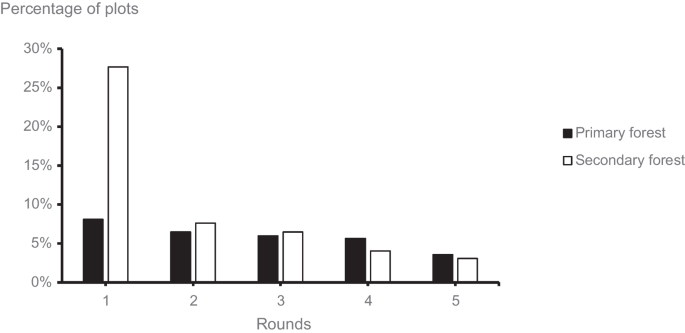
Percentage of primary and secondary forest plots removed compared to the total number of plots available to players at the beginning of the game, throughout all 20 game sessions with n = 103 players, per round.
Across all game sessions, the crops that were planted most often were annual crops (60% of the crops chosen by players) with maize being the crop planted the most often overall. Among perennials, timber (planted mostly with cacao) was the most popular choice, possibly because it could be combined with other perennials.
Crop choice varied widely across different rounds. Annual crops (especially maize) were planted most extensively during the first round, while perennial crops (especially cacao) and timber (for agroforestry) were planted in largest amounts during the second and third rounds, respectively. In round 4, maize was planted in much higher proportion than other crops, and in round 5, timber was chosen the most often (Figure 5).

Total number of plots planted with crops in CHAKRAS (CHoices in Amazonia for Knowledge and Research on Agricultural Systems) across all 20 games and per round.
These patterns of choice suggest a strong influence of external interventions, such as in the case of the NGO offering free agroforestry seedlings in round 2, the regional government offering cacao seedlings in round 3, and the private company offering free maize seeds in round 4. In round 5, the increase in timber plantations could be attributed to the fact that players sold the timber they had planted in round 2 and decided to repeat the experience by planting more.
Across all 20 game sessions, the external support most often chosen by players was that of the NGO. The second most popular support was that of the maize company, followed by the governmental project. When asked to choose between the carbon project, the papaya rental, or none, despite similar economic benefits, farmers strongly preferred the carbon project over papaya rental (Figure 6). During the debriefing discussions, farmers in favor of the carbon initiative tended to express environmental considerations: “We would not do it for money, it would be to be able to preserve forest and continue to breathe” (a farmer in session 8) while those who opposed it feared it would take away their right to continue farming (“If this becomes a reality, there wouldn’t be farmers anymore!” – a farmer in session 9). Overall, most farmers saw the carbon project as a desirable approach that would help them protect forests.
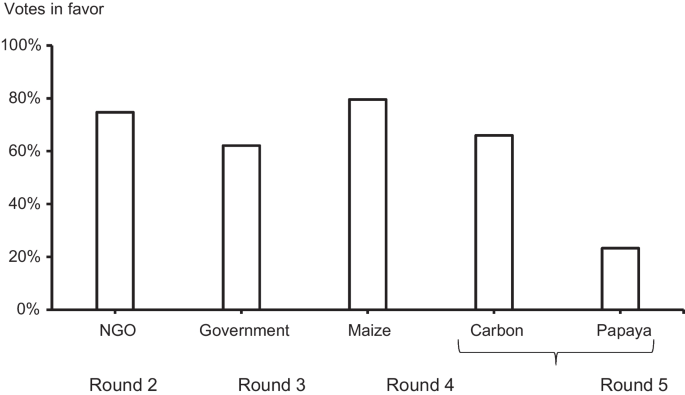
Percentage of players who voted in favor of various external interventions offered at the beginning of rounds. At the beginning of round 5 (far right), players had to choose between either carbon credits, papaya rental, or none.
In the case of the NGO support, players could choose to receive seedlings for either a cacao, copoazú, or citrus plot. Players mostly chose cacao (31%), followed by citrus (23%) and copoazú (17%).
3.3 Comparing player characteristics with decisions in the game
Farmers who played the game were mostly men (63%) of Andean origin (51%) and on average 43 years old. 72% of players reported farming to be their first activity in terms of income. Almost half (47%) were members of an association but only 17% were members of a cooperative (categorized as a support level 4, see Table 2). 61% reported having received support from a project in the last 5 years: 48% received support from a governmental project (support level 2, see Table 2) and 18% received support from an NGO (level 3, see Table 2).
Age had a mild but significant negative correlation with the number of annual crops planted, suggesting that younger players were more likely to choose annual over perennial crops (Table 5). This could be related to younger farmers’ need to produce quick returns on investment, as they may have limited resources to engage in longer-term investment for perennial plantations. During the debriefing, a player summarized it as follows: “In real life, we plant short-term crops first, and only later we plant pure long-term crops to avoid deforesting too much” (session 20). Players’ genders, regions of origin, and opinions about support programs were not significantly correlated with decisions in the game (Table 5).
The support level received by players in real life seemed to be the most important predictor for game strategy (Table 5). Farmers who were in favor of governmental support (round 2) and who voted for the carbon project over papaya land rental (round 5) were significantly more likely to have received higher levels of support (including NGO support and cooperative membership) in real life. Support level was also significantly related both to the amount of primary forest cleared (F(3, 92) = 4.40, p = 0.006) and to the amount borrowed in the game (F(3, 92) = 3.12, p = 0.030; n = 96 in both models, 7 players excluded for missing data) (Figure 7). Pairwise comparisons (Tukey’s HSD) showed that these overall effects were driven by particular groups rather than by a gradient across support levels. Players who were members of a cooperative cleared on average 1.30 fewer primary forest plots than players receiving no support (95% CI [0.35, 2.25], p = 0.003) and 1.01 fewer than players receiving governmental support (95% CI [0.06, 1.97], p = 0.033), the former amounting to roughly a fifth of the primary forest available to them; no other pair of support levels differed significantly. For borrowing, players receiving governmental support took out loans 4.70 coins larger than players receiving no support (95% CI [0.12, 9.29], p = 0.042), and no other pair differed significantly. A possible explanation for the latter is that AGROIDEAS, a program of the Ministry of Agriculture that many players were involved with, includes the granting of loans as a support strategy. Given the size of the support-level groups, these comparisons have limited power, and several non-significant differences of comparable magnitude (notably between cooperative members and NGO-supported players) should not be read as evidence of no difference.
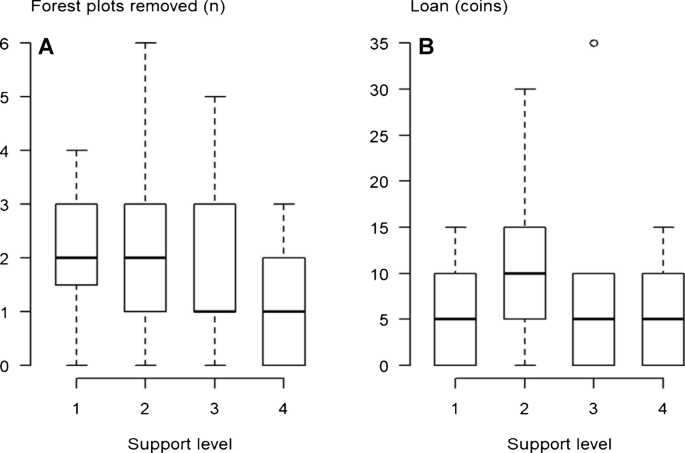
Relation between the support levels players receive in real life (1 = no support, 2 = governmental support only, 3 = NGO support, 4 = membership in a cooperative) and the number of forest plots players removed during the game (A), and the size of the loan taken out during the game (B). Support levels relate significantly to both variables.
Farmers’ preference for growing annual or perennial crops in real life was also significantly related to various of their decisions in the game. Players who mentioned a perennial crop as their main crop in real life planted fewer annual and more perennial crops in the game. Players who mentioned a higher proportion of perennial crops out of all the crops they mentioned growing in real life also voted more often in favor of governmental support in the game and were more likely to choose the carbon project over papaya. The proportion of perennial crops in real life was mildly negatively correlated with annual crop choice in the game and mildly positively correlated with perennial crop choice in the game (Table 5).
While in the game, all players managed the same farm size, real life farm sizes differed significantly between players. Farmers with larger cultivated lands in real life were more likely to be in favor of NGO support in the game. Interestingly, farmers who paid back their loan in the game also had a higher farm size on average. Finally, players who chose carbon (as a form of “land rental,” see Table 5, to receive carbon credits) had a much larger area of primary forest on their farms than players who chose papaya (11 ha of primary forest in real life versus 3,3 ha on average). Total land surface and secondary forest area in real life did not significantly affect players’ decisions in the game (Table 5).
Interestingly, farmers who, in real life, had formal land ownership (i.e., land title) planted more agroforestry in the game (2.1 plots on average) compared to farmers with unstable land tenure (i.e., rental or possession certificate) (1.3 plots on average) (p = 0.017).
3.4 Qualitative feedback on the game’s credibility, legitimacy, and salience
During most (all except one) postgame discussions, farmers reported that the game resembled their reality. For some farmers “nothing was missing” (session 1) in the game, while others specified the ways in which the game resembled their experience of farming. Farmers perceived the game to be a good representation of reality regarding the kinds of intervening institutions and programs represented (“The projects are the same in real life as in the game” (session 5), or, “NGOs are like this in real life, we have lived this!” (session 6), and it was said that the game represented well the economic difficulties faced in real life: “Profitability in the game is as in real life” (session 5), and “These five rounds, this is how we suffer. It is all work and investment” (session 11). The game represented very real struggles to pay back loans (“Loans are the same [in real life], most of us cannot pay them back. We cannot pay back because of high costs” session 11) or to hire labor (“[The game] represents reality in that people do not want to work because we pay them little and the work is hard. But if you harvest more than 3 or 4 hectares you need extra labor” session 9). Several players commented that they had, in real life too, lost parts of their crops to fire.
Players commented that their land-use decisions in the game resembled real life, for example by starting with planting annual crops and only later planting perennial crops. One player said, “The game is as in real life, each one played with the same ambitions as in real life, [some are] conformist and relaxed, others are more ambitious” (session 7). This expressed similarity between real-life choices and choices in the game confirms our findings of correlations between real-life crop choice and game crop choice (see section 3.3) and was further demonstrated in a per-session analysis of strategies: a community dedicated to cassava plantations in real life planted the most cassava out of all the game sessions (39 plots compared to 4 plots on average in other sessions). Game sessions with members of cacao cooperative board members resulted in a 1.5 times higher number of cacao plots compared to other sessions.
Players also commented on some important differences between the game and reality. The most important distinctions related to finances: loans are more difficult to receive in reality than in the game. A player explained: “To receive a loan, they ask you to be part of an association, you have to be registered” (session 5). In addition, the market is not as predictable as in the game, with many products (including bananas, citrus, and rice) suffering from recurring low seasonal demand. In general, prices go down when a lot of farmers are selling products at the same time, which typically happens right after maize harvesting season. One player commented: “In reality, our greatest problem is the market. Copoazú for example produces well, but they give you a low price for it” (session 14). Several players noted that, in reality, they mix various crops on a single plot, including successional systems that alternate maize or cassava, bananas, and cacao. Some players wished the game would also include livestock. Regarding external interventions, players had often had real-life experiences with NGOs, the regional government, and papaya farmers, but most had not heard about private companies offering maize seeds and knew of carbon projects only in theory. In general, players commented that they felt more supported by external institutions in the game than in real life: “If we had all the support of the game, including loans, we could have a better income” (session 18).
Overall, the CHAKRAS game was credible, based on a systemic analysis of the farming system; salient, through the representation of interventions that influence farmers in real life; and considered legitimate by the players, who perceived that the game aligned with their views. These findings directly address the challenge of designing interventions that align with smallholders’ realities, suggesting that participatory and context-sensitive representations of farming systems are critical for both understanding and influencing land-use decisions.
3.5 Implications for the use of serious games to investigate land use
One of the main issues noted elsewhere for serious games is a lack of clarity about the degree to which players’ decisions in the game can be extrapolated to their decisions in real life (Garcia and Speelman 2017; Jackson 2012). Previous agricultural studies using serious games have concluded, based on post-game discussions, that farmers’ decisions in the game do resemble those they make in life (see Castella et al. 2005; Fisher et al. 2012; Kong et al. 2021; Novotny et al. 2024; Speelman et al. 2014b). In this study, we have gone a step further by showing that farmers’ decisions in the game relate to their real-life conditions and choices, in ways not always visible while playing and not expressed orally during post-game conversations. By doing so, this study contributes to addressing the difficulty of empirically capturing complex, dynamic decision-making processes among smallholder farmers.
We argue that serious games, when designed in a way that mimics the local social-ecological system, lead stakeholders to make similar decisions to those they (think they) would make in real life. The feedback we received from players during the discussions, and the significant relations between players’ real-life and in-game decisions, may not have been possible without the meticulous design steps we took, including previous data collection (in this case field interviews) and thorough game testing efforts. Building a robust model of the social-ecological system of interest seems to be an important prerequisite for the successful use of a serious game to explore decision-making processes. As described by Garcia et al. (2022), a game that allows for accurate representation of decision-making should feel “real” to the players who interact with it.
We converge with previous studies (e.g., Alpuche Álvarez et al. 2024) in stating that one of the main strengths of serious games is the ability to reveal decision-making patterns that may not be observed or mentioned in traditional questionnaire-based research. We believe that serious games have the potential to enrich traditional research structures (often consisting in a lineal relationship between researcher and subject) by turning the researcher into an external observer, while the research subject interacts not with a scientist but rather with (a representation of) their own system (Speelman et al. 2017). By removing the researcher from the center of action, farmers can be freed from a sense of expectations and ideas about what they believe is expected from them. In return, researchers can gain new insight by watching what stakeholders do, rather than hearing what they have to say about it (Castella et al. 2005). In this sense, serious games respond directly to calls for more inclusive and participatory research methods that better capture the social and behavioral dimensions of land-use change.
3.6 Design choices and good practices for credible serious games
The credibility players attributed to the CHAKRAS game relies on a small number of design choices that we consider transferable. First, the components of the game were not selected by the research team but derived from farmers’ own representations, elicited through individual fuzzy cognitive mapping, and retained in proportion to how often they were mentioned (see Lagneaux et al. 2026 for the detailed process). This kept the game anchored in the players’ mental models rather than the designers’. This approach aligns with the companion modeling tradition, in which models are built from stakeholders’ own representations rather than imposed by researchers (Etienne et al. 2011; Speelman et al. 2014a). Second, we deliberately reduced complexity, cutting the number of components from 30 to 24 over six test rounds, on the principle that a game that is too complex is hard to learn and boring to play, and an unfinished game is not a credible one. Our approach corresponds to what Edmonds and Moss (2005) term a “keep it descriptive” strategy: we started with the full set of components described by farmers and simplified where testing showed the game became too dense (Edmonds and Moss 2005). Other land-use games report the same tension between representational fidelity and playability (Sari et al. 2024; Tanika et al. 2024). Third, we represented external interventions as generic actor types rather than named programs, which allowed players to recognize the mechanism and associate them with their lived experience (Castella et al. 2005; Garcia et al. 2022).
We believe that the physical transportability of the game was also a great asset that allowed us to carry it to the field and play it with many different types of farmers. Further, the fun experienced by players proved to be even more important than we had expected, and it should be an important consideration for future designers: having fun is what keeps players engaged, willing to recommend the experience to neighbors or friends, and it supports a livelier experience for both players and researchers (Crookall 2010).
There are some things that, based on our gained experience, we would now do differently. Players noted that they intercrop on a single plot, whereas our game allowed only one land use per plot; that market prices fluctuate with season and product, whereas ours were fixed; and that livestock, which we excluded to limit complexity, is part of many farming systems. For designers, the practical lesson is to record such simplifications explicitly at the design stage and to treat them as the game’s acknowledged limits. Galizzi and Navarro-Martinez (2019) found that general, context-free social preference games explain field behavior poorly. Our contrasting results suggest the importance of good design: the closer a game’s content stays to the players’ own system, the more likely it is that results relate to real life.
4 Conclusion
In this study, we set out to examine the degree to which decisions made by farmers in a serious game setting relate to real-life decisions. We designed the CHAKRAS game based on an analysis of the farming system in Madre de Dios, the Peruvian Amazon, and assessed its credibility, salience, and legitimacy through multiple game sessions with farmers. We showed that the game, made credible through a meticulous design process, and salient through the representation of institutional interventions, was recognized by farmers as a legitimate representation of their realities. Our results further demonstrate this by showing that the decisions farmers make while playing the CHAKRAS game related to the type of institutional support they receive and the crops they plant in real life: cooperative members cleared less primary forest in the game, and farmers receiving governmental support borrowed more. In addition, farmers’ crop choice in the game was related to the support programs represented in the game, including those of an NGO, the government, and a private company. Considering the current expansion of the agricultural frontier in Madre de Dios, and the observed influence of external interventions on farmers’ decisions, we argue that actors and policies involved in the design of such interventions will play a key role in the future of Amazonian people and forests. Novel approaches to rural interventions are needed, based on innovative scientific methods. We conclude that serious games, like the one developed for this study, are useful for simulating the influences of interventions on farmers’ decision-making processes, particularly because farmers’ decisions and preferences in the game resemble their decisions in real life. As serious games show potential for application in intervention design, for example by testing the adoption of future interventions through play with farmers or to train extensionists by having them play the role of farmers, they may also support the co-design of more context-appropriate and adaptive land-use strategies that better align with smallholders’ realities. The design steps we describe (deriving components from farmers’ own cognitive maps, simplifying iteratively through testing, and declaring the simplifications made) offer a starting point for others aiming to build credible games in other contexts. Future research could explore the social learning outcomes of serious games, for example the influence of playing the CHAKRAS game on farmers’ opinions, which are themselves likely to inform real-life decisions.
Data availability
The datasets generated during and/or analyzed during the current study are available in the DANS Data Station Life Sciences repository, under https://doi.org/10.17026/LS/Y92GKQ and https://doi.org/10.17026/LS/NDB8RL (Lagneaux 2025b, 2025a).
Code availability
Not applicable
References
Alpuche Álvarez YA, Jepsen MR, Müller D et al (2024) Unraveling the complexity of land use change and path dependency in agri-environmental schemes for small farmers: a serious game approach. Land Use Policy 139:107067. https://doi.org/10.1016/j.landusepol.2024.107067
Barreteau O, Abrami G, Bonté B et al (2021) Serious games. In: Biggs R, de Vos A, Preiser R et al (eds) The Routledge handbook of research methods for social-ecological systems. Routledge, New York, pp 176–188. https://doi.org/10.4324/9781003021339. (ISBN 978-0-367-89840-3)
BCRP (2023) Madre de Dios: síntesis de actividad económica febrero 2023. Banco Central de Reserva del Perú, Departamento de Estudios Económicos, Lima. https://www.bcrp.gob.pe/docs/Sucursales/Cusco/2023/sintesis-madre-de-dios-02-2023.pdf. Accessed 28 Aug 2024
Bosma RH, Ha TTP, Hiep TQ et al (2020) Changing opinion, knowledge, skill and behaviour of Vietnamese shrimp farmers by using serious board games. J Agric Educ Ext 26:203–221. https://doi.org/10.1080/1389224X.2019.1671205
Cash D, Clark WC, Alcock F et al (2002) Salience, credibility, legitimacy and boundaries: linking research, assessment and decision making. KSG Faculty Research Working Paper Series RWP02-046. John F Kennedy School of Government, Harvard University, Cambridge. https://doi.org/10.2139/ssrn.372280
Castella J-C, Trung TN, Boissau S (2005) Participatory simulation of land-use changes in the northern mountains of Vietnam: the combined use of an agent-based model, a role-playing game, and a geographic information system. Ecol Soc 10:27. https://doi.org/10.5751/ES-01328-100127
Chavez A, Guariguata MR, Cronkleton P et al (2012) Superposición espacial en la zonificación de bosques en Madre de Dios: implicaciones para la sostenibilidad del recurso castañero. Center for International Forestry Research (CIFOR), Bogor. https://doi.org/10.17528/cifor/004034
ComexPerú (2023) Producción agropecuaria retrocedió un 14.2% en abril. Sociedad de Comercio Exterior del Perú, Lima. https://www.comexperu.org.pe/articulo/produccion-agropecuaria-retrocedio-un-142-en-abril. Accessed 28 Aug 2024
Crookall D (2010) Serious games, debriefing, and simulation/gaming as a discipline. Simul Gaming 41:898–920. https://doi.org/10.1177/1046878110390784
Dahdouh-Guebas F, Mafaziya Nijamdeen TWGF, Hugé J et al (2022) The Mangal Play: a serious game to experience multi-stakeholder decision-making in complex mangrove social-ecological systems. Front Mar Sci 9:909793. https://doi.org/10.3389/fmars.2022.909793
Dewi S, Van Noordwijk M, Zulkarnain MT et al (2017) Tropical forest-transition landscapes: a portfolio for studying people, tree crops and agro-ecological change in context. Int J Biodivers Sci Ecosyst Serv Manag 13:312–329. https://doi.org/10.1080/21513732.2017.1360394
DRAMDD (2022) Superficie cosechada de los principales cultivos (ha) año 2022. Dirección Regional de Agricultura de Madre de Dios, Puerto Maldonado. https://www.dramdd.gob.pe/informacion-agricola/. Accessed 28 Aug 2024
Edmonds B, Moss S (2005) From KISS to KIDS — an ‘anti-simplistic’ modelling approach. In: Davidsson P, Logan B, Takadama K (eds) Multi-agent and multi-agent-based simulation, vol vol 3415. Springer, Berlin, p pp 130-144. https://doi.org/10.1007/978-3-540-32243-6_11
Etienne M, Du Toit DR, Pollard S (2011) ARDI: a co-construction method for participatory modeling in natural resources management. Ecol Soc 16:44. https://doi.org/10.5751/ES-03748-160144
Fisher J, Farré I, Dray A et al (2012) Serious games to explore uncertainty of future farms. In: Proceedings of the 16th Australian Agronomy Conference, 14–18 October 2012. https://www.agronomyaustraliaproceedings.org/images/sampledata/2012/8191_4_fisherj-serious-games-to-play.pdf. Accessed 28 Aug 2024
Galizzi MM, Navarro-Martinez D (2019) On the external validity of social preference games: a systematic lab-field study. Manag Sci 65:976–1002. https://doi.org/10.1287/mnsc.2017.2908
Garcia C, Speelman EN (2017) Landscape approaches, wicked problems and role playing games. ForDev Working Paper 01. Tropenbos International ComMod Workshop. https://www.researchgate.net/profile/Claude-Garcia/publication/320170969_Landscape_Approaches_Wicked_Problems_and_Role_Playing_Games/links/59d26d02aca2721f4369ac08/Landscape-Approaches-Wicked-Problems-and-Role-Playing-Games.pdf. Accessed 28 Aug 2024
Garcia CA, Savilaakso S, Verburg RW et al (2020) The global forest transition as a human affair. One Earth 2:417–428. https://doi.org/10.1016/j.oneear.2020.05.002
Garcia CA, Savilaakso S, Verburg RW et al (2022) Strategy games to improve environmental policymaking. Nat Sustain 5:464–471. https://doi.org/10.1038/s41893-022-00881-0
Gatti LV, Basso LS, Miller JB et al (2021) Amazonia as a carbon source linked to deforestation and climate change. Nature 595:388–393. https://doi.org/10.1038/s41586-021-03629-6
Githinji M, van Noordwijk M, Muthuri C et al (2023) Farmer land-use decision-making from an instrumental and relational perspective. Curr Opin Environ Sustain 63:101303. https://doi.org/10.1016/j.cosust.2023.101303
Githinji M, van Noordwijk M, Muthuri C et al (2024) “You never farm alone”: farmer land-use decisions influenced by social relations. J Rural Stud 108:103284. https://doi.org/10.1016/j.jrurstud.2024.103284
Global Forest Watch (2024) Madre de Dios, Peru deforestation rates and statistics. https://www.globalforestwatch.org/dashboards/country/PER/18?category=forest-change. Accessed 17 June 2024
INEI (2013) Resultados definitivos. IV Censo Nacional Agropecuario 2012. Instituto Nacional de Estadística e Informática, Lima. https://www.gob.pe/institucion/inei/informes-publicaciones/3920618-resultados-definitivos-censo-nacional-agropecuario-2012. Accessed 17 June 2024
INEI (2018) Censos 2017: en Madre de Dios viven 141 070 personas. Instituto Nacional de Estadística e Informática, Lima. https://censo2017.inei.gob.pe/censos-2017-en-madre-de-dios-viven-141-070-personas/. Accessed 17 June 2024
INEI (2019) Evolución de los indicadores de empleo e ingresos por departamento, 2007–2018. Instituto Nacional de Estadística e Informática, Lima. https://www.inei.gob.pe/media/MenuRecursivo/publicaciones_digitales/Est/Lib1537/libro.pdf. Accessed 17 June 2024
Jackson C (2012) Internal and external validity in experimental games: a social reality check. Eur J Dev Res 24:71–88. https://doi.org/10.1057/ejdr.2011.47
Jones G (1997) Chapter 1—the history, development, and future of agricultural extension. In: Swanson BE, Bentz RP, Sofranko AJ (eds) Improving agricultural extension: a reference manual. Food and Agriculture Organization of the United Nations, Rome. https://www.fao.org/4/W5830E/w5830e00.htm. Accessed 17 June 2024
Kong R, Castella J-C, Suos V et al (2021) Investigating farmers’ decision-making in adoption of conservation agriculture in the northwestern uplands of Cambodia. Land Use Policy 105:105404. https://doi.org/10.1016/j.landusepol.2021.105404
Lagneaux EG (2025a) Individual fuzzy-cognitive mapping surveys with smallholder farmers in Madre de Dios, Peru. DANS Data Station Life Sciences. https://doi.org/10.17026/LS/NDB8RL
Lagneaux EG (2025b) Serious game data on land use among smallholder farmers in Madre de Dios, Peru. DANS Data Station Life Sciences. https://doi.org/10.17026/LS/Y92GKQ
Lagneaux EG, Callo-Concha D, Speelman EN et al (2024a) Panarchy to explore land use: a historical case study from the Peruvian Amazon. Sustain Sci. https://doi.org/10.1007/s11625-024-01502-9
Lagneaux EG, Descheemaeker K, Speelman EN et al (2026) Farming systems in the Peruvian Amazon: a fuzzy cognitive mapping study on the impact of interventions. Agric Syst 234:104682. https://doi.org/10.1016/j.agsy.2026.104682
Lagneaux EG, Quaedvlieg J, Sabogal D et al (2024b) Understanding the diversity of private conservation in the Peruvian Amazon. Conserv Sci Pract 6:e13228. https://doi.org/10.1111/csp2.13228
Moore T (2019) Deforestation in Madre de Dios, its implications for first peoples. In: Chirif A (ed) Deforestation in times of climate change. IWGIA, Copenhagen, p 201 (ISBN 978-87-92786-95-1). https://www.academia.edu/download/89023256/Peru_Deforestation_in_Times_of_Climate_Change_Dec_2019.pdf. Accessed 17 June 2024
Nicolau AP, Herndon K, Flores-Anderson A et al (2019) A spatial pattern analysis of forest loss in the Madre de Dios region, Peru. Environ Res Lett 14:124045. https://doi.org/10.1088/1748-9326/ab57c3
Novotny IP, Boul Lefeuvre N, Attiogbé KS et al (2024) Exploring farmer choices in southern Togo: utilizing a strategy game to understand decision-making in agricultural practices. Agric Syst 218:103960. https://doi.org/10.1016/j.agsy.2024.103960
Özesmi U, Özesmi SL (2004) Ecological models based on people’s knowledge: a multi-step fuzzy cognitive mapping approach. Ecol Model 176:43–64. https://doi.org/10.1016/j.ecolmodel.2003.10.027
Pena Alegria PG (2025) Property, community and the making of an agricultural frontier of the Peruvian Amazon. PhD dissertation, University of Oxford, UK. https://ora.ox.ac.uk/objects/uuid:ba0e5319-cce7-493a-9711-ba0319289041. Accessed 28 Aug 2024
Peña Valdeiglesia J, Alegre Orihuela JC (2017) Tipificación de prototipos de sistemas de producción agroforestal en la provincia de Tambopata, Madre de Dios. Aporte Santiaguino. https://doi.org/10.32911/as.2017.v10.n2.166
PNCBMCC (2021) Cobertura y pérdida de bosque húmedo amazónico 2021. Ministerio del Ambiente (MINAM), Lima. https://geobosques.minam.gob.pe/geobosque/descargas_geobosque/perdida/documentos/Reporte_Cobertura_y_Perdida_de_Bosque_Humedo_Amazonico_2021.pdf. Accessed 28 Aug 2024
Pokorny B (2013) Smallholders, forest management and rural development in the Amazon. Routledge, London. https://doi.org/10.4324/9780203073919. (ISBN978-0-203-07391-9)
Pokorny B, Cayres G, Nunes W (2005) Participatory extension as basis for the work of rural extension services in the Amazon. Agric Hum Values 22:435–450. https://doi.org/10.1007/s10460-005-3398-4
Pokorny B, de Jong W, Godar J et al (2013) From large to small: reorienting rural development policies in response to climate change, food security and poverty. Forest Policy Econ 36:52–59. https://doi.org/10.1016/j.forpol.2013.02.009
Pokorny B, Robiglio V, Reyes M et al (2021) The potential of agroforestry concessions to stabilize Amazonian forest frontiers: a case study on the economic and environmental robustness of informally settled small-scale cocoa farmers in Peru. Land Use Policy 102:105242. https://doi.org/10.1016/j.landusepol.2020.105242
Qu X, Li X, Bardgett RD et al (2024) Deforestation impacts soil biodiversity and ecosystem services worldwide. Proc Natl Acad Sci U S A 121:e2318475121. https://doi.org/10.1073/pnas.2318475121
R Core Team (2023) R: a language and environment for statistical computing. R Foundation for Statistical Computing, Vienna. https://www.R-project.org/. Accessed 28 Aug 2024
Rizzo G, Migliore G, Schifani G et al (2024) Key factors influencing farmers’ adoption of sustainable innovations: a systematic literature review and research agenda. Org Agric 14:57–84. https://doi.org/10.1007/s13165-023-00440-7
Rodela R, Speelman EN (2023) Serious games in natural resource management: steps toward assessment of their contextualized impacts. Curr Opin Environ Sustain 65:101375. https://doi.org/10.1016/j.cosust.2023.101375
RStudio Team (2023) RStudio: integrated development environment for R, version 2023.03.1. Posit Software PBC, Boston. https://posit.co. Accessed 28 Aug 2024
Ryschawy J, Grillot M, Charmeau A et al (2022) A participatory approach based on the serious game Dynamix to co-design scenarios of crop-livestock integration among farms. Agric Syst 201:103414. https://doi.org/10.1016/j.agsy.2022.103414
Sabogal C, de Jong W, Pokorny B et al (2008) Manejo forestal comunitario en América Latina: experiencias, lecciones aprendidas y retos para el futuro. Centro Agronómico Tropical de Investigación y Enseñanza (CATIE), Turrialba (ISBN 978-979-1412-73-5 ). https://repositorio.catie.ac.cr/handle/11554/2970. Accessed 28 Aug 2024
Sari RR, Tanika L, Speelman EN et al (2024) Farmer options and risks in complex ecological-social systems: the FORCES game designed for agroforestry management of upper watersheds. Agric Syst 213:103782. https://doi.org/10.1016/j.agsy.2023.103782
Speelman EN, García-Barrios LE, Groot JCJ et al (2014a) Gaming for smallholder participation in the design of more sustainable agricultural landscapes. Agric Syst 126:62–75. https://doi.org/10.1016/j.agsy.2013.09.002
Speelman EN, Groot JCJ, García-Barrios LE et al (2014b) From coping to adaptation to economic and institutional change – trajectories of change in land-use management and social organization in a Biosphere Reserve community, Mexico. Land Use Policy 41:31–44. https://doi.org/10.1016/j.landusepol.2014.04.014
Speelman EN, Van Noordwijk M, Garcia C (2017) Gaming to better manage complex natural resource landscapes. In: Namirembe S, Leimona B, Van Noordwijk M et al (eds) Co-investment in ecosystem services: global lessons from payment and incentive schemes. World Agroforestry Centre, Nairobi
Tanika L, Sari RR, Hakim AL et al (2024) The H2Ours game to explore water use, resources and sustainability: connecting issues in two landscapes in Indonesia. Hydrol Earth Syst Sci 28:3807–3835. https://doi.org/10.5194/hess-28-3807-2024
Van Noordwijk M, Speelman E, Hofstede GJ et al (2020) Sustainable agroforestry landscape management: changing the game. Land 9:243. https://doi.org/10.3390/land9080243
Wamucii CN, van Oel PR, Teuling AJ et al (2024) Guiding community discussions on human–water challenges by serious gaming in the upper Ewaso Ngiro River basin, Kenya. Hydrol Earth Syst Sci 28:3495–3518. https://doi.org/10.5194/hess-28-3495-2024
Wilkinson P (2016) A brief history of serious games. In: Dörner R, Göbel S, Kickmeier-Rust M et al (eds) Entertainment computing and serious games. Lecture notes in computer science, vol 9970. Springer, Cham, pp 17–41. https://doi.org/10.1007/978-3-319-46152-6_2. (ISBN 978-3-319-46152-6)
Acknowledgements
Authors acknowledge all the farmers who have participated in this study. We also thank the participants of the six game trial sessions carried out in Puerto Maldonado. We are especially grateful to the many individuals who have helped us contact farmers, including Percy Rojas and Yesmi Hualla Zevallos, and the local institutions who have facilitated various game sessions, namely RONAP, AIDER, the AGROBOSQUE cooperative, and Camino Verde Tambopata. Special thanks to Elisabeth Cuadros Bolaños, Armando Ferensk Vega Lopez, Jhon Farfán Ccama, and Leo Mougel for their assistance and support in carrying out interviews, organizing fieldwork, and facilitating the game sessions. We thank Robin Van Loon for his valuable assistance with language editing.
Funding
This study was funded by the SESAM program of Wageningen University (INREF) and the Foundation of German Business (SDW, Stiftung der Deutschen Wirtschaft).
Author information
Authors and Affiliations
Contributions
Conceptualization: E.L., E.S., K.D., and D.C-C.; methodology: E.L. and E.S.; investigation: E.L. and T.A.; writing—original draft: E.L.; writing—review and editing: E.L., E.S., K.D., D.C-C., and T.A.; funding acquisition: E.S. and E.L.; supervision: E.S., K.D., and D.C-C.
Corresponding author
Ethics declarations
Ethics approval
This study was approved by the Research Ethics Committee for review of nonmedical studies of Wageningen University & Research (WUR-REC). The study was performed in accordance with the ethical standards as laid down in the 1964 Declaration of Helsinki and its later amendments.
Consent to participate
Verbal informed consent was obtained from all individual participants included in the study. The participants’ data were anonymized after all game sessions were carried out.
Consent for publication
The authors affirm that research participants provided informed consent for publication of anonymized data.
Conflict of interest
The authors declare no competing interests.
Additional information
Publisher's Note
Springer Nature remains neutral with regard to jurisdictional claims in published maps and institutional affiliations.
Supplementary information
Below is the link to the electronic supplementary material.
ESM 1 (download DOCX )
(DOCX 946 KB)
Rights and permissions
This article is published under an open access license. Please check the 'Copyright Information' section either on this page or in the PDF for details of this license and what re-use is permitted. If your intended use exceeds what is permitted by the license or if you are unable to locate the licence and re-use information, please contact the Rights and Permissions team.
About this article

Cite this article
Lagneaux, E.G., Abdala, T., Descheemaeker, K. et al. Linking serious game decisions to real-world farmer land use: a case study from the Peruvian Amazon. Agron. Sustain. Dev. 46, 76 (2026). https://doi.org/10.1007/s13593-026-01147-1
Received:
Accepted:
Published:
Version of record:
DOI: https://doi.org/10.1007/s13593-026-01147-1