


Abstract
Lactic acid (LA) is a versatile platform chemical widely used in food, pharmaceutical, and biodegradable plastic industries. While industrial LA production predominantly relies on fermentation, the chemo-catalytic conversion of renewable biomass-especially non-edible lignocellulosic feedstocks-has emerged as a promising alternative due to its potential for higher efficiency, lower environmental impact, and reduced competition with food resources. This review systematically summarizes recent advances in the chemo-catalytic production of lactic acid from biomass-derived sugars, glycerol, and real biomass (e.g., cellulose, straw). The catalytic systems are categorized into three main types: alkaline catalysis (including homogeneous and heterogeneous bases), acid catalysis (focusing on Lewis acid zeolites, metal oxides, and rare-earth catalysts), and emerging photocatalytic approaches. Key reaction pathways, catalyst design strategies, and the roles of active sites are discussed in detail. A comparative analysis of catalytic performance under various conditions is presented, along with a critical evaluation of challenges such as catalyst stability, product separation, and scalability. Finally, future directions for the development of sustainable and industrially viable LA production processes are proposed.
1 Introduction
The depletion of fossil fuel reserves, escalating energy demands, and growing environmental concerns have spurred significant interest in the development of renewable and sustainable resources. Biomass, as a plentiful and carbon-neutral resource, presents a promising alternative for the production of fuels, chemicals, and materials. Lactic acid (LA, 2-hydroxypropionic acid) is a key platform chemical derived from biomass, extensively utilized in the food, pharmaceutical, and cosmetic sectors [1,2,3,4]. Moreover, as the monomer for polylactic acid (PLA), a biodegradable polymer, LA plays a pivotal role in the field of green materials, addressing the global challenge of plastic pollution [5,6,7,8,9].
Industrial LA production is currently dominated by biological fermentation, which offers high product purity [10, 11]. However, this process is not without its drawbacks. Fermentation is often costly, time-consuming, and requires strict pH control and complex downstream purification steps. More importantly, it typically relies on edible feedstocks such as glucose, sucrose, and starch, leading to competition with food supply and raising ethical concerns [6, 7]. The raw material cost alone can account for over 34% of the total production cost [12].
To overcome these limitations, chemo-catalytic conversion of biomass to LA has emerged as a highly attractive alternative [12, 13]. This approach offers several potential advantages, including higher reaction rates, greater selectivity, and the ability to utilize non-edible, abundant lignocellulosic biomass (e.g., agricultural residues like straw and corn stover) as feedstock. By circumventing the need for costly enzymatic hydrolysis or pretreatment steps required in fermentation, chemical catalysis can significantly reduce production costs [12]. The past two decades have witnessed a paradigm shift towards chemo-catalytic routes, driven by the need for higher efficiency and feedstock flexibility. While early chemical catalysts focused on model substrates like glucose, recent advancements have expanded the feedstock scope to include crude glycerol and complex lignocellulosic biomass (e.g., straw, wood).
The productivity varies significantly with the feedstock, depending critically on molecular structure, crystallinity, and impurity content. Six-carbon aldoses (e.g., glucose) typically afford LA yields exceeding 70% (up to 97% under optimized acid-catalyzed conditions), but their overall conversion is kinetically limited by the mandatory initial isomerization to fructose. In contrast, fructose, being a ketose, bypasses this isomerization step and directly undergoes retro-aldol cleavage to C3 triose intermediates, thereby often achieving higher yields than glucose under otherwise identical conditions. Xylose, a five-carbon sugar, gives comparable or slightly lower yields (typically 60–95%) because its retro-aldol cleavage unavoidably produces C2 fragments (glycolic acid or formic acid) alongside the C3 lactic acid precursor, inherently limiting the maximum LA selectivity. Glycerol, a C3 platform molecule derived from biodiesel production, can be selectively converted to LA with yields as high as 80–96% over noble-metal or Cu-based catalysts, owing to its simpler structure and fewer side reactions compared to saccharides. Cellulose, despite its abundance as a renewable carbon source, affords only moderate yields (typically 20–70%) due to its highly crystalline structure, which requires both efficient hydrolysis of glycosidic bonds and subsequent cleavage of C–C bonds under compatible conditions. Raw lignocellulosic biomass (e.g., straw, corn stover, rice husk) presents the greatest challenge, typically yielding less than 50% LA, primarily because the recalcitrant lignin matrix impedes catalyst access to carbohydrates, while ash and extractives poison active sites and hinder mass transfer. Real biomass wastes (e.g., food waste, spent coffee grounds, sugarcane bagasse) exhibit highly variable yields (ranging from approximately 14% to 73%) depending on the feedstock composition, pretreatment severity, and catalyst compatibility. Overall, the productivity trend across feedstocks generally follows the order: C6 ketoses (fructose) ≈ glucose > glycerol > xylose > cellulose > raw lignocellulose, underscoring that substrate accessibility and inhibitor content are the dominant factors governing LA yield. Representative catalytic performances are systematically compared in Tables 1, 2 and 3 and discussed in detail in Sect. 2.1–2.3. These tables include both model sugar substrates (glucose, fructose, xylose), which are essential for mechanistic understanding and catalyst benchmarking, and real non-edible biomass feedstocks (cellulose, straw, corn cobs, bread residues, spent coffee grounds, etc.), which demonstrate the practical potential of chemo-catalytic routes for valorizing waste and lignocellulosic materials without competing with food supply.
Beyond traditional thermochemical and biochemical routes, emerging green catalytic strategies—particularly photocatalysis and photothermal catalysis—have recently garnered significant attention for biomass valorization. Photocatalysis utilizes solar energy to drive chemical transformations under mild conditions, offering a sustainable alternative to energy-intensive thermal processes. However, conventional photocatalysis often suffers from low quantum efficiency and slow reaction rates, limiting its practical application. Photothermal catalysis, which synergistically combines photochemical and thermal effects, has emerged as a promising solution to these limitations. By converting absorbed light into localized heat at the catalyst surface, photothermal systems can achieve reaction temperatures far exceeding the bulk solution temperature, enabling rapid and efficient conversions under ambient conditions [13]. This localized heating effect not only accelerates reaction kinetics but also facilitates the removal of reaction products (e.g., water in esterification reactions), thereby shifting the thermodynamic equilibrium toward product formation [14]. Recent advances have demonstrated the remarkable potential of photothermal catalysis for biodiesel production from various feedstocks. For instance, Huang et al. developed a biomass-derived SO₃H-functionalized graphene-like photothermal catalyst (S-NGL-600) that achieved 96.8% biodiesel yield from microalgae lipids at room temperature (25 °C) under light irradiation (λ = 300–2500 nm, 1.2 kW·m⁻², 60 min), with life cycle assessment revealing significant energy savings (0.87 MJ/MJ) and negative carbon emissions (− 89.42 kg CO₂eq/MJ) [14]. In another study, the same group reported a photothermal catalyst comprising neighboring potassium single atoms anchored on graphene-like biomaterial, which enabled 99.6% biodiesel yield from various acidic oils at room temperature (30 °C, λ > 400 nm, 2 h) with a net negative CO₂ emission of − 10.8 kg CO₂eq/kg [13]. More recently, adjacent Cs single atoms on graphene-like supports were shown to catalyze the one-step conversion of high-acid-value non-edible oils to biodiesel (> 97% yield) within 37 min under solar irradiation (1.5 AM, 100 mW·cm⁻²), with the pyroelectric effect of adjacent single-atom sites further enhancing the catalyst basicity [15]. These studies collectively underscore the transformative potential of photothermal catalysis for sustainable biofuel production under mild conditions.
In parallel with catalyst development, life cycle assessment (LCA) has become an indispensable tool for evaluating the true environmental sustainability of biomass conversion processes. While catalytic performance metrics such as yield and selectivity are essential for laboratory-scale evaluation, they do not necessarily translate to industrial viability without considering the full environmental footprint—including feedstock cultivation, catalyst production, energy consumption, waste generation, and product purification. LCA provides a holistic framework to quantify key environmental impact categories such as global warming potential (GWP) and fossil resource depletion, enabling fair comparisons between different production routes and identifying hotspots for improvement [13, 14]. As demonstrated in the aforementioned photothermal biodiesel studies, LCA has revealed that photothermal catalytic processes can achieve net negative carbon emissions, primarily due to the carbon credit associated with biomass feedstock uptake during growth, while electricity consumption during conversion remains the dominant contributor to overall emissions [16]. The integration of LCA into early-stage catalyst and process design is therefore critical for guiding the development of truly sustainable biomass valorization technologies and facilitating their transition from laboratory innovation to industrial application.
Recent advances in photocatalytic systems have demonstrated remarkable potential for LA production under mild conditions. Cao et al. developed an N-TiO₂ photothermal catalyst enabling up to 98.9% LA yield from sugars at 60 °C within 30 min [17]. Huang et al. constructed a highly crystalline carbon nitride (HC-CN) with structural oxygen, achieving 94.3% LA yield from glucose at room temperature within 50 min under full-spectrum light [18]. Liu et al. reported a triazole-modified carbon nitride photocatalyst (C-CNN) that delivered 85.5–98.3% LA yields from various sugars at room temperature with 98.6% selectivity [19]. Li et al. developed a fluorine-doped carbon nitride (F-CN) featuring frustrated Lewis acid-base pairs, achieving 94.8% LA yield from xylose at 40 °C [20]. These emerging photothermal and photocatalytic strategies, which will be critically discussed in Sect. 2.3, highlight the growing potential for sustainable LA production under ambient conditions.
This review aims to provide a comprehensive and systematic overview of the state-of-the-art in the chemo-catalytic production of lactic acid from biomass. We will focus on three primary catalytic pathways: base catalysis, acid catalysis, and photocatalysis. For each approach, we will delve into the reaction mechanisms, catalyst development, and the influence of key process parameters. By critically evaluating the advantages and limitations of each method, this review seeks to identify the key challenges and promising future directions for the sustainable and economically viable production of lactic acid, thereby contributing to the advancement of biomass valorization technologies.
1.1 Historical development of lactic acid production
To provide a concise visual overview of the long and rich history of lactic acid production, Fig. 1 summarizes the key milestones from its discovery in 1780 to the present day. The timeline highlights three distinct phases: the early foundational discoveries (1780–1895), the industrial fermentation era (1881–1990 s), and the recent chemo-catalytic revolution (2000s–present). This schematic representation helps readers to quickly grasp the chronological progression and the paradigm shifts that have shaped the current landscape of LA production, setting the stage for the detailed discussion of each catalytic approach in the following sections.

Historical timeline of lactic acid production (1780–present), highlighting key discoveries, industrial milestones, and the emergence of chemo-catalytic routes
2 Chemocatalytic production of lactic acid
This unified reaction network (Scheme 1) will serve as a reference framework throughout Sect. 2. For each catalytic route—alkaline, acid, and photocatalytic—we will discuss which elementary step is rate-limiting and how the catalyst’s active sites (Brønsted acid, Lewis acid, or basic sites) promote or inhibit each transformation.
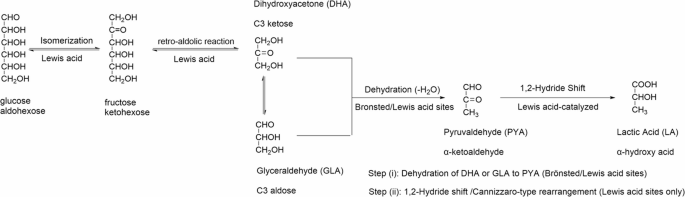
Proposed reaction network for the chemocatalytic conversion of hexoses (e.g., glucose, fructose) and to lactic acid (LA) via the key C3 intermediates (dihydroxyacetone, DHA; glyceraldehyde, GLA) and pyruvaldehyde (PYA)
2.1 Base catalysis
2.1.1 Homogeneous base catalysis
In recent years, there have been few studies on the use of basic catalysts for non-edible biomass, and most of them focus on the conversion of glycerol. In terms of catalytic oxidation of glycerol, the most commonly studied catalytic activity for the preparation of lactic acid involves the use of solid catalysts to oxidize glycerol in water-based alkaline systems, where precious metals such as Pt, Au, and Pd are widely used as active substances, and some inexpensive copper-based catalysts also show catalytic efficiencies comparable to those of precious metal catalysts. In addition to metal catalysts, some studies have shown that bases are necessary and play a key role in glycerol conversion. This method is also an effective alternative to the traditional fermentation route, especially for control selectivity [21]. In the presence of a base system, OH− can react with H+, so that the ionization equilibrium moves to the positive side, thus promoting the oxidative dehydrogenation of glycerol and enhancing the adsorption of metal sites [22]. However, the catalytic performance of sodium carbonate is not satisfactory, and the separation and recovery of homogeneous catalysts are often challenging, resulting in higher reaction costs [23]. Therefore, homogeneous catalysts suffer from inherent limitations, and the importance of heterogeneous catalysts cannot be overstated.
In terms of catalyst support, activated carbon is one of the most common choices. Marques studied the Pd/C catalyst during the conversion of glycerol to lactic acid [24]. It was found that the solid nanoparticles were well dispersed on the functionalized activated carbon. The catalyst showed a glycerol conversion rate of 99% and lactate selectivity of 46% at 230℃, its selectivity was not high, and most of it was converted to other substances. Then Zhang studied the treatment of glycerol in an alkaline aqueous solution in the presence of Pt/AC and PT-Cu /C catalysts to prepare lactic acid as the main product [25, 26]. The catalytic effect of LiOH on the conversion of glycerol to LA was stronger than that of other bases such as NaOH, KOH, and Ba(OH)2. It was found that under the optimal LiOH/ glycerol molar ratio, lactic acid could obtain the highest yield of 69%, the catalyst was stable, and no significant deactivation was found after five times recovery. Shen et al. studied the effects of 8 alkali metal and alkaline earth metal hydroxides on the hydrothermal conversion of glycerol and found that NaOH/KOH showed similar activity, which was much higher than other hydroxides [27]. Therefore, NaOH/KOH is commonly used as a high-concentration initiator to enable glycerol to produce a satisfactory LA yield. Some typical studies are used with supported metals. For example, Zhang et al. developed a BiOBr/Znₓ@SnO₂₋ₙ photocatalyst with Zn-doped SnO₂ loaded on BiOBr, achieving 79.6% lactic acid yield from fructose under alkaline conditions and maintaining 70.7% activity after five cycles, demonstrating good stability [28]. Recent studies have demonstrated that the catalytic performance of Cu-based systems can be significantly enhanced through rational support selection, metal doping, and heterojunction construction. For instance Moreira et al. investigated 20 wt% CuO supported on Al₂O₃, ZnO, and MgO in a continuous flow system at 240 °C and 35 atm, achieving 83–95% glycerol conversion with 76–86% LA yield; Cu/ZnO and Cu/MgO exhibited excellent stability over 30 h without deactivation. Notably, recent studies on Cu-based catalysts have demonstrated enhanced stability through proper support design [29]. Yang et al. developed a ZrO₂-supported CuO catalyst with an optimal Cu loading of 30 wt% (30% CuO/ZrO₂, prepared by deposition-precipitation), achieving 100% glycerol conversion and 94.6% LA selectivity at 453 K under N₂ with NaOH/glycerol = 1:1. However, reusability tests over three cycles showed significant deactivation (conversion: 59.1% to 24.1%), with AAS analysis confirming no Cu leaching, suggesting deactivation was mainly due to CuO particle aggregation rather than metal loss [30]. For instance, Tan et al. developed CuₓO (Cu₂O/CuO) species highly dispersed within N-doped porous carbon (12.86 wt% Cu), which, when used as a support for Au catalysts, exhibited remarkable stability over four cycles (conversion decreased only from 65.6% to 57.6%) with no detectable metal leaching, due to the strong interaction between CuₓO and N functionalities [31].
It can also be found from the above that the catalytic oxidation of glycerol to lactic acid is usually carried out in the alkali solution system, which can also explain the importance of the base in this synthesis process. Strong bases catalyze various intermediate steps in the reaction, but high concentrations of sodium hydroxide or potassium hydroxide are required for high lactic acid yield, resulting in a large buildup of bases. In the downstream industrial production, lactic acid needs to be acidified to produce the corresponding inorganic salts of LA and by-products, which increases the processing cost, and is not a reasonable choice for large-scale production and green chemistry, so the alkali-free system is the focus of future research. However, the absence of hydroxyl ions in the alkali-free system significantly affects the selection of catalytic carriers, which play an important role in the intermediate reaction, which is a key step in the formation of lactic acid. Some existing studies include porous carbon materials [31], Pt-based supported catalysts [32, 33], USY molecular sieves [34], and bimetallic catalysts [35], most of which utilize metal oxides containing Lewis acid sites, which are better than monomeric, but the reaction conditions required for alkali-free systems are often strict in some topics. When conditions moderate, lactic acid production also decreases. However, it is not difficult to find that the addition of Cu species can significantly enhance the catalytic activity of oxidative dehydrogenation of glycerol in the alkaline system and increase the yield of lactic acid.
2.1.2 Heterogeneous base catalysis
Strong bases (e.g. NaOH, KOH), a homogeneous catalyst that can cleave C-C bonds in aqueous solutions and have therefore been extensively studied in the synthesis of lactate. To overcome the high energy barrier of the C-C bond, lactic acid is usually generated under high-temperature hydrothermal conditions (≥ 473 K). However, high temperatures may also accelerate alkali-catalyzed adverse reactions such as hydration, dehydration, and isomerization, resulting in the formation of various by-products. Therefore, when NaOH, KOH, or Ca(OH)2, lactic acid production is usually limited to the range of 20%-50%. The hydrothermal method used as a catalyst in an aqueous solution above 473 K is one of the most potential methods to transform biomass into valuable resources because water can be used as a reaction medium with special properties under high temperature and pressure conditions. Jin’s research group has conducted extensive studies on alkaline hydrothermal catalysis of biomass to lactic acid [36]. In a systematic investigation, Yan et al. evaluated NaOH, Ca(OH)₂, and Ba(OH)₂ as catalysts for converting various carbohydrate feedstocks (glucose, fructose, cellulose, starch, and xylan) under hydrothermal conditions (300 °C, 1 min) with 0.75–2.5 M alkali concentrations. They found that the yield of lactic acid from glyceraldehyde and glucose at 300 °C with 0.75 M NaOH was 39.9% and 23.6%, respectively. The significantly higher yield from glyceraldehyde suggests that retro-aldol cleavage of glucose to C3 intermediates (glyceraldehyde and dihydroxyacetone) is the primary pathway for LA formation. Notably, alkaline earth metal hydroxides (Ca(OH)₂, Ba(OH)₂) exhibited distinct catalytic behavior: the divalent cations (Ca²⁺, Ba²⁺) form transition complexes with sugar intermediates, promoting selective C3–C4 bond cleavage and enhancing LA selectivity. Under optimized conditions, cellulose and starch could also be converted directly to LA, achieving yields of 19.2% and 18.7%, respectively, demonstrating the feasibility of using real biomass feedstocks rather than just model sugars [37]. This work established the foundation for alkaline hydrothermal LA production and highlighted two critical challenges: (i) high alkali concentrations (0.75–2.5 M) are required for reasonable LA yields, leading to costly neutralization and salt waste disposal; and (ii) LA yields remain moderate (20–40%), necessitating further catalyst development. The divalent cations of alkaline earth metal hydroxides form transition complexes, which are conducive to the production of lactic acid. Ba (OH)2 is superior and can be applied to glucose conversion with high lactic acid yields even at room temperature. Recently, Li team found that Ca(OH)2 showed good activity for glucose to produce lactic acid under H2 conditions [38]. H2 also inhibits the breakdown of lactic acid. The strong alkalinity of the catalyst is conducive to the formation of intermediates such as dihydroxyacetone or glyceraldehyde, which promotes the conversion of glucose to lactic acid. In recent years, there have also been studies on the base catalytic process of trioses. Albuquerque et al. developed a dual metal/base catalytic system for converting hydroxyacetone to LA. Using a Pt/MgO-Al₂O₃ catalyst and a Mg-Al layered double hydroxide (LDH) as a base in water at 40 °C, they achieved an astonishing 100% selectivity towards LA. This process is considered green due to the use of a recyclable solid base (LDH) instead of homogeneous bases like NaOH, eliminating the need for neutralization steps. The catalyst could be recovered by simple filtration and reused with minimal loss in activity over three cycles (3.7 vs. 3.5) [39]. The metal/alkali dual catalyst system is used to replace the alkali hydroxide to solve the separation requirements and corrosion problems usually involved in similar processes. Moinsused potassium aryloxide (KOArtBu) as a bifunctional catalyst to depolymerize polylactic acid to prepare lactic acid [40]. The Pt/Al2O3 is supported by the supported metal catalyst, and the Mg-Al layered double hydroxide (LDH) and its derived three-dimensional mixed oxide are used as the basic solid catalyst. It was found that the selectivity for lactic acid reached an astonishing 100% and hindered the undesirable cascade oxidation of pyruvate by lactic acid. They then screened alkali metal hydroxides and alkaline earth metal hydroxides, and the results showed that at lower concentrations or shorter reaction times, the activity of KOH was the best, and the lactic acid yield reached 90%. In general, a clear description of the reaction mechanism is very important to understand the target reaction process to a certain extent. Kishida speculated the mechanism of glucose conversion to LA under the alkaline hydrothermal reaction of Ca (OH)2 [36]. Because of the larger radius of Ca2+, Ca2+ is more likely than Na+ to bind to the two O atoms to form a complex that promotes the break of the C3-C4 bond and produces lactic acid. They also proposed a reaction pathway for the conversion of glucose to LA under alkaline hydrothermal reaction conditions (Fig. 2). Recent a study [41] has shown that Ba (OH)2 and Ca (OH)2 can play a synergistic role in promoting the conversion of glucose to LA. At the same time, the reaction conditions are mild, the reaction time is short, and high glucose concentration can be converted, so the catalytic system has great practical application potential.

Alkaline hydrothermal reaction from glucose to form LA pathway [36]
Unlike the single alkaline catalyst mentioned above, the alkali-catalyzed system containing Ni [42], Cu [43] and polymer [44] has a high efficiency for the conversion of biomass. In the presence of NaOH and CuO, the lactate yield of glucose obtained in just 9 s at 461 K was 59%, which was better than a single CuO or NaOH catalyst. Most importantly, glyceraldehyde proved to be a key intermediate in the production of lactic acid. Huo studied that nickel can promote the yield of lactic acid in cellulose under alkaline hydrothermal conditions [45]. By adding 0.5mmolNi at 300℃ with 2.5MNaOH solution, the highest yield of 34.07% was obtained in 1 min. Zhang found that adding Zn, Ni and activated carbon under alkaline hydrothermal conditions could greatly improve the lactic acid yield of cellulose [46]. At 300 °C, 0.03gNi, 0.07 g activated carbon, and 2.5 mol/L NaOH, the highest yield of lactic acid was 42%, which was much higher than that of NaOH only. Duo found that the low-cost, high-activity alkaline catalyst Na2SiO3 can be used as a mild catalyst to solve the corrosion problem, and the optimal conditions can obtain a 30% LA yield [47]. However, the above hydrothermal method uses a relatively high reaction temperature (i.e. 300 °C), which limits its large-scale application. In the production of lactic acid by hydrothermal method, the solid alkaline catalyst with low corrosion is an excellent choice. In this regard, the Onda team studied the use of multifunctional activated hydrotalcite to convert glucose into LA in a flow reactor, with an LA yield of 20.3% at 50 °C [48]. The results showed that there was a linear relationship between lactic acid yield and Brønsted-base site. Epane found that microwave, as an effective and environmentally friendly means, can also produce LA from sugars under solvent-free conditions, which is considered a green preparation method, and under the action of microwave, solvent-free glucose can obtain 75% lactic acid yield [49].
Later Onda proposed a method of producing lactic acid at low temperatures, that is, using a Pt/C catalyst in an alkaline medium and combining alkaline degradation with air oxidation, D-glucose was prepared into lactic acid and gluconic acid in one pot [50]. Under the best conditions, 0.05 M glucose could be converted into 45% lactic acid. Choudhary et al. used cetyltrimethyl ammonium bromide (CTAB) as a structure-directing agent to hydrothermally load copper oxide onto MgO, obtaining a highly efficient and recyclable catalyst (CuCTAB/MgO) [43]. Using CuCTAB/MgO with 2.5 M NaOH (2 mL) in water at 393 K for 1 h, a 70% lactic acid yield from glucose was achieved. The catalytic system features high yield, low energy input, catalyst recyclability, and broad substrate applicability. Wang used a polymer catalyst ([IMEP]Cl) as a weak Lewis acid along with NaOH/KOH to convert glucose to LA [44]. The key reaction mechanism was studied and the rate-determining step was determined as dihydroxyacetone (DHA) to pyruvaldehyde (PYA). At 100 °C, the lactate yield of glucose on [IMEP]Cl is the highest, 63%. Compared with alkaline conversion processes, IMEP-based co-catalysts provide a meaningful green path to achieve high lactic acid yield at lower reaction temperatures and lower base concentrations.
Esposito and Antonietti also conducted a detailed study on the preparation of LA by Ba (OH)2 in glucose. The difference is that at 250 °C, LA yield can reach 57% in just 3 min [51]. The group of Li first tried to use the mechanochemical ball milling method, and the LA yield was 35.6% after 6 h using glucose raw materials and Ba(OH)2 [52]. It is worth noting that Li reported an effective method for quantification of sugar into glucose, they reported an effective method for the quantitative conversion of glucose to LA under anaerobic conditions at room temperature, as shown in Fig. 3, achieving a LA yield of 95.4% at 48 h under 1 bar N₂ [53]. Ba (OH)2 acts both as a catalyst and as a reactant to form barium lactate, forcing the reaction and stabilizing the lactic acid, and then converting the resulting barium lactate into lactic acid by adding H2SO4 aqueous solution. Compared with other catalysts, this catalyst has the advantages of high yield, low temperature, and pressure. The yield of lactic acid under various atmospheres was studied, and it was concluded that the atmosphere played a crucial role in determining the degradation products in the reaction system, and the anaerobic conditions must be strictly controlled to achieve high lactic acid yield. As mentioned above, an acceptable lactic acid yield can be obtained from sugars under the alkaline hydrothermal method.
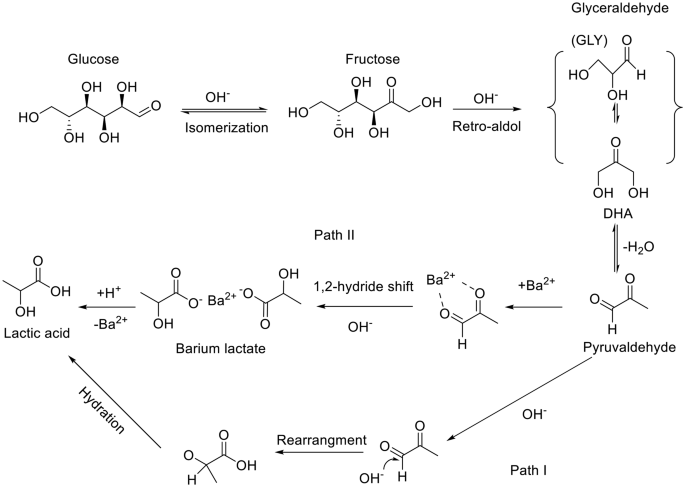
Pathway of conversion of glucose to lactic acid catalyzed by base catalyst at room temperature under anaerobic conditions [53]
Nowadays, resource conservation has become the focus of research, and it is very promising to produce lactic acid directly from real biomass. The direct conversion of real biomass feedstocks reveals a striking feedstock-dependent variability that reflects not merely differences in reaction severity, but fundamentally different substrate accessibility and catalyst poisoning mechanisms (Table 1). Among agricultural residues, corncob (44.7% LA yield) and rice straw (58.8%) — both rich in hemicellulose and cellulose but encased in a recalcitrant lignin matrix — require harsh alkaline hydrothermal conditions (260–300°C) and co-catalysts (e.g., NiO nanoplates) to achieve moderate yields, as lignin-derived phenolic compounds quench active sites and hinder mass transfer [54, 55]. In sharp contrast, bread residues afford a much higher yield (73% with Ca(OH)₂) due to their predominantly amorphous starch composition, which hydrolyzes readily and bypasses the rate-limiting cellulose crystallinity barrier [56]. However, even among simple sugars, the choice of alkali metal hydroxide matters: Sánchez et al. showed that KOH (36.97%) slightly outperforms NaOH (36.04%) and LiOH (32.54%) for bread residue conversion, a trend attributable to the larger ionic radius of K⁺ enhancing sugar intermediate complexation. Conversely, marine biomass (alginate) gives the lowest yield (14.66% over CaO at 200°C, 6 h), which is rationalized by the unique presence of uronic acid units and sulfate esters in alginate that compete with OH⁻ for Ca²⁺ coordination, thereby reducing the effective base concentration for retro-aldol cleavage [57]. Collectively, these data underscore that feedstock composition — specifically, the ratio of readily hydrolyzable polysaccharides to recalcitrant lignin and ash — is the dominant factor governing LA yield in alkaline systems, rather than the intrinsic catalytic activity of the base itself. The low yields for lignocellulosic and marine biomass further highlight the urgent need for either (i) mild pretreatment strategies to expose carbohydrates or (ii) base-tolerant, fouling-resistant heterogeneous catalysts that can operate in complex matrixes.” They found that CaO is hydrated with Ca (OH)2 in an aqueous solution to generate a Brønsted base (OH−), which is the key to the reaction.
Table 1 compiles representative examples of alkaline-catalyzed LA production from both model sugars (for mechanistic benchmarking) and real biomass feedstocks (for practical applicability). The inclusion of model sugars does not imply endorsement of edible feedstocks; rather, these studies provide the fundamental understanding necessary for translating catalysis to non-edible biomass.”
2.2 Acid catalysis
As mentioned above, although an acceptable lactic acid yield can be obtained with an alkaline catalyst to a certain extent. But an acid solution is always needed to neutralize the base, while hydrolyzing possible lactic acid to obtain the final product, pure lactic acid. Unlike bases that promote the production of lactic acid, Lewis acid mainly catalyzes the conversion of carbohydrates into lactic acid or alkyl lactic acid in alcohol in the water medium. Since no additional processing is required, acidic catalysts are a better choice for the production of lactic acid. Specifically, Lewis acidic sites are thought to be key to converting lactic acid from different carbohydrates and even cellulose. From the point of view of environmental protection, the non-homogeneous acid catalyst which is less corrosive and can be recycled is the main object of discussion in lactic acid preparation. The catalytic production of lactic acid from gluconic acid involves a complex process involving several chain reactions as shown in Fig. 4. Hayashi first reported the conversion of triose to lactic acid in 2005 [60]. Since then, many heterogeneous catalysts have been developed, including polyoxometalates [61], zeolites [62], metal oxides [57], and supported catalysts [63]. Trends regarding sugar reactants have been evolving, with a previous focus on tri sugar conversion (DHA/GLA) and more recent research focusing on the development of multifunctional catalysts for the conversion of glucose, cellulose, or hemicellulose to lactic acid (one-pot process). The new trends in the use of biomass feedstocks for lactic acid production are summarized below.
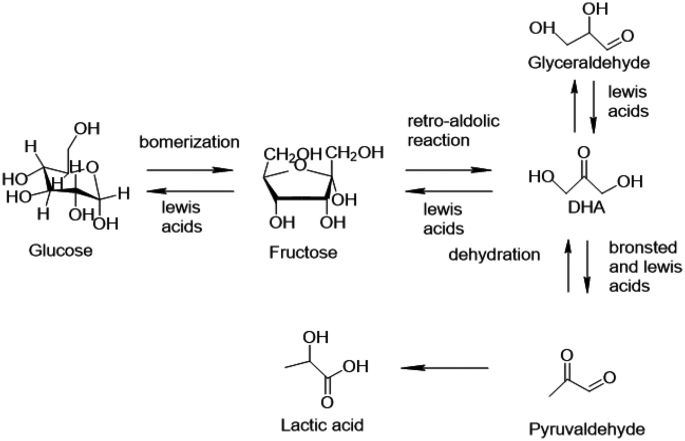
Brønsted/Lewis acid catalyzes the conversion of glucose to lactic acid
2.2.1 Trioses to lactic acid
Early studies have shown that USY and SN-based zeolites or salts show high activity for the conversion of trioses such as glyceraldehyde and dihydroxyacetone in alcohol, and achieve excellent alkyl lactate yield under mild conditions (≤ 388 K) [64]. Therefore, these Lewis acids may catalyze the direct conversion of hexose into lactic acid. Glyceraldehyde and dihydroxyacetone are formed as key intermediates. In heterogeneous systems, the conversion of trioses is usually carried out in the presence of a solid Lewis acid catalyst in a mixture of water, alcohol, and water alcohol. DHA, or GLY, is considered a key intermediate for converting sugars into LA. Elucidating the direct production of LA from simple C3 sugars is important for further understanding of the reaction that converts C6 sugars and cellulose into LA. There have been many reports of Lewis acid catalysts thermochemically catalyzing the conversion of trioses (glycerol, dihydroxyacetone and glyceraldehyde) and hexose (fructose and glucose) to lactic acid because no change in the carbon chain length is required, thus avoiding the rate-limiting stage of the reaction, the glycolysis of trans-aldose. Dehydrogenation is a key step in the catalytic conversion of glycerol to lactic acid. Precious metals such as Pt, Au, Pd, and their alloys are active in the dehydrogenation of alcohols. Therefore, they have been extensively studied in the conversion of glycerol. Aluminum, gallium, tin, lead, and several other polyvalent cations exhibit the properties of Lewis acids and exhibit excellent catalytic activity in converting trioses to lactic acid under homogeneous conditions, and most studies of heterogeneous catalysts are also of these metals. The vast majority of research has focused on combining metal Lewis acid functional groups with weak Brønsted acid sites in the same catalyst, both of which are necessary for the efficient conversion of trioses to lactic acid. At present, most of the catalysts used are zeolite, niobium metal oxide [65, 66], niobium phosphate [67], and silica-supported catalysts [68].
In recent years, the research on the conversion of dihydroxyacetone to lactic acid mainly focuses on metal salts, zeolites, metal-organic frameworks, and supported metal oxides. Initially, Taarning et al. used several Lewis acid zeolites to produce LA from DHA and found that Sn-β was highly selective for isomerization of trioses into LA. Multistage tin zeolite with a micro mesoporous structure has also been proposed and studied for the production of LA from trioses [69].
Rasrendra et al. studied in detail 26 metal salts for LA preparation from DHA, and they found that Al salt was identified as the most active, with an LA yield of 93% at 140 °C and 90 min [70]. Nakajima et al. studied the reaction of niobium oxide (Nb2O5·nH2O) with LA in DHA. It is also pointed out that two main characteristics convert these solids into biomass-derived carbohydrate increments, (i) the combination of Brønsted and Lewis acids, because the dehydration of propionate is enhanced in the presence of Brønsted acids. And (ii) the unsaturated coordination site of Nb2O5·nH2O has been shown to function as a water-tolerant Lewis acid site in water or water/organic solvent mixtures [66]. The distinct catalytic performance of various Lewis acid centers (Sn, Al, Nb, Cr, etc.) in triose-to-LA conversion can be rationalized by their electronic configurations, ionic radii, and coordination preferences in aqueous media. Al³⁺ and Cr³⁺ exhibit high charge density (ionic radii: Al³⁺ 0.54 Å, Cr³⁺ 0.62 Å) and strong Lewis acidity, enabling effective polarization of the carbonyl group of pyruvaldehyde (PVA) and facilitating the subsequent 1,2-hydride shift that converts PVA to LA [70]. In contrast, Sn⁴⁺ (0.69 Å) and Nb⁵⁺ (0.64 Å) possess lower charge-to-radius ratios in aqueous environments, resulting in moderate Lewis acidity that favors dehydration of DHA to PVA but shows limited activity for the PVA-to-LA isomerization step [60]. Importantly, water compatibility is a crucial factor: Nb-based catalysts retain their Lewis acidity even in the presence of abundant physisorbed water due to the formation of relatively weak water–Lewis acid adducts, whereas stronger Lewis acids like Al³⁺ tend to form stable aquo complexes [Al(H₂O)₆]³⁺ that partially deactivate the catalytic sites [71]. The combination of Brønsted and Lewis acid sites on Nb₂O₅·nH₂O further enhances the overall reaction rate by promoting the dehydration of DHA to PVA on Brønsted sites, while Lewis sites catalyze the rate-determining isomerization of PVA to LA [66]. This bifunctional synergy explains why niobium oxides outperform typical homogeneous Lewis acids (e.g., Sc(OTf)₃) in aqueous-phase reactions. For Sn-containing zeolites (Sn-BEA), the tetrahedral SnO₄ framework sites act as water-tolerant Lewis acids that catalyze the intramolecular hydride shift via a concerted mechanism, but their activity is often limited by poor stability in acidic aqueous media due to Sn leaching from the zeolite framework [30]. Collectively, the optimal Lewis acidity strength (neither too strong to cause deactivation nor too weak to be ineffective), water tolerance, and bifunctional Brønsted/Lewis acid cooperation are the key descriptors governing the catalytic performance of these metal centers for selective LA production from trioses.
Wang et al. prepared a bimetallic oxide catalyst based on niobium by a simple sol-gel method, and as a heterogeneous solid acid catalyst, the optimal yield of trisaccharide conversion to LA was 98.7% underwater conditions at 160 °C for 4 h [72]. The strong interaction between Sn and Nb effectively promoted the catalytic activity, and the possible reaction mechanism of isomerization of pyruvaldehyde into LA was proposed. Therefore, it is essential to develop new catalytic strategies under benign conditions to achieve efficient sugar conversion to LA. Experimentally, Jolimaitre et al. confirmed that the dehydration of DHA to PVA is catalyzed by both Brønsted and Lewis acids, whereas the subsequent PVA-to-LA conversion proceeds exclusively via Lewis acid catalysis, with the aquo complex [Al(OH₂)₆]³⁺ identified as the most active Lewis acid species [71], which is consistent with the high charge density of Al³⁺ discussed above. It is proved that [Al (OH2)6]3+ is the most active Lewis acid. The MS team demonstrated that MIL-101 (Al) -NH2 metal-organic framework (MOF) is a water-resistant and selective solid Lewis acid catalyst for isomerization of dihydroxyacetone into lactic acid [73]. The Lewis acid MIL-101(Al)−NH2 catalyst promoted a high lactate selectivity of 91% and a dihydroxyacetone conversion of 96% in water at 120 °C, and the catalyst was stable and could be reused four times with no degradation in catalytic performance. Feliczak-Guzik prepared tin containing fractional zeolite, characterized and used it for catalytic isomerization of dihydroxyacetone (DHA) to produce lactic acid and alkyl lactate, and found that dihydroxyacetone (DHA) could be effectively (yield > 90%) catalyzed to isomerize into alkyl lactate and lactic acid [69]. The application of microwave radiation can significantly reduce the catalytic reaction time. Wang studied the conversion of 1, 3-dihydroxyacetone (DHA) to LA under hydrothermal conditions using tin silicic phosphate as a reusable Brønsted-Lewis acid bifocal catalyst [74]. The product distribution is closely related to reaction temperature, catalyst load, and substrate concentration. At 140 °C, DHA was completely transformed and LA yield was the highest (93.8%) after 5 h. The large presence of Brønsted and Lewis acid sites facilitated the reaction. Takagak prepared a variety of silica-supported metal oxide catalysts for conversion of dihydroxyacetone to lactic acid by the initial wet impregnation method, and chromium oxide catalysts with Lewis acid site were selective for lactic acid [68].
The co-impregnation of chromium and titanium oxides in different proportions speeds up the reaction rate and increases the lactic acid yield to 80% at 130 °C. It is also proved that the Brønsted acid site of titanium oxide and the Lewis acid site of chromium oxide contribute to the continuous conversion of DHA to PA and LA. There have also been many studies on the conversion of glycerol to lactic acid. Deng reported a well-defined clamp-on manganese complex supported by PNP ligands for the conversion of glycerol to sodium lactate and the release of dihydrogen [75]. Under mild reaction conditions, the yield and selectivity of sodium lactate were 96% with Mn-3 complex as the catalyst. It can achieve low load and high yield, which is an energy-saving scheme. Taoteam efficiently converted glycerol catalyzed by heteropolyacid (HPA) to LA under mild, alkali-free conditions [76]. The catalytic performance of molecular HPA seems to be related to its REDOX potential and Brønsted acidity. Under optimized reaction conditions, 94% selectivity at 98% conversion. The reaction occurs by forming dihydroxyacetone/glyceraldehyde and pyruvaldehyde as intermediates. Under the applied reaction conditions, no leaching of HPMo was observed, and HPMo/C could be cycled up to 5 times without significant loss of activity. Embong et al. studied CaO/MgO and CaO/γ-Al2O3 catalysts for the selective conversion of glycerol to lactic acid. The catalyst was prepared by impregnation method and calcined at 700℃, and then surface analysis was carried out to clarify its surface properties [77]. It was found that the glycerol conversion rate was 95% and the lactic acid yield was 49% under the best conditions.
One of the current challenges in the catalytic conversion of lactic acid from trioses is to select the right catalyst and reaction conditions to achieve high conversion and product selectivity. In addition, the stability and recycling of the catalyst are also key issues. In addition, the purity and separation of lactic acid conversion products are also challenges, especially in multi-step reactions. In the future, with the increasing emphasis on sustainable development, the development of environmentally friendly catalysts and reaction processes will become a trend to reduce waste generation and energy consumption. Of course, the main research direction is still focused on non-edible biomass and waste unused biomass.
To provide a deeper mechanistic understanding of Lewis acid catalysis, it is instructive to examine how Lewis acid sites promote each elementary step in the conversion of sugars to LA. Four sequential stages can be distinguished (Fig. 3):
-
(i)
Isomerization (aldose → ketose). For glucose (an aldose), the initial and kinetically demanding step is its isomerization to fructose (a ketose). Lewis acid sites, particularly Sn⁴⁺, Al³⁺, and Zr⁴⁺ in zeolite frameworks, catalyze this transformation via an intramolecular 1,2-hydride shift, also known as the Lobry de Bruyn–van Ekenstein rearrangement. The Lewis acid coordinates to the carbonyl oxygen of glucose, polarizing the C = O bond and rendering the adjacent C–H bond more acidic. This facilitates hydride migration from C2 to C1, accompanied by proton transfer, yielding fructose. DFT calculations have shown that Sn⁴⁺ in the BEA framework reduces the activation barrier for this hydride shift from ~ 35 kcal/mol (uncatalyzed) to ~ 22 kcal/mol, owing to the stabilization of the cyclic transition state through Sn–O coordination [78]. Notably, this isomerization step is bypassed for fructose, which explains its higher LA yields under identical conditions.
-
(ii)
Retro-aldol cleavage (C₆ → 2 C₃). Once fructose is formed (or directly for ketoses), the Lewis acid site promotes the cleavage of the C3–C4 bond of fructose through coordination to the hydroxyl oxygen at C3 or the carbonyl oxygen at C2. This coordination withdraws electron density, weakening the adjacent C–C bond and facilitating its cleavage into two C3 intermediates: dihydroxyacetone (DHA) and glyceraldehyde (GLA). The efficiency of this step is influenced by the Lewis acidity strength: moderately strong Lewis acids (e.g., Sn⁴⁺, Zr⁴⁺) provide optimal polarization without over-stabilizing the substrate, whereas excessively strong Lewis acids (e.g., Al³⁺ in aqueous media) may form stable aquo complexes that deactivate the catalytic site [79].
-
(iii)
Dehydration (C₃ triose → pyruvaldehyde). The C3 intermediates (DHA and GLA) undergo dehydration to form pyruvaldehyde (PYA), as Scheme 2. This step is catalyzed by both Brønsted and Lewis acid sites: Brønsted acids protonate the hydroxyl group, rendering it a better leaving group, while Lewis acids stabilize the developing negative charge on the departing water. In bifunctional catalysts (e.g., Nb₂O₅·nH₂O), the synergy between Brønsted and Lewis acid sites accelerates this dehydration step without promoting unselective side reactions [66].
-
(iv)
1,2-Hydride shift (pyruvaldehyde → LA). The final and often rate-limiting step is the conversion of PYA to LA via a 1,2-hydride shift, also described as a Cannizzaro-type rearrangement. This step is exclusively catalyzed by Lewis acid sites [66]. The Lewis acid polarizes the carbonyl group of PYA, facilitating the migration of the hydride from the aldehyde C–H to the adjacent carbonyl carbon. The activation barrier for this hydride shift is substantially higher (ΔG‡ = 1.22 eV in photocatalytic systems) compared to competing unselective pathways, making it the selectivity-determining step [80]. Lewis acids with high charge density (e.g., Al³⁺, Er³⁺) are particularly effective in lowering this barrier through strong carbonyl polarization, which explains why rare-earth cations (Er³⁺, Yb³⁺) achieve near-quantitative LA yields from trioses [70, 81]. Conversely, in photocatalytic systems, the unselective proton-coupled electron transfer (PCET) pathways compete with this hydride shift, limiting LA selectivity on pristine photocatalysts; this limitation can be overcome by introducing Lewis acid sites (e.g., oxygen vacancies on TiO₂) that steer the reaction toward the hydride-shift pathway [19].
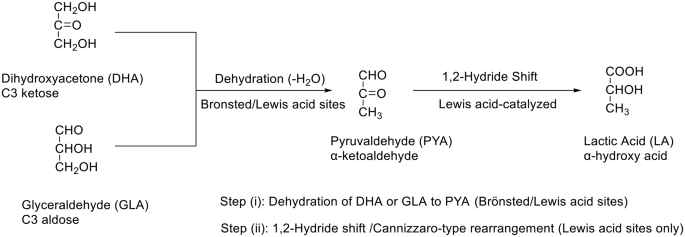
Reaction scheme for the cascade transformation of C₃trioses (dihydroxyacetone, DHA; glyceraldehyde, GLA) into lactic acid (LA) via pyruvaldehyde (PYA) intermediate [66].
This unified mechanistic framework—encompassing isomerization, retro-aldol cleavage, dehydration, and 1,2-hydride shift—is summarized in Table 5 (Sect. 2.4), which compares the rate-limiting steps and catalytic functions across alkaline, acid, and photocatalytic routes.
2.2.2 Glucose, fructose, and xylose to lactic acid
In the past few years, several heterogeneous acid catalysts have been applied. It mainly consists of zeolites [78, 79], metal oxides [82, 83], supported carbon-based materials [84], modified polyoxometalates, metal-organic, frameworks [85]and immobilized metal trifluoro methane sulfonate catalysts [67], which show great potential in biomass-related reactions. Especially some supported zeolite catalysts have become the focus of research. Sn(IV) -based organometallic complexes [86]. Following the mechanistic framework detailed in Sect. 2.2.1, this subsection examines the performance of various metal-modified zeolites for converting glucose, fructose, and xylose to LA. Different metals modulate these steps to varying degrees, and the resulting performance differences reveal systematic structure–activity relationships.
For framework-substituted Sn-BEA zeolites, the isolated tetrahedral Sn⁴⁺ sites function as water-tolerant Lewis acids that catalyze both the isomerization of glucose to fructose (via intramolecular hydride shift) and the subsequent retro-aldol cleavage, achieving a 67.1% LA yield from glucose/fructose under optimized conditions (200 °C, 4.0 MPa He, 30 min) with > 98% conversion [78]. To further enhance the catalytic performance, bimetallic modifications have been extensively explored. The introduction of Zn into Sn-BEA (Zn–Sn-β) creates Lewis acid–base pairs that facilitate the retro-aldol cleavage of fructose, yielding 54% LA from sucrose [87]. Similarly, Pb–Sn-β achieves 52–54.6% LA from glucose and fructose, but the high toxicity of Pb²⁺ precludes practical application despite its mechanistic interest in carbonyl polarization [88]. Among bimetallic systems, In–Sn-β exhibits the best performance (53% LA yield from glucose at 190 °C, 2 h) [89], because In³⁺ modulates the Lewis acidity by introducing weaker acid sites that reduce the concentration of strong Brønsted acid sites responsible for humin formation, thereby enhancing LA selectivity. In a parallel approach, Xia et al. also evaluated Cr–Sn-β systems, but their catalytic activity was inferior to In–Sn-β under comparable conditions [90].
Beyond BEA-framework zeolites, mesoporous supports offer an alternative platform for immobilizing homogeneous Lewis acids. Wang et al. covalently anchored ytterbium trifluoromethanesulfonate (Yb(OTf)₃) onto sulfonic-acid-functionalized SBA-15, achieving a 58% LA yield from glucose at 200 °C with stable recyclability over five cycles without significant deactivation [67]. This strategy preserves the high intrinsic Lewis acidity of Yb³⁺—one of the most active homogeneous catalysts for triose-to-LA conversion—while enabling facile catalyst recovery, though the multi-step synthesis and potential leaching of the sulfonate–Yb linkage under hydrothermal conditions remain concerns.
For Zr-modified BEA zeolites, Cui et al. developed a hierarchical HR-Zr-BEA catalyst via an alkali-free etching method that exposes more accessible acid sites [91]. This catalyst achieved 67.9% LA yield from xylose and > 50% from glucose or sucrose under mild conditions, with good stability and reusability. The hierarchical porosity enhances mass transfer of sugar intermediates, while the Zr⁴⁺ Lewis acid sites promote the rate-limiting C–C bond cleavage.
Recent work has also explored rare-earth-exchanged β-zeolites. Shen et al. demonstrated that Y-β and Yb-β zeolites afford LA yields of 45.3% and 43.6%, respectively, from glucose under identical conditions [92]. The catalytic activity correlates inversely with the ionic radius of the lanthanide cation (Y³⁺: 0.90 Å; Yb³⁺: 0.87 Å), consistent with the trend that smaller, more charge-dense cations exhibit stronger Lewis acidity and promote the rate-limiting C3–C4 bond cleavage. However, ion-exchange forms suffer from gradual metal leaching, as the exchangeable cations are only weakly anchored to the framework.
In parallel with metal selection, zeolite pretreatment has emerged as a critical strategy for optimizing acid-site distribution. You et al. demonstrated that HCl dealumination of H-ZSM-5 selectively removes extra-framework Al species while increasing the proportion of Brønsted acid sites, thereby suppressing sugar dehydration to 5-hydroxymethylfurfural [93]. Building on this concept, Yuan et al. prepared dealuminated ZSM-5-supported Er catalysts (Er/deAl-ZSM-5), achieving the highest LA yield (69.1%) among the zeolite-based systems discussed here [94]. The dealumination not only increases surface area and promotes Er₂O₃ dispersion but also creates a favorable Lewis/Brønsted acid balance that directs the cascade toward LA rather than humins. This catalyst also demonstrated good activity for cellobiose, xylose, and inulin conversion, with stable recyclability, representing a significant advance toward real biomass application.
Collectively, these studies reveal a clear hierarchy: Er/deAl-ZSM-5 (69.1%) > Sn-BEA (67.1%) ≈ HR-Zr-BEA (67.9%) > Yb/SBA-15 (58%) > In–Sn-β (53%) > Pb–Sn-β (52–54%) > Y-β/Yb-β (43–45%). The highest-performing systems share two common features: strong Lewis acid sites with balanced Brønsted acidity and high metal dispersion on a stable support. However, all heterogeneous zeolite catalysts face the inherent trade-off between active-site accessibility and hydrothermal stability—metal leaching (Sn, Er, Zr) in hot aqueous media remains a persistent challenge that must be addressed through robust metal–support interactions or encapsulation strategies before industrial application becomes viable.
The reduction of Brønsted acid site by dealumination significantly inhibited the dehydration of sugar to HMF, increased the surface area of the scaffold, and promoted the dispersion of Er2O3 on the scaffold. It was found that under optimal conditions, the yield of lactic acid was as high as 69.1%, and the catalyst also had good catalytic activity for the conversion of cellobiose, xylose, and inulin, it has good stability and recyclability. The representative catalytic performances for the acid-catalyzed conversion of various sugars to lactic acid are summarized in Table 2. The advantage of this research is that it can promote the production of LA directly from raw biomass.
The distinct performances of Sn-β, In-Sn-β, Pb-Sn-β, and Er-modified zeolites arise from differences in framework composition, acid site distribution, and metal dispersion. For Sn-β, isolated tetrahedral Sn⁴⁺ sites serve as water-tolerant Lewis acids catalyzing glucose isomerization and retro-aldol cleavage, while the hydrophobic BEA framework suppresses side reactions [78]. For In-Sn-β, indium modulates Lewis acidity by creating weak acid sites and reducing strong acid sites responsible for humin formation, enhancing LA selectivity [89]. For Pb-Sn-β, Pb²⁺ promotes initial isomerization and retro-aldol steps, whereas Sn⁴⁺ catalyzes the dehydration–isomerization sequence to LA [88]. For Er-modified zeolites, Er³⁺ enhances Lewis acidity while decreasing Brønsted acidity via proton replacement in bridging Si–O(H)–Al groups; dealumination further improves performance by increasing surface area and promoting Er₂O₃ dispersion [92, 94]. Collectively, optimal Lewis acid strength, balanced Lewis/Brønsted acid distribution, and high metal dispersion are the key factors governing catalytic performance.
Among possible metal oxides, Nb2O5 nanorods [82], YNbO4 [65], Al2O3, TiO2, ZrO2, SnO2, CeO2 [83], and ZnO [95] have been recently studied. Al2O3 has the best performance (LA yield of 34%), which is attributed to the highest density of functional groups of acids and bases, which is important for promoting stepwise reactions. To improve the catalytic performance of Nb2O5, Santos designed the rhombic crystal system Nb2O5, which improved the glucose conversion and LA yield compared with the commonly used Nb [96]. More Lewis acid sites were attributed to the Nb2O5 nanorods catalyst. Previous studies have found that the coexistence of Lewis acid and base sites in ZnO can effectively produce LA. In this regard, the Xu studied ZnO as a relationship catalyst for the conversion of biomass-based sugars to LA and found that the highest yield could reach 45.1% [95]. The advantages of this catalyst are its stability, easy separation, and recovery. Liu proposed a valuable work on the production of LA directly from lignocellulosic sugars (including L-glucose, glucose, and xylose) with good yields, and proposed the path of polysaccharide conversion to lactic acid as shown in Fig. 5 [97]. The conversion of glucose to lactic acid by various activated carbon-based heterogeneous metal oxide catalysts in aqueous solution was tested. Kupila’s team studied the use of Sn, Al, and Cr oxides as catalysts for activated carbon support and found that the tested carbon-supported metal oxide catalysts all showed high glucose conversion (> 94%) and were able to convert glucose to lactic acid within 20–120 min, compared with chromium oxide [63]. The addition of tin oxide and alumina results in higher lactic acid production, up to about 42%, but the catalyst is unstable and poor in reusability. It can be seen that although the heterogeneous metal oxides are easy to recover and friendly to the environment, the lactic acid yield is not excellent. Kosri began with D-xylose using oxides of Cr and Sn loaded on γ-Al at 170 °C and obtained high yield lactic acid (~ 70%) at total conversion, showing that the acidic site can improve the selectivity of lactic acid production while having strong application potential on an industrial scale in the future [98]. Previous reports have shown that several metal chlorides have the potential to produce LA by chemical catalysts, such as lead and molybdenum, which have been used to catalyze cellulose, glucose, or fructose to produce LA [99]. Rare earth metals, including scandium, yttrium, and lanthanides (Ln), have been receiving great interest as novel Lewis acid catalysts, which are cheaper and easier to recycle than typical Lewis acid catalysts, and are therefore considered environmentally friendly catalysts [100]. Zhang found that rare earth metal ions have special catalytic activity for the formation of lactic acid using glucose as substrate, and its activity increases monotonically with the increase of atomic number, and the ionic radius decreases [101]. From La3+ to Ln3+, when catalyzed by Yb3+, the lactic acid yield of glucose can be as high as 75.9%. As atomic number increases, higher oxidation potential may promote disproportionation in glucose conversion through intramolecular H shift. Meanwhile, DFT calculation showed that heavy lanthanide (III) ions greatly reduced the energy barrier of C3-C4 cleavage in fructose. These factors may contribute to the high activity of rare earth metal ions, thus contributing to the formation of lactic acid from biomass. Huang also used solid Lewis acid material MIL-100 (Fe), a metal-organic framework (MOFs) material, which has outstanding advantages such as large specific surface area, ultra-high porosity, high thermal stability chemical stability, and can obtain 32% LA yield [102]. It is found that the metal, surface area, and Lewis acidity of the framework has effects on the catalytic activity. Recently, Deng and colleagues investigated several readily available, inexpensive, and less toxic metal cations that catalyze fructose for 2 h in a 463 K aqueous medium [103]. It was found that under the same reaction conditions, the yield of Al (III) was the highest and the yield of lactic acid was 41%. Moreover, the combination of Al (III) and Sn (II) with a molar ratio of 1:1 significantly improved the conversion of fructose, and the yield of lactic acid could reach 90%.

Proposed mechanism of aldose conversion to lactic acid in the presence of Lewis acid [97]
The catalytic conversion of different sugars (glucose, fructose, and xylose) to lactic acid is fundamentally governed by their molecular structures and the corresponding reaction pathways. Glucose, a six-carbon aldose, must first undergo isomerization to fructose via a Lewis acid-catalyzed intramolecular hydride shift (the Lobry de Bruyn–van Ekenstein transformation), followed by retro-aldol cleavage of fructose into two C3 triose intermediates (dihydroxyacetone, DHA, and glyceraldehyde, GLA), which are subsequently dehydrated and rearranged to LA [104]. This multi-step sequence renders glucose conversion kinetically more demanding and highly dependent on the presence of Lewis acid sites for the initial isomerization step. In contrast, fructose, being a ketose, bypasses the isomerization step and directly undergoes retro-aldol cleavage to C3 trioses, which explains its generally higher LA yields compared to glucose under identical catalytic conditions [70, 78]. Xylose, a five-carbon aldose, follows a similar pathway to glucose but produces C2 and C3 fragments upon retro-aldol cleavage, leading to a mixture of lactic acid (from the C3 fragment) and glycolic acid or formic acid (from the C2 fragment), which inherently limits the maximum attainable LA yield [91, 98]. Furthermore, the kinetics of retro-aldol cleavage are influenced by the substrate’s carbonyl position and ring conformation in aqueous solution, with furanose forms (favored for fructose) being more susceptible to cleavage than pyranose forms (favored for glucose) [103, 104]. These structural and mechanistic differences collectively account for the observed product yield trends: fructose > glucose > xylose under analogous acid-catalyzed conditions, as summarized in Table 2.
To provide a systematic comparison of the diverse Lewis acid catalysts discussed in this section, Table 3 summarizes their key characteristics, including active metal species, ionic radii, substrate scope, LA yields, proposed active site descriptors, advantages, and limitations. This tabulated comparison allows readers to directly benchmark the catalytic performance and structural features of Sn-β zeolites, Nb-based oxides, rare-earth catalysts, MOFs, and metal salts across different substrate types and reaction conditions.
2.2.3 From other biomass to lactic acid
Due to the complex structure of biomass and the fact that lignin can induce catalyst deactivation, few studies have been conducted to produce LA directly from cellulosic biomass. Converting cellulose into lactic acid is both more attractive and more challenging. It is more crystalline than hemicelluloses or starch, and the reaction requires the cleavage of not only the glycosidic bonds that connect the glucose units, but also the specific C-C bonds in the glucose units, so converting it to lactic acid is more difficult. Since cellulose is inexhaustible and a precious natural polymer compound, the direct conversion of cellulose/hemicellulose to LA via heterogeneous catalysts is critical to driving the industrial production of bioplastics in biorefineries. It can effectively solve the environmental problems caused by the consumption of fossil energy, and has important significance for the sustainable, rapid, and healthy development of the economy. Therefore, the efficient catalytic system of cellulose conversion to lactic acid has become a research hotspot. Liang constructed a novel zinc cadmium sulphide/molybdenum dioxide-molybdenum carbide–carbon (ZnxCd1-xS-y/MoO2-Mo2C-C) heterojunction which the maximum selectivity of lactic acid (64.1%) comes from arabinose and conversion of biomass-based monosaccharides was approximately 100% [114]. Chambon used AlW as a solid catalyst to obtain 28% lactic acid yield from cellulose [109], and Coman used NbF5-AlF3 as a catalyst to obtain 27% lactic acid yield from cellulose [110]. One of the problems with these solid catalysts is the leaching of metal substances into solution. And the production of lactic acid is quite low. With this in mind, there is a great need to develop an environmentally efficient catalyst for converting cellulose into lactic acid. Wang et al. studied a homogeneous catalyst for the direct conversion of cellulose to lactic acid in an aqueous solution [105]. The system containing diluted Pb (II) in water can catalyze the conversion of ball- milling cellulose, glucose, and fructose into lactic acid, while obtaining a higher yield of about 70%, and is also suitable for the conversion of lignocellulosic biomass raw materials without pretreatment. However, the separation and recovery of Pb (II) will increase the process cost, and it is difficult to separate lactic acid from aqueous solutions containing by-products and its subsequent purification. Considering its toxicity, the design of more environmentally friendly and efficient catalytic systems has become the focus of future research. Then they designed a double-cationic system composed of Al (III) and Sn (II) with a molar ratio of 1/1 and found that 66% of the lactic acid yield could be obtained by ball milling cellulose after 4 h of reaction at 463 K, which was comparable to the lactic acid yield obtained by using Pb (II) [103]. To continue their research, they found a cheaper and less toxic vanadium salt, VOSO4, which performed well in the production of either LA or formic acid from cellulose by simply transferring the reaction atmosphere from N2 to O2 [115].
As a Lewis acid catalyst, lanthanide trifluoro mesylate has attracted great interest because of its unique properties. Initially, Wang and his colleagues studied the conversion of cellulose to lactic acid by Lewis acids of different lanthanides and found that the lactic acid yield of Er(OTf)3 was up to 89.6% under optimized reaction conditions [116]. Then ErCl3 was used to catalyze cellulose and other raw biomass materials in a nitrogen atmosphere, and the lactic acid yield of cellulose was as high as 91%, and other biomass could also obtain excellent yields [106]. At the same time, it remains stable in five catalytic runs. This stable and environmentally friendly method is essential for the large-scale production of lactic acid. Wu studied heat sulfonated and oxidative modification of chemical mechanical pulp (CTMP) existing in lignin, and found can increase the pulp cellulose and hemicellulose components of enzymes and lanthanide three fluorine of methanesulfonic acid ester catalyst accessibility [117]. Among the various lanthanide trifluoromethanesulfonic acid catalysts evaluated, the lactic acid yields of hardwood pulp and softwood pulp were the highest when Er (OTf)3 was used, with 72% and 67%, respectively, which is very meaningful for the high-value utilization of pulp if energy is produced. To continue the research, Wang and colleagues studied erbium-grafted H-Beta molecular sieves and achieved up to 58% LA yield at 240 °C and 2MPa N2 within 30 min [107]. The discovery of erbium ions appears to be critical to achieving these LA yields. Then, inspired by Er3+, an Erbium-exchange montmorillonite K10 clay catalyst was prepared and studied in the production of lactic acid from cellulose [108]. Under optimized reaction conditions, a high yield of 67.6% of lactic acid was obtained. However, during the recovery process, the yield of lactic acid decreased, which may be related to metal leaching. Although such lanthanide trifluoro methanate catalysts exhibit high LA yields, they are relatively expensive, thus limiting the large-scale production of bio-based chemicals. To this end, Kim and his team reported an integrated process of value-added platform chemicals for lignocellulosic biomass production. In the presence of La(OTf)3, the catalytic conversion of the hemicellulose-rich portion of the cork mixture to lactic acid with high yield and selectivity can be said to be sustainable for the future biorefinery offers an opportunity [118]. Due to the excellent catalytic performance of lanthanides, there are still relevant studies on the preparation of lactic acid from non-edible biomass. For example, Kutrakul studied the use of cheaper lanthanide chloride as a catalyst for the conversion of carbohydrate raw materials (i.e., cellulose, raw sugar, and pretreatment bagasse) into lactic acid [119]. In particular, ErCl3 and YbCl3 are highly reactive to the conversion of sucrose and cellulosic biomass (bagasse) to lactic acid in a very short time (15 min), with a yield of up to 92%. At the same time, it is proposed that the combination of hot compression shrinkage under subcritical conditions is applied to the conversion of cellulose to LA to promote the cleavage of cellulose β, 1–4 glucoside bond. It’s a more environmentally friendly process. The advantage of this process is that there are fewer steps for downstream treatment, while the lanthanides can be recovered using porous materials, and the lactic acid yield is slightly reduced after four cycles. It provides a superior and effective solution for lactic acid production, with efficient energy use and time consumption. Although some of the above water-soluble salts can selectively convert cellulose into lactic acid, these salts are usually expensive, highly toxic, and difficult to recover, and heterogeneous catalysts can avoid these shortcomings, so they have been widely studied in recent years.
A recent study, the cellulose into several transition metal oxides of lactic acid (ZrO2, Al2O3, TiO2, Fe3O4, V2O5, CeO2, Y2O3, Tm2O3, HfO2, Ga2O3, MgO style, La2O3, Nb2O5, and Ta2O5.), It was found that zirconia had the best catalytic effect, and the amount of acid-base site on ZrO2 played an important role in the conversion of cellulose to lactic acid. Meanwhile, the zirconia catalyst was stable in high temperature water, and almost no Zr was leached from the catalyst to the solution during the reaction [111]. Previously, Yang studied whether xylose or xylan could be produced by adding a ZrO2 catalyst in pH neutral aqueous solution under different reaction conditions, and proposed a possible ferric acid/base reaction mechanism, explaining why ZrO2 has an advantage over solid base catalyst MgO in producing lactic acid from xylose [112]. Kong studied the conversion of sucrose to lactic acid using 3-aminopropyl trimethoxy silane on a functionalized Sn-Beta molecular sieve [79]. The obtained catalyst has a balanced acid-base site and can achieve an LA yield of 58% under optimized hydrothermal conditions. Today, converting some organic biomass into lactic acid has also become a hot research direction, such as kitchen waste, corn stalks, coffee, etc., if it is reused, it can promote the use of renewable energy. Recently, Geon-SooHa studied the effective conversion of erbium trifluoro mesylate into lactic acid from waste coffee grounds, and his proposed strategy to convert SCG into LA with a high yield (70 mol%) within 1 h proved to be economically feasible [113]. The chemical catalytic conversion of waste kudzu cellulose to produce lactic acid is an important means to realize the resource utilization of biomass waste. Kang et al. studied the preparation of lignin-based carbon carriers (LCSA) by one-step sulfonation and chloro-sulfonic acid carbonization using lignin as raw material [120]. It was obtained by modifying carbon carriers with cheap and readily available Al and Zn chlorides. At 160 °C, 50 mg Pueraria cellulose, 50 mg catalyst, and 10mL deionized water were used for 120 min. The conversion rate of Pueraria cellulose was 53.7%, and the highest LA yield was 24.7%. Microalgae is a rich, non-cultivable, and easily available new aquatic carbon source, which can be regarded as a potential biomass. Xia et al. studied the process of conversion of raw microalgae and microalgae residues into lactic acid under relatively mild reaction conditions with the help of Fe-Sn-Beta catalyst of non-homogeneous Lewis acid [121]. After the reaction at 210 °C for 2 h, the microalgae residues can produce lactic acid efficiently with a yield of 33.9%. The catalytic reaction is carried out in an air atmosphere, which makes the reaction process more convenient and safer and overcomes the expensive pretreatment cost, which is an economical strategy for preparing lactic acid.
Collectively, the comparative analysis in Table 3 reveals a clear structure–activity relationship: catalysts with strong Lewis acidity and good water tolerance (e.g., Sn-BEA, Er-deAl-ZSM-5) generally achieve the highest LA yields from hexoses, while Nb-based oxides offer superior hydrothermal stability at the expense of lower activity. Rare-earth catalysts, though highly active, face challenges in recovery and cost, whereas base-metal oxides (ZrO₂, ZnO) provide a more economical but less active alternative. This systematic comparison underscores the trade-offs that must be considered when selecting a catalyst for specific biomass conversion applications.
2.3 Photocatalytic preparation of lactic acid
At present, due to the strict conditions, low efficiency, high cost, difficult separation and other problems of lactic acid preparation by fermentation, research on lactic acid production has gradually turned to chemical methods including heterogeneous catalysis and homogeneous catalysis [122]. For homogeneous catalysis, high Lewis acidity makes erbium one of the most active homogeneous catalysts. For heterogeneous catalysts, the tin-containing bimetallic system combines the high Lewis acidity of Sn while moderating it with another metal, thereby reducing by-products. The multistage bimetallic Sn-β molecular sieve combines a large number of open sites that catalyze glucose isomerization in the mesoporous region and promotes the inhibitory effect of fructose inverse aldol in the microporous region to produce up to 67% lactic acid from glucose. Loss of activity remains a problem for heterogeneous catalysts. In order to explore more economical catalytic methods to achieve industrial production of lactic acid, photocatalysis has become a research hotspot. In recent years, a series of reports on photocatalysis have shown new functional materials, such as BiOX (X = Cl, Br) [123], COF [124], and functional carbon nitride [125], showing high photocatalytic performance. However, from the perspective of environmental and economic benefits, functional carbon nitride photocatalyst has good application value and development potential. As a new type of photocatalyst, graphitic carbon nitride (g-C3N4) has been widely concerned because of its efficient photocatalytic activity, and has made great achievements in photocatalysis. Zou used cellulose nanofibers (CNF) assisted polymerization to prepare one-dimensional porous g-C3N4 nanorods (HCN) with nitrogen-vacancy and oxygen dopant for the photochemical synthesis of lactic acid through monosaccharide photooxidation [125]. It was found that the yield of lactic acid in HCN from hexose to pentose was as high as 75.5%, and it also had an excellent hydrogen production rate. In recent years, Li from Dalian Polytechnic University has done a lot of research on the photocatalytic conversion of lactic acid, and designed an alkaline CuO@CS-H photocatalyst to transform biomass-derived sugars into lactic acid [126]. The CuO powder was uniformly dispersed in the hydrogel, which did not change the visible light adsorption capacity of CuO, but significantly enhanced the stability of CuO. At the same time, through the poisoning experiment, it was verified that the catalyst O2- played a major role in catalysis. Further research was conducted on ultra-thin porous carbon nitride (Ut-OCN) [127], where carbon nitride nanosheets were incorporated on the surface of PY53to enhance the light absorption capacity, and as a highly efficient photocatalyst for lactic acid production, an excellent lactic acid yield of more than 85% was obtained, and superoxide free radicals were proved to be the main active substances for photocatalysis [128]. Zhao designed a novel homojunction photocatalyst (ZN1-cadmium xS) through a solid solution method, which showed excellent efficiency in producing hydrogen from glucose and lactic acid simultaneously under visible light irradiation [129]. The glucose conversion rate is about 90% and the lactate selectivity is 87%. The photocatalytic strategy published above can avoid the effects of the biological methods and the homogeneous and heterogeneous catalytic methods on the production of lactic acid, to obtain excellent yield. However, the preparation process of the photocatalyst used in the above process is relatively complicated. Therefore, the Cui prepared a photocatalyst FG-s-PVA@CNNS3 based on “fish gill” shaped hydrogel. The ordered porous structure of the catalyst is conducive to the adsorption and mass transfer of the reactants, and the yield of lactic acid can reach 92.6% [130]. At the same time, it shows excellent stability and reusability, and the yield of the 10th cycle reaches 95.6% of the first cycle. FG-s-PVA@CNNS3 also shows excellent versatility. Recent advances in photocatalytic production of lactic acid from biomass-derived substrates are listed in Table 4.
However, there has been little research on the production of lactic acid through the photocatalytic conversion process using cellulose as the initial feedstock, possibly because its high chemical stability properties are caused by a complex inter-hydrogen/intra hydrogen bond network and highly organized crystal structure [131]. Wu used CoO/ G-C3N4 as a photocatalyst for hydrogen and lactic acid of cellulose and wheat straw [132]. The pretreatment of phosphor-cellulose obtained the best conversion rate (about 71wt%) after 12 h, and the lactic acid yield was about 2574µmol·g−1cellulose (only about 23.17%) after 12 h photo-reformed treatment. Zhong et al. applied a series of Cu-modified photocatalysts and achieved a lactic acid yield of 38.5% under visible-light irradiation at 60 °C [133]. At the same time, the catalyst has excellent recyclability, and the DFT calculation verifies that the incorporation of Cu reduces the band gap of Pal, thereby increasing the light collection effect, and providing a promising sustainable strategy for biomass enhancement. Can inspire to study the catalytic effects of other natural minerals. Recent 2025 studies advanced photocatalytic LA production via non-metallic modification. Liu et al. developed a triazole-modified carbon nitride photocatalyst (C-CNN) with hole localization and activated-carbon conjugated photothermal effect. It achieved 85.5–98.3% LA yields from various sugars (glucose, fructose, xylose, arabinose, methylglyoxal, DHA) at room temperature within 2 h, with surface temperature reaching 80.5 °C under light. LCA showed 50% lower GWP (2.14 vs. 4.3 kg CO₂ eq/kg LA) and reduced fossil depletion (1.98 vs. 8.9 MJ/kg LA) [19]. Li et al. constructed a F-doped carbon nitride (F-CN) with frustrated Lewis acid-base pairs, enabling F–H hydrogen-bonding for isomerization and selective ·O₂⁻ generation. This gave 94.8% LA yield from xylose (70 min, 40 °C), with 74.8–97.8% yields from glucose, fructose, arabinose, and pyruvaldehyde. LCA revealed GWP of only 0.7 kg CO₂ eq/kg LA (one-sixth of petrochemical route) and 87.8% fossil resource reduction [20]. These results highlight the growing potential of sustainable, selective LA production under mild conditions.
Recent mechanistic studies have provided critical insights into the factors that limit LA selectivity in photocatalytic systems. Zhang et al. systematically investigated the aqueous photoreforming of pyruvaldehyde (PYA)—the key intermediate in LA production from glucose, fructose, and glycerol—over TiO₂-based photocatalysts [134]. They identified that at neutral pH, PYA undergoes multiple parallel proton-coupled electron transfer (PCET) pathways with low kinetic barriers (ΔG‡ = 0.24–0.61 eV), producing undesired C₃ oxygenates such as hydroxyacetone and lactaldehyde, while the selective Cannizzaro-type 1,2-hydride shift to LA has a substantially higher barrier (ΔG‡ = 1.22 eV). This kinetic discrepancy renders the PCET pathways kinetically favored, limiting LA selectivity to < 20% on pristine TiO₂. To overcome this limitation, the authors constructed a bifunctional Au/TiO₂–Vₒ catalyst with enhanced Lewis acidity (unsaturated Ti⁴⁺ sites introduced via oxygen vacancies) and plasmonic photothermal effects. The Lewis acid sites modulate intermediate adsorption and steer the reaction toward the Cannizzaro-type pathway, while the localized surface plasmon resonance (LSPR)-induced heating promotes the rate-limiting 1,2-hydride shift, ultimately achieving > 90% LA selectivity—a 3.4-fold increase over purely photocatalytic processes. In a complementary study, Wan et al. developed an atomic-level heterojunction photocatalyst consisting of Cu–S₃ moieties embedded in a CdₓZn₁₋ₓS host with a coherent-lattice interface [80]. The coherent-lattice interface enables strong interfacial electronic interactions that suppress charge carrier recombination, while the Cu–S₃ moieties induce significant LSPR effects, extending light absorption to the near-infrared region and generating photothermal effects that facilitate reactant activation. This architecture achieved a 10-fold increase in glycerol-to-LA conversion with > 95% selectivity. Collectively, these studies underscore that the rational design of photocatalytic systems—through Lewis acid site engineering, oxygen vacancy creation, plasmonic photothermal enhancement, and atomic-level heterojunction construction—can effectively suppress unselective PCET pathways and promote the kinetically demanding 1,2-hydride shift, thereby overcoming the intrinsic selectivity limitations of photocatalytic LA production under mild conditions.
It should be emphasized that photocatalytic LA production is governed by a complex interplay of multiple reaction parameters beyond light illumination. Catalyst loading (typically 0.5–5 g/L) critically affects photon absorption and active site availability; excessive loading can cause light scattering and reduce quantum efficiency. Initial substrate concentration (usually 0.01–0.2 M) influences reaction kinetics and product distribution, with higher concentrations often promoting side reactions due to mass transfer limitations and intermediate accumulation. Solution pH plays a decisive role in determining the dominant reactive oxygen species (·O₂⁻ at alkaline pH vs. ·OH at acidic pH) and the speciation of sugar intermediates, thereby affecting LA selectivity. The reaction atmosphere (O₂, air, or N₂) controls the oxidative pathway: O₂ atmospheres facilitate superoxide radical generation for C–C bond cleavage, while inert atmospheres favor photoreforming pathways with H₂ coproduction. Reaction temperature (ranging from 25 to 80 °C in photocatalytic systems) influences both the kinetics of photochemical steps and the thermodynamics of thermal catalytic steps in photothermal hybrids. The wavelength and intensity of light (typically 300–800 nm, 100–500 mW·cm⁻²) determine the excitation efficiency of photogenerated charge carriers and the initiation of specific reaction pathways. Solvent composition (aqueous, aqueous–organic mixtures, or solvent-free) affects substrate solubility, intermediate stability, and catalyst wettability. These parameters are inherently interdependent; for instance, the optimal pH for glucose conversion over g-C₃N₄ shifts from 10 to 12 depending on catalyst surface charge and the presence of co-catalysts. A comprehensive optimization of these multidimensional conditions is therefore essential for achieving both high LA yield and selectivity.
2.4 Other catalysts
Beyond the conventional acid, base, and photocatalysts discussed above, several emerging catalytic strategies have recently been explored for LA production. These can be broadly categorized into two groups: (i) novel catalytic material platforms—including single-atom catalysts, perovskite oxides, and metal fluoride-based systems—and (ii) synergistic hybrid strategies that integrate multiple energy inputs, such as photothermal and relay photo/thermal catalysis, as well as alternative driving forces like electrocatalysis.
Most of the heterogeneous catalysts currently reported for chemically catalyzing the conversion of biomass to lactic acid are based on acid/alkaline properties. The long-term stability of these catalysts remains uncertain due to leaching or deactivation in hydrothermal media. The stability of transition metal oxide materials in hydrothermal media has always been a problem in aqueous catalysis. Only a very small number of metal oxides, such as ZrO₂, TiO₂, and α-Al₂O₃, show acceptable stability in certain biomass conversion reactions in subcritical water. With the development of the lactic acid catalytic process, some new catalytic methods have come into being and showed excellent results. Rachuri et al. developed an Ir-SAC catalyst which shows excellent selectivity towards glycerol to lactic acid conversion with a remarkable recyclability to offer an unprecedentedly high TON of over 104 million under optimized conditions [135]. Yang reported that LaCoO₃ perovskite catalyst can effectively catalyze the conversion of cellulosic biomass to lactic acid in a hydrothermal medium [136]. The reaction temperature, gas atmosphere, and catalyst load have profound effects on the productivity of glucose-lactic acid. At initial pressures of 200 °C and 400 psi N₂, C5 to C6 aldoses, including xylose and glucose, produced similar amounts of lactic acid, up to 40%. Verziu explored a novel heterogeneous NB-doped nano-inorganic fluoride (represented by Nb@MF₂, M = Mg, Ca, respectively) catalytic system for the conversion of cellulose to lactic acid in a one-pot process [137], and compared it with the previously developed and reported Sn@MgF₂ [138] and Nb@AlF₃ [110] catalysts. It was found that the acidity of the catalyst was significantly increased, and the active site for the generation of lactic acid from glucose was Nb(V)/Nb(IV).
The synergy between photocatalysis and photothermal effects has recently been demonstrated as a powerful strategy to overcome selectivity limitations in LA production. As discussed in Sect. 2.3, Zhang et al. showed that plasmonic Au nanoparticles on oxygen-vacancy-enriched TiO₂ can induce localized heating via LSPR, effectively promoting the rate-limiting 1,2-hydride shift in PYA-to-LA conversion while suppressing unselective PCET pathways [134]. This photothermal strategy, combined with Lewis acid site engineering, represents a promising direction for achieving high LA selectivity under ambient, base-free conditions.
Beyond these novel material platforms, the integration of multiple energy inputs has emerged as an equally powerful strategy for enhancing LA production. A landmark demonstration of photothermal synergism was provided by Cao et al., who developed a nitrogen-doped TiO₂ (N-TiO₂) catalyst via a urea-assisted sol-gel method [139]. The significance of this work lies not merely in the reported 98.9% LA yield — one of the highest values among photocatalytic systems — but in its mechanistic innovation: nitrogen doping narrows the bandgap for visible-light absorption, while carbon incorporation from the urea precursor enhances photothermal conversion efficiency. This dual functionality enables concerted action between photogenerated superoxide radicals (·O₂⁻), which drive oxidative C–C cleavage of sugar intermediates, and localized photothermal heating, which accelerates the rate-limiting 1,2-hydride shift from pyruvaldehyde to LA. Control experiments confirmed that neither pure photocatalysis (at room temperature) nor pure thermocatalysis (in the dark at 60°C) achieves comparable yields, underscoring a genuine synergistic effect. Compared to conventional g-C₃N₄ photocatalysts discussed in Sect. 2.3, which typically require longer reaction times (2–4 h) or higher catalyst loadings, the N-TiO₂ system offers superior reaction rates and near-quantitative selectivity. Nevertheless, three critical limitations warrant attention: (i) the catalyst’s long-term stability under continuous irradiation beyond the reported cycles remains insufficiently characterized; (ii) its applicability to recalcitrant lignocellulosic feedstocks — which contain lignin-derived inhibitors and exhibit poor mass transfer — has not been demonstrated; and (iii) the energy balance of the photothermal process, particularly the electricity consumption of the Xe lamp, requires life-cycle assessment to validate its sustainability claims. Thus, while this work provides a valuable proof-of-concept for photothermal LA production, translating it to practical biomass conversion will require catalysts with enhanced fouling resistance and integrated pretreatment-compatible designs.” At the same time, it has good reusability and can be recycled without loss of activity. The developed N and C enhanced photothermal synergistic scheme opens up a pathway for the production of organic acids from renewable biomass resources under mild conditions. Yang studied a new porous aerogel CuxSnSO@GO, which showed thermal and photocatalytic properties in the conversion process of reducing sugar (mainly composed of glucose) [140]. Under mild conditions (> 40 °C), the thermal/photocatalytic process showed excellent performance in the conversion of cellulase hydrolysis products to LA. The optimum yield is about 83.6%. Compared with photocatalytic systems or thermos-catalytic systems, the synergistic effect of photocatalysis and thermos-catalytic systems can improve the conversion and LA selectivity, and the mechanism of photocatalysis/thermos-catalysis is proposed. Later, Ding developed a ternary heterostructure NTCN/LDH composite, in which the Lewis acid site from LDH can provide an active site for substrate adsorption for thermal catalytic isomerization, and the ternary heterojunction can regulate reactive oxygen species and promote selective C–C bond breaking under visible light irradiation [141]. It was found that the photocatalytic production of LA from various biomass sugars was 89–99% after 15–60 min of visible over irradiation. At the same time, the catalyst is easy to recover, and repeated experiments show that the yield of lactic acid can still reach 92% of the first experiment. In addition, the evaluation shows that the overall system has less impact on the environment than the current industrial LA production process. This multifunctional NTCN/LDH catalyst has great potential for industrialization. Ye recently proposed a light-driven system for highly selective conversion of glucose to lactic acid at low temperatures [142]. By constructing a hybrid multi-functional multi-walled carbon nanotubes/layered double hydroxide composite catalyst (CNT/LDHs), the highest lactic acid yield was achieved, reaching 88.6%. In addition to these photothermal and photo-driven strategies, electrocatalysis has emerged as another alternative driving force. Aslam reported a study on glycerol electrolysis using anion exchange membrane electrodes assembled in electrolytic cells [143]. The reaction conditions such as mass transfer, temperature, current density, and KOH concentration were optimized, among which temperature plays an important role in reaction rate and thermodynamics. Under optimized conditions, a multi-component Pt/C-zeolite electrocatalyst system (Pt/C-CBV600) was developed and tested, which can increase the selectivity of lactic acid from 33.8% to 57.3% of independent Pt/C, and it is assumed that CBV600 molecular sieve with rich surface sites of Lewis acid can effectively bind dihydroxyacetone intermediates and drive the reaction to pyruvaldehyde, which is a key step in the formation of lactic acid. Schroedter’s team transformed waste wood into pure L-(+)-lactic acid, up to 94.6 g·L⁻¹ lactic acid in batch studies [144].
Collectively, these emerging strategies—whether through novel material design (single-atom catalysts, perovskites, metal fluorides) or synergistic energy integration (photothermal, relay catalysis, electrocatalysis)—offer promising pathways for improving LA yield, reducing energy consumption, and minimizing by-product formation. Their performance, stability, and economic viability are systematically compared with conventional catalytic routes in the following Sect. (2.5 and 2.6), providing a comprehensive perspective for future catalyst development and process design.
Recent advances have further expanded the catalytic toolkit for LA production through photocatalytic and photothermal approaches. Pt–Rh bimetallic single-atom catalysts anchored on layered carbon nitride (PtRh/CN) achieved a remarkable lactic acid yield of 92.9% from lignocellulose photoreforming, with mechanistic studies confirming that e⁻, h⁺, ¹O₂, ⋅O₂⁻, and ⋅OH species all facilitate simultaneous H₂ and LA production [145]. Similarly, a cost-effective Pt single-atom catalyst supported on carbon nitride (PtSA-C₃N₄) enabled > 99% monosaccharide conversion with extraordinary selectivity up to 97% for lactic acid, achieving an H₂ evolution rate 4.6 times higher than nanosized Pt counterparts [146]. K-doped C-rich polymerized carbon nitride (RPCN) with uniform K/C dual sites delivered > 90% selectivity for glucose-to-LA conversion under visible light and mild conditions via cascade isomerization–dehydration reactions, with recyclability over five consecutive cycles (81.3–95.3% yield retention) [15] N-doped carbon dots on ultrathin carbon nitride (NCDs/CCN) achieved an LA yield of 87.6% within 90 min from xylose in an alkaline system, with superoxide radicals (⋅O₂⁻) identified as the primary oxidizing active species [147]. Zn, Mg dual-doped graphitic carbon nitride (Zn, Mg-CN) was also developed for visible-light-driven conversion of cellobiose to lactic acid under mild conditions [148]. These studies collectively underscore the growing momentum toward sustainable, selective, and energy-efficient LA production under ambient conditions.
To provide a concise summary of the unified mechanistic framework discussed throughout Sect. 2, Table 5 compares the four elementary steps—isomerization, retro-aldol cleavage, dehydration, and 1,2-hydride shift—across the three catalytic routes (alkaline, acid, and photocatalytic), highlighting the distinct rate-limiting steps and catalytic functions of each approach.
2.5 Economic feasibility and catalyst cost considerations for industrial application
Beyond catalytic performance, the economic viability and scalability of chemo-catalytic LA production are critically dependent on catalyst cost, stability, recyclability, and downstream separation. A systematic comparison of the three catalytic routes reveals significant differences in these aspects.
For alkaline catalysis, the use of homogeneous bases (NaOH, KOH, Ca(OH)₂) entails low material costs but incurs substantial expenses in neutralization, salt waste disposal, and product purification. Although heterogeneous solid bases (e.g., hydrotalcite, Na₂SiO₃) alleviate separation issues, their LA yields remain modest (typically 20–50%), and the high-temperature hydrothermal conditions (≥ 300 °C) impose considerable energy penalties. Consequently, this route is currently less competitive for industrial implementation unless waste alkaline streams can be valorized.
For acid catalysis, precious-metal-based systems (Pt, Au, Pd) offer high activity but are economically prohibitive for bulk chemical production. In contrast, base-metal catalysts such as CuO/ZrO₂ and Sn-β zeolites present more attractive cost profiles. Notably, rare-earth catalysts (e.g., ErCl₃, YbCl₃, La(OTf)₃) have garnered attention due to their exceptional LA yields (up to 97% from glucose and > 90% from cellulose). However, the high cost of rare-earth salts and their potential leaching into the aqueous phase remain major hurdles. A landmark techno-economic assessment by Ma et al. [81], based on a 50,000-ton-per-annum chemical plant, demonstrated that ErCl₃-catalyzed glucose conversion could achieve competitive economics, with a projected internal rate of return exceeding 20%, provided that the catalyst is effectively recovered and reused. This analysis underscores that catalyst recycling efficiency is the decisive factor for industrial feasibility.
Regarding catalyst recovery and reuse, heterogeneous catalysts (zeolites, metal oxides, MOFs) offer the advantage of simple filtration or centrifugation. However, many systems suffer from gradual deactivation due to metal leaching (e.g., Sn from Sn-β in hot water, Cu from CuO/ZrO₂) or carbonaceous deposition. For homogeneous rare-earth catalysts, recovery strategies such as ion-exchange resins, membrane filtration, or precipitation as insoluble salts have been explored, but these add significant operational costs. Current research is actively pursuing immobilized rare-earth complexes on magnetic nanoparticles or porous supports to combine high activity with facile recovery.
From an industrial perspective, the following priorities emerge: (i) reducing precious-metal dependence by developing Cu-, Zn-, or Al-based alternatives with comparable activity and stability; (ii) enhancing catalyst lifetime through robust support design and in-situ regeneration protocols; (iii) integrating catalyst recovery into the overall process flow, with particular attention to minimizing rare-earth losses; and (iv) conducting comprehensive life-cycle and techno-economic assessments for each catalytic system under realistic feedstock and operating conditions. The promising results from Ma et al. for ErCl₃ suggest that chemo-catalytic routes can indeed be economically viable, but widespread adoption will require continued innovation in catalyst design and recovery engineering [81]. Despite these challenges, acid catalysis—particularly with base-metal or recyclable rare-earth systems—currently presents the most practical compromise between performance and cost, a point further elaborated in the conclusions.
2.6 Stability and regeneration of catalytic systems: a comparative analysis
Beyond initial catalytic activity, the practical viability of biomass-to-LA conversion critically depends on catalyst stability during repeated use. A systematic comparison of the three catalytic routes reveals markedly different deactivation mechanisms, operational lifespans, and regeneration strategies (summarized in Table 6).
Alkaline catalysis systems predominantly employ homogeneous bases (NaOH, KOH, Ca(OH)₂) or solid bases (hydrotalcite, Na₂SiO₃). For homogeneous alkaline catalysts, the primary issue is not catalyst deactivation per se, but rather the fundamental impossibility of recovery—the base is consumed during neutralization and converted to salts, making “recycling” conceptually inapplicable. This necessitates continuous base feeding and generates large volumes of salt waste, representing a major economic and environmental burden. Solid base catalysts, such as Mg-Al layered double hydroxides (LDHs), offer recoverability via filtration. However, their stability in hydrothermal media is limited: LDHs undergo structural collapse at temperatures above 200 °C due to dehydroxylation and reconstruction, while Na₂SiO₃ gradually dissolves in hot water, leading to progressive loss of active sites. Regeneration of solid bases typically requires calcination at 400–500 °C to restore the layered structure, but this energy-intensive process often results in reduced surface area and activity upon repeated cycles. As summarized in Table 4, most solid base catalysts show significant activity loss (> 30%) within 3–5 cycles, with the added disadvantage that high-temperature alkaline conditions accelerate reactor corrosion.
Acid catalysis systems encompass a diverse range of materials with varying stability profiles. Zeolite-based catalysts (Sn-β, Zr-BEA, Er-β) generally exhibit good thermal stability but suffer from metal leaching in hot aqueous media, particularly for Sn and Al species incorporated into the framework. For example, Sn-β zeolite, despite its high initial LA yield (67%), shows gradual Sn leaching during prolonged use in water at 200 °C, with activity decreasing by 15–25% after three cycles. Dealumination of zeolite frameworks under hydrothermal conditions further compromises the structural integrity and Brønsted acidity. Metal oxide catalysts (ZrO₂, Nb₂O₅, TiO₂) demonstrate superior hydrothermal stability—ZrO₂, in particular, shows negligible metal leaching and maintains > 90% of its initial activity after five cycles due to its robust oxide framework and strong metal–oxygen bonds. However, carbonaceous deposition (coking) on the catalyst surface remains a ubiquitous deactivation pathway, partially blocking active sites and reducing accessibility. Regeneration of acid catalysts typically involves calcination in air at 400–600 °C to combust organic deposits, or washing with dilute acid to remove leached species and restore active sites. Notably, erbium-exchanged montmorillonite K10, despite its high LA yield (67.6%), experiences progressive deactivation due to Er³⁺ leaching into the aqueous phase, with activity dropping by ~ 40% after four cycles, highlighting that ion-exchange-based catalysts are particularly vulnerable in hydrothermal environments.
Photocatalytic systems, while offering mild operating conditions, face distinct stability challenges. The primary deactivation mechanisms include: (i) photocorrosion of semiconductor materials (e.g., CuO, CdS), where photogenerated holes oxidize the lattice ions; (ii) surface poisoning by strongly adsorbed intermediates or by-products; and (iii) structural degradation of organic components in hybrid photocatalysts (e.g., hydrogels, carbon nitride frameworks). Graphitic carbon nitride (g-C₃N₄)-based photocatalysts show reasonable stability under visible light, with most reports indicating < 20% activity loss over 5–10 cycles, primarily due to surface fouling rather than structural collapse. The “fish gill”-shaped PVA@CNNS hydrogel photocatalyst reported by Cui et al. achieved remarkable recyclability, maintaining 95.6% of its initial LA yield after 10 cycles, owing to the protective hydrogel matrix that prevents aggregation and facilitates mass transfer [130]. However, for cellulose substrates, the presence of lignin residues and particulate matter accelerates photocatalyst fouling, significantly reducing operational lifetime. Regeneration of photocatalysts is generally simpler than for thermal catalysts—washing with water or mild solvents to remove adsorbed organics, followed by brief UV or visible-light irradiation to reactivate surface oxygen vacancies, often suffices to restore activity.
A comparative synthesis of these findings reveals that no single catalytic system excels in all aspects of stability. Acidic metal oxides (ZrO₂, Nb₂O₅) offer the best hydrothermal stability and ease of regeneration but suffer from moderate activity and coking issues. Zeolite-based acid catalysts provide superior activity but are compromised by framework metal leaching. Photocatalysts operate under ambient conditions and show good cyclability for monosaccharide substrates, but their efficiency for real biomass remains low and fouling is more severe. Alkaline solid bases, while recoverable, exhibit the poorest hydrothermal stability and require energy-intensive regeneration. Based on the literature summarized in Table 4, we propose the following stability-performance ranking for practical applications: ZrO₂/Nb₂O₅ > Sn-β zeolite > g-C₃N₄ photocatalysts > LDH solid bases > Er-montmorillonite, with the understanding that the optimal choice depends on feedstock type, reaction severity, and economic constraints. Future efforts should prioritize: (i) developing leaching-resistant catalyst architectures through strong metal–support interactions or encapsulation strategies; (ii) designing low-temperature regeneration protocols to preserve catalyst structure; and (iii) establishing standardized accelerated aging tests to enable fair comparison of catalyst durability across different studies.
To provide a holistic and reader-friendly overview that transcends the individual catalytic performances discussed in the preceding sections, we summarize the three catalytic routes—alkaline, acid, and photocatalytic—across seven critical evaluation criteria in Table 7. These criteria include catalytic efficiency (LA yield range), feedstock adaptability, catalyst cost, operational stability and recyclability, product selectivity, environmental footprint, and technical maturity. This multi-dimensional comparison is intended to assist researchers in identifying the most suitable catalytic platform for specific feedstock types and application scenarios, while also highlighting the key trade-offs that must be addressed in future research and development.
Key takeaway from the summative comparison: Alkaline catalysis offers low material costs and broad feedstock acceptance, but suffers from poor selectivity, high salt waste, and limited recyclability. Acid catalysis provides the best overall balance of yield, selectivity, and feedstock flexibility, making it the most practical near-term option, though its industrial viability hinges on solving metal leaching and rare-earth recovery challenges. Photocatalysis is the most sustainable and environmentally friendly route, with exceptional selectivity under ambient conditions, but its limited substrate scope (mainly monosaccharides) and low efficiency for cellulosic biomass, combined with scale-up challenges, relegate it to a long-term strategic option. The choice of catalytic route should therefore be guided by feedstock type, economic constraints, and sustainability priorities.
3 Conclusions
In summary, alkaline, acid, and photocatalytic routes each exhibit distinct characteristics for biomass-to-LA conversion. Alkaline catalysis offers high C–C bond cleavage activity but suffers from poor selectivity, high base consumption, and costly neutralization, making it economically unattractive. Acid catalysis, particularly Lewis acid zeolites and rare-earth salts, demonstrates superior selectivity and feedstock flexibility with high LA yields from real biomass; however, metal leaching, catalyst deactivation, and high costs remain critical barriers. Photocatalysis operates under ambient conditions with exceptional selectivity from monosaccharides, yet its efficiency drops sharply for cellulosic biomass due to mass transfer and charge recombination limitations.
A multi-dimensional comparison reveals that acid catalysis currently offers the best balance of yield, feedstock flexibility, and practicality, but requires urgent resolution of stability and cost issues, whereas photocatalysis, though most sustainable, demands breakthroughs in quantum efficiency. Importantly, despite their distinct catalytic mechanisms, all three routes share a common reaction network: isomerization (aldose→ketose), retro-aldol cleavage (C₆→2 C₃), dehydration (C₃ triose→PYA), and 1,2-hydride shift (PYA→LA). The key distinction lies not in the intermediates or elementary steps, but in which step is rate-limiting and how the catalyst promotes it—retro-aldol cleavage for alkaline catalysis, isomerization/hydride shift for acid catalysis, and charge separation/hydride-shift competition for photocatalysis. This unified mechanistic understanding, summarized in Table 5, provides a foundation for cross-catalytic strategy transfer and rational catalyst design.
Accordingly, future research should adopt a priority-based strategy that directly addresses these findings: (i) short-term: develop robust, low-cost acid catalysts with enhanced anti-leaching properties and standardized regeneration protocols, replacing precious metals with base metals (Cu, Zn, Al) and improving rare-earth recovery—addressing the stability and cost barriers identified as the primary limitations of acid catalysis; (ii) mid-term: elucidate mechanisms via in situ characterization and DFT to rationally guide catalyst design, with particular emphasis on quantifying the activation barriers of the rate-limiting steps identified for each catalytic route; (iii) long-term: expand to underutilized waste streams within an integrated biorefinery framework, overcoming the substrate accessibility challenges that currently limit LA yields from raw lignocellulose; (iv) overarching: conduct techno-economic and life-cycle assessments to validate industrial viability, building on the recent ErCl₃-based plant-scale evaluation as a benchmark for economic modeling—ensuring that the environmental advantages of photocatalytic routes (low GWP, ambient operation) and the economic promise of acid catalysis (high yield, feedstock flexibility) are rigorously quantified against conventional fermentation processes. With continued innovation, chemo-catalytic LA production is poised to become a cornerstone of the sustainable bioeconomy.
Data availability
No datasets were generated or analysed during the current study.
References
Li G, Wang R, Pang J, Wang A, Li N, Zhang T. Production of renewable hydrocarbon biofuels with lignocellulose and its derivatives over heterogeneous catalysts. Chem Rev. 2024;124:2889–954. https://doi.org/10.1021/acs.chemrev.2c00756.
Zhang B, Biswal BK, Zhang J, Balasubramanian R. Hydrothermal treatment of biomass feedstocks for sustainable production of chemicals, fuels, and materials: Progress and perspectives. Chem Rev. 2023;123:7193–294. https://doi.org/10.1021/acs.chemrev.2c00673.
Li Y, Wang Z. Biomaterials for corneal regeneration. Adv Sci. 2025;12:2408021. https://doi.org/10.1002/advs.202408021.
Li Z, Lu Y, Xiao D, Sun Y, Xu Y, Han J, Xu J, Xu B, Li C. Stretchable, self-healing, temperature-tolerant, multiple dynamic interaction-enabled conductive biomass eutectogels for energy harvesting and self-powered sensing. Nano Energy. 2025;135:110630. https://doi.org/10.1016/j.nanoen.2024.110630.
Salvatore MM, Maione A, Buonanno A, Guida M, Andolfi A, Salvatore F, Galdiero E. Biological activities, biosynthetic capacity and metabolic interactions of lactic acid bacteria and yeast strains from traditional home-made kefir. Food Chem. 2025;470:142657. https://doi.org/10.1016/j.foodchem.2024.142657.
Bezirci E, Taşpınar-Demir H, Turanlı-Yıldız B, Erdem A, Alemdar F, Türker M. Propionic acid production via two-step sequential repeated batch fermentations on whey and flour. Biochem Eng J. 2023;192:108816. https://doi.org/10.1016/j.bej.2023.108816.
Firoz AB, Rybakov V, Fetisova AA, Shlapakova LE, Pariy IO, Toropkov N, Lozhkomoev AS, Mukhortova YR, Sharonova AA, Wagner DV, Surmeneva MA, Kholkin AL, Surmenev RA. 3D-printed biodegradable composite poly(lactic acid)-based scaffolds with a shape memory effect for bone tissue engineering. Adv Compos Hybrid Mater. 2025;8:95. https://doi.org/10.1007/s42114-024-01084-1.
Zhao R, Li G, Li Y, Jang E, Bae JW. Ba-modified ordered mesoporous SBA-15 for selective dehydration of lactic acid to acrylic acid. Chem Eng J. 2025;504:158753. https://doi.org/10.1016/j.cej.2024.158753.
Guo S, Tan S, Zhang X, Huang X, Ji G. Pyramid-like magnetic carbon composites device toward tunable and adaptive radar-visible compatible properties. Carbon. 2025;231:119737. https://doi.org/10.1016/j.carbon.2024.119737.
Liu J, Han X, Tao F, Xu P. Metabolic engineering of Geobacillus thermoglucosidasius for polymer-grade lactic acid production at high temperature. Bioresour Technol. 2024;393:130164. https://doi.org/10.1016/j.biortech.2023.130164.
Yankov D. Fermentative lactic acid production from lignocellulosic feedstocks: From source to purified product. Front Chem. 2022;10:823005. https://doi.org/10.3389/fchem.2022.823005.
Xu S, Wu Y, Li J, He T, Xiao Y, Zhou C, Hu C. Directing the simultaneous conversion of hemicellulose and cellulose in raw biomass to lactic acid. ACS Sustain Chem Eng. 2020;8:4244–55. https://doi.org/10.1021/acssuschemeng.9b07552.
Huang J, Liu T, Wang K, Huang Z, Wang J, Rokhum SL, Li H. Room-temperature and carbon-negative production of biodiesel via synergy of geminal-atom and photothermal catalysis. Environ Chem Lett. 2024;22:1607–13. https://doi.org/10.1007/s10311-024-01723-5.
Huang J, Wang J, Huang Z, Liu T, Li H. Photothermal technique-enabled ambient production of microalgae biodiesel: Mechanism and life cycle assessment. Bioresour Technol. 2023;369:128390. https://doi.org/10.1016/j.biortech.2022.128390.
Luo QZ, Huang JS, Liu TY, Yuan JL, Belousov AS, Li SK, Yang S, Li H. Steering K/C dual sites to orient Lewis acid/oxygen species for photo-upgrading of biomass sugars into lactic acid. Rare Met. 2025;44(5):3218–33. https://doi.org/10.1007/s12598-024-03176-9.
Huang JS, Huang ZC, Liu TY, Chen JS, Wang JQ, Rokhum SL, Li H. One-step photothermal synthesis of biofuels from high-acid-value non-edible oils with adjacent Cs single atoms at ambient conditions. Rare Met. 2025;44(8):5529–43. https://doi.org/10.1007/s12598-025-03303-0.
Cao YY, Chen DD, Meng Y, Saravanamurugan S, Li H. Visible-light-driven prompt and quantitative production of lactic acid from biomass sugars over a N-TiO₂ photothermal catalyst. Green Chem. 2021;23:10039–49. https://doi.org/10.1039/d1gc03057d.
Huang JS, Ding Y, Li J, Hu Z, Saravanamurugan S, Wang JQ, Su YQ, Yang S, Li H. Modulating structural oxygen/crystallinity enables ambient cascade photo-upgrading of biomass saccharides to lactic acid. Carbon Energy. 2025;7:e675. https://doi.org/10.1002/cey2.675.
Liu H, Huang JS, Wen Y, Li J, Wang JQ, Saravanamurugan S, Li H. Triazole drives hole localization and superoxide radical formation for enhancive photocatalytic cascade isomerization/C–C bond scission of biomass to lactic acid. Small. 2025;21:2411758. https://doi.org/10.1002/smll.2024111758.
Li J, Ding Y, Huang JS, Wang JQ, Ameen S, Li H. Insight into F-site enhanced interfacial H-bonding interaction and O₂ activation for selective biomass photo-upgrading to lactic acid. Chem Eng J. 2025;516:164210. https://doi.org/10.1016/j.jcej.2025.164210.
Xu S, Tian Q, Xiao Y, Zhang W, Liao S, Li J, Hu C. Regulating the competitive reaction pathway in glycerol conversion to lactic acid/glycolic acid selectively. J Catal. 2022;413:407–416. https://doi.org/10.1016/j.jcat.2022.07.003.
Zope BN, Hibbitts DD, Neurock M, Davis RJ. Reactivity of the gold/water interface during selective oxidation catalysis. Science. 2010;330:74–8. https://doi.org/10.1126/science.1195055.
Zhang Y, Pang S, Wei Z, Jiao H, Dai X, Wang H, Shi F. Synthesis of a molecularly defined single-active site heterogeneous catalyst for selective oxidation of N-heterocycles. Nat Commun. 2018;9:1465. https://doi.org/10.1038/s41467-018-03834-4.
Marques FL, Oliveira AC, Mendes Filho J, Rodríguez-Castellón E, Cavalcante CL, Vieira RS. Synthesis of lactic acid from glycerol using a Pd/C catalyst. Fuel Process Technol. 2015;138:228–35. https://doi.org/10.1016/j.fuproc.2015.05.032.
Zhang C, Wang T, Liu X, Ding Y. Cu-promoted Pt/activated carbon catalyst for glycerol oxidation to lactic acid. J Mol Catal Chem. 2016;424:91–7. https://doi.org/10.1016/j.molcata.2016.08.018.
Zhang C, Wang T, Liu X, Ding Y. Selective oxidation of glycerol to lactic acid over activated carbon supported Pt catalyst in alkaline solution. Chin J Catal. 2016;37:502–9. https://doi.org/10.1016/S1872-2067(15)61055-5.
Shen Z, Jin F, Zhang Y, Wu B, Kishita A, Tohji K, Kishida H. Effect of alkaline catalysts on hydrothermal conversion of glycerin into lactic acid. Ind Eng Chem Res. 2009;48:8920–5. https://doi.org/10.1021/ie900937d.
Zhang Y, Yang S, Wang Z, Qin H, Lyu G, Chen J, Yang G. High selective conversion of fructose to lactic acid by photocatalytic reforming of BiOBr/Znx@SnO2-n in alkaline condition. J Catal. 2022;413:843–57. https://doi.org/10.1016/j.jcat.2022.07.042.
Moreira ABF, Bruno AM, Souza MMVM, Manfro RL. Continuous production of lactic acid from glycerol in alkaline medium using supported copper catalysts. Fuel Process Technol. 2016;144:170–80. https://doi.org/10.1016/j.fuproc.2015.12.025.
Yang G-Y, Ke Y-H, Ren H-F, Liu C-L, Yang R-Z, Dong W-S. The conversion of glycerol to lactic acid catalyzed by ZrO2-supported CuO catalysts. Chem Eng J. 2016;283:759–67. https://doi.org/10.1016/j.cej.2015.08.027.
Tan H, Yao C, Zhan T, Li W, Zhu J, Wang G, Liu W, Sun M, Wang S. Selective oxidation of glycerol to dihydroxyacetone over N-doped porous carbon stabilized CuxO supported Au catalysts. Mol Catal. 2020;498:111243. https://doi.org/10.1016/j.mcat.2020.111243.
Liang D, Gao J, Sun H, Chen P, Hou Z, Zheng X. Selective oxidation of glycerol with oxygen in a base-free aqueous solution over MWNTs supported Pt catalysts. Appl Catal B Environ. 2011;106:423–32. https://doi.org/10.1016/j.apcatb.2011.05.050.
Ning X, Li Y, Yu H, Peng F, Wang H, Yang Y. Promoting role of bismuth and antimony on Pt catalysts for the selective oxidation of glycerol to dihydroxyacetone. J Catal. 2016;335:95–104. https://doi.org/10.1016/j.jcat.2015.12.020.
Purushothaman RKP, Van Haveren J, Mayoral A, Melián-Cabrera I, Heeres HJ. Exploratory catalyst screening studies on the base free conversion of glycerol to lactic acid and glyceric acid in water using bimetallic Au–Pt nanoparticles on acidic zeolites. Top Catal. 2014;57:1445–53. https://doi.org/10.1007/s11244-014-0316-2.
Zhang M, Shi J, Ning W, Hou Z. Reduced graphene oxide decorated with PtCo bimetallic nanoparticles: Facile fabrication and application for base-free oxidation of glycerol. Catal Today. 2017;298:234–40. https://doi.org/10.1016/j.cattod.2017.04.013.
Kishida H, Jin F, Yan X, Moriya T, Enomoto H. Formation of lactic acid from glycolaldehyde by alkaline hydrothermal reaction. Carbohydr Res. 2006;341:2619–23. https://doi.org/10.1016/j.carres.2006.06.013.
Yan X, Jin F, Tohji K, Kishita A, Enomoto H. Hydrothermal conversion of carbohydrate biomass to lactic acid. AIChE J. 2010;56:2727–33. https://doi.org/10.1002/aic.12193.
Li B, Yu Y, Jia B, Huang Z, Liu J, Guo B, Zhang Q. Promoted production of lactic acid from glucose by calcium hydroxide in the presence of hydrogen. ChemistrySelect. 2024;9:e202304987. https://doi.org/10.1002/slct.202304987.
Albuquerque EM, Borges LEP, Fraga MA. Lactic acid production from hydroxyacetone on dual metal/base heterogeneous catalytic systems. Green Chem. 2015;17:3889–99. https://doi.org/10.1039/C5GC00736D.
Moins S, Coulembier O. Synergistic pathways in PLA breakdown and PTMC formation: A one-pot eutectic‐driven recycling mechanism. Angew Chem. 2025;137:e202421150. https://doi.org/10.1002/ange.202421150.
Wang Z, Mo C, Xu S, Chen S, Deng T, Zhu W, Wang H. Ca(OH)2 induced a controlled-release catalytic system for the efficient conversion of high-concentration glucose to lactic acid. Mol Catal. 2021;502:111406. https://doi.org/10.1016/j.mcat.2021.111406.
Huo Z, Fang Y, Ren D, Zhang S, Yao G, Zeng X, Jin F. Selective conversion of glucose into lactic acid with transition metal ions in diluted aqueous NaOH solution. ACS Sustain Chem Eng. 2014;2:2765–71. https://doi.org/10.1021/sc500507b.
Choudhary H, Nishimura S, Ebitani K. Synthesis of high-value organic acids from sugars promoted by hydrothermally loaded Cu oxide species on magnesia. Appl Catal B Environ. 2015;162:1–10. https://doi.org/10.1016/j.apcatb.2014.05.012.
Wang X, Song Y, Huang C, Liang F, Chen B. Lactic acid production from glucose over polymer catalysts in aqueous alkaline solution under mild conditions. Green Chem. 2014;16:4234–40. https://doi.org/10.1039/C4GC00811A.
Wang F-W, Huo Z-B, Wang Y-Q, Jin F-M. Hydrothermal conversion of cellulose into lactic acid with nickel catalyst. Res Chem Intermed. 2011;37:487–92. https://doi.org/10.1007/s11164-011-0274-2.
Zhang S, Jin F, Hu J, Huo Z. Improvement of lactic acid production from cellulose with the addition of Zn/Ni/C under alkaline hydrothermal conditions. Bioresour Technol. 2011;102:1998–2003. https://doi.org/10.1016/j.biortech.2010.09.049.
Duo J, Zhang Z, Yao G, Huo Z, Jin F. Hydrothermal conversion of glucose into lactic acid with sodium silicate as a base catalyst. Catal Today. 2016;263:112–6. https://doi.org/10.1016/j.cattod.2015.11.007.
Onda A, Ochi T, Kajiyoshi K, Yanagisawa K. A new chemical process for catalytic conversion of d-glucose into lactic acid and gluconic acid. Appl Catal Gen. 2008;343:49–54. https://doi.org/10.1016/j.apcata.2008.03.017.
Epane G, Laguerre JC, Wadouachi A, Marek D. Microwave-assisted conversion of d-glucose into lactic acid under solvent-free conditions. Green Chem. 2010;12:502–6. https://doi.org/10.1039/b922286c.
Onda A, Ochi T, Kajiyoshi K, Yanagisawa K. Lactic acid production from glucose over activated hydrotalcites as solid base catalysts in water. Catal Commun. 2008;9:1050–3. https://doi.org/10.1016/j.catcom.2007.10.005.
Esposito D, Antonietti M. Chemical conversion of sugars to lactic acid by alkaline hydrothermal processes. Chemsuschem. 2013;6:989–92. https://doi.org/10.1002/cssc.201300092.
Li L, Yan L, Shen F, Qiu M, Qi X. Mechanocatalytic production of lactic acid from glucose by ball milling. Catalysts. 2017;7:170. https://doi.org/10.3390/catal7060170.
Li L, Shen F, Smith RL, Qi X. Quantitative chemocatalytic production of lactic acid from glucose under anaerobic conditions at room temperature. Green Chem. 2017;19:76–81. https://doi.org/10.1039/C6GC02443B.
Sánchez C, Egüés I, García A, Llano-Ponte R, Labidi J. Lactic acid production by alkaline hydrothermal treatment of corn cobs. Chem Eng J. 2012;181–182:655–60. https://doi.org/10.1016/j.cej.2011.12.033.
Younas R, Zhang S, Zhang L, Luo G, Chen K, Cao L, Liu Y, Hao S. Lactic acid production from rice straw in alkaline hydrothermal conditions in presence of NiO nanoplates. Catal Today. 2016;274:40–8. https://doi.org/10.1016/j.cattod.2016.03.052.
Sánchez C, Serrano L, Llano-Ponte R, Labidi J. Bread residues conversion into lactic acid by alkaline hydrothermal treatments. Chem Eng J. 2014;250:326–30. https://doi.org/10.1016/j.cej.2014.04.023.
Jeon W, Ban C, Park G, Woo HC, Kim DH. Hydrothermal conversion of macroalgae-derived alginate to lactic acid catalyzed by metal oxides. Catal Sci Technol. 2016;6:1146–56. https://doi.org/10.1039/C5CY00966A.
Yan X, Jin F, Tohji K, Moriya T, Enomoto H. Production of lactic acid from glucose by alkaline hydrothermal reaction. J Mater Sci. 2007;42:9995–9. https://doi.org/10.1007/s10853-007-2012-0.
Wang Y, Jin F, Sasaki M, Wahyudiono, Wang F, Jing Z, Goto M. Selective conversion of glucose into lactic acid and acetic acid with copper oxide under hydrothermal conditions. AIChE J. 2013;59:2096–104. https://doi.org/10.1002/aic.13960.
Hayashi Y, Sasaki Y. Tin-catalyzed conversion of trioses to alkyl lactates in alcohol solution. Chem Commun. 2005;21:2716–8. https://doi.org/10.1039/b501964h.
Kumpidet C. Transformation of biomass to platform chemicals using homogeneous polyoxometalate catalysts. Doctoral Thesis. University of Erlangen-Nuremberg; 2020.
Ennaert T, Van Aelst J, Dijkmans J, De Clercq R, Schutyser W, Dusselier M, Verboekend D, Sels BF. Potential and challenges of zeolite chemistry in the catalytic conversion of biomass. Chem Soc Rev. 2016;45:584–611. https://doi.org/10.1039/C5CS00859J.
Kupila R, Lappalainen K, Hu T, Romar H, Lassi U. Lignin-based activated carbon-supported metal oxide catalysts in lactic acid production from glucose. Appl Catal Gen. 2021;612:118011. https://doi.org/10.1016/j.apcata.2021.118011.
Li S, Deng W, Li Y, Zhang Q, Wang Y. Catalytic conversion of cellulose-based biomass and glycerol to lactic acid. J Energy Chem. 2019;32:138–51. https://doi.org/10.1016/j.jechem.2018.07.012.
Kim M, Ronchetti S, Onida B, Ichikuni N, Fukuoka A, Kato H, Nakajima K. Lewis acid and base catalysis of YNbO4 toward aqueous-phase conversion of hexose and triose sugars to lactic acid in water. ChemCatChem. 2020;12:350–9. https://doi.org/10.1002/cctc.201901435.
Nakajima K, Hirata J, Kim M, Gupta NK, Murayama T, Yoshida A, Hiyoshi N, Fukuoka A, Ueda W. Facile formation of lactic acid from a triose sugar in water over niobium oxide with a deformed orthorhombic phase. ACS Catal. 2018;8:283–90. https://doi.org/10.1021/acscatal.7b03003.
Wang S, Chen K, Wang Q. Ytterbium triflate immobilized on sulfo-functionalized SBA-15 catalyzed conversion of cellulose to lactic acid. J Porous Mater. 2018;25:1531–9. https://doi.org/10.1007/s10934-018-0566-7.
Takagaki A, Goto H, Kikuchi R, Oyama ST. Silica-supported chromia-titania catalysts for selective formation of lactic acid from a triose in water. Appl Catal Gen. 2019;570:200–8. https://doi.org/10.1016/j.apcata.2018.11.018.
Feliczak-Guzik A, Sprynskyy M, Nowak I, Buszewski B. Catalytic isomerization of dihydroxyacetone to lactic acid and alkyl lactates over hierarchical zeolites containing tin. Catalysts. 2018;8:31. https://doi.org/10.3390/catal8010031.
Rasrendra CB, Fachri BA, Makertihartha IGBN, Adisasmito S, Heeres HJ. Catalytic conversion of dihydroxyacetone to lactic acid using metal salts in water. Chemsuschem. 2011;4:768–77. https://doi.org/10.1002/cssc.201000457.
Jolimaitre E, Delcroix D, Essayem N, Pinel C, Besson M. Dihydroxyacetone conversion into lactic acid in an aqueous medium in the presence of metal salts: Influence of the ionic thermodynamic equilibrium on the reaction performance. Catal Sci Technol. 2018;8:1349–56. https://doi.org/10.1039/C7CY02385E.
Wang X, Song Y, Huang L, Wang H, Huang C, Li C. Tin modified Nb2O5 as an efficient solid acid catalyst for the catalytic conversion of triose sugars to lactic acid. Catal Sci Technol. 2019;9:1669–79. https://doi.org/10.1039/C9CY00257J.
Rahaman MS, Tulaphol S, Mills K, Molley A, Hossain MA, Lalvani S, Maihom T, Crocker M, Sathitsuksanoh N. Aluminum-based metal‐organic framework as water‐tolerant Lewis acid catalyst for selective dihydroxyacetone isomerization to lactic acid. ChemCatChem. 2022;14:e202101756. https://doi.org/10.1002/cctc.202101756.
Wang X, Liang F, Huang C, Li Y, Chen B. Siliceous tin phosphates as effective bifunctional catalysts for selective conversion of dihydroxyacetone to lactic acid. Catal Sci Technol. 2016;6:6551–60. https://doi.org/10.1039/C6CY00553E.
Deng C-Q, Deng J, Fu Y. Manganese-catalysed dehydrogenative oxidation of glycerol to lactic acid. Green Chem. 2022;24:8477–83. https://doi.org/10.1039/D2GC03235J.
Tao M, Yi X, Delidovich I, Palkovits R, Shi J, Wang X. Hetropolyacid-catalyzed oxidation of glycerol into lactic acid under mild base‐free conditions. Chemsuschem. 2015;8:4195–201. https://doi.org/10.1002/cssc.201501200.
Embong K, Basir NI, Abdullah AZ. Selective conversion of glycerol to lactic acid by CaO/γ–Al2O3 supported catalyst. J Eng Sci. 2020;16:29–45. https://doi.org/10.21315/jes2020.16.1.3.
Sun Y, Shi L, Wang H, Miao G, Kong L, Li S, Sun Y. Efficient production of lactic acid from sugars over Sn-beta zeolite in water: Catalytic performance and mechanistic insights. Sustain Energy Fuels. 2019;3:1163–71. https://doi.org/10.1039/C9SE00020H.
Kong L, Shen Z, Zhang W, Xia M, Gu M, Zhou X, Zhang Y. Conversion of sucrose into lactic acid over functionalized Sn-beta zeolite catalyst by 3-aminopropyltrimethoxysilane. ACS Omega. 2018;3:17430–8. https://doi.org/10.1021/acsomega.8b02179.
Wan Q, Cui ET, Tong T, Cao ZY, Wang FM, Yin S, Song KP, Jiang W, Liu GG, Ye JH. A coherent-lattice atomic-level heterojunction enabling efficient and selective upcycling of glycerol for lactic acid and H₂ production. ACS Nano. 2025;19:7327–36. https://doi.org/10.1021/acsnano.4c17824.
Ma H, Tingelstad P, Chen D. Lactic acid production by catalytic conversion of glucose: An experimental and techno-economic evaluation. Catal Today. 2023;408:2–8. https://doi.org/10.1016/j.cattod.2022.10.019.
Cao D, Cai W, Tao W, Zhang S, Wang D, Huang D. Lactic acid production from glucose over a novel Nb2O5 nanorod catalyst. Catal Lett. 2017;147:926–33. https://doi.org/10.1007/s10562-017-1988-6.
Yamaguchi S, Yabushita M, Kim M, Hirayama J, Motokura K, Fukuoka A, Nakajima K. Catalytic conversion of biomass-derived carbohydrates to methyl lactate by acid–base bifunctional γ-Al2O3. ACS Sustain Chem Eng. 2018;6:8113–7. https://doi.org/10.1021/acssuschemeng.8b00809.
Zhang S, Jin F, Hu J, Zhang W. Role of metallic Zn, Ni and activated carbon additives in improving the hydrothermal conversion of glucose into lactic acid. J Chem Technol Biotechnol. 2017;92:1046–52. https://doi.org/10.1002/jctb.5080.
Murillo B, Zornoza B, De La Iglesia O, Wang S, Serre C, Téllez C, Coronas J. Tin-carboxylate MOFs for sugar transformation into methyl lactate. Eur J Inorg Chem. 2019;2019:2624–9. https://doi.org/10.1002/ejic.201900310.
Barros Dos Santos J, De José Araújo N, De Lúcia E, Silva Zanta C, Roberto Meneghetti M, Margareti Plentz Meneghetti S. Fructose conversion in the presence of Sn(IV) catalysts exhibiting high selectivity to lactic acid. RSC Adv. 2015;5:90952–9. https://doi.org/10.1039/C5RA20881E.
Dong W, Shen Z, Peng B, Gu M, Zhou X, Xiang B, Zhang Y. Selective chemical conversion of sugars in aqueous solutions without alkali to lactic acid over a Zn-Sn-beta Lewis acid-base catalyst. Sci Rep. 2016;6:26713. https://doi.org/10.1038/srep26713.
Xia M, Dong W, Gu M, Chang C, Shen Z, Zhang Y. Synergetic effects of bimetals in modified beta zeolite for lactic acid synthesis from biomass-derived carbohydrates. RSC Adv. 2018;8:8965–75. https://doi.org/10.1039/C7RA12533J.
Xia M, Dong W, Shen Z, Xiao S, Chen W, Gu M, Zhang Y. Efficient production of lactic acid from biomass-derived carbohydrates under synergistic effects of indium and tin in In–Sn-beta zeolites. Sustain Energy Fuels. 2020;4:5327–38. https://doi.org/10.1039/D0SE00798F.
Xia M, Shen Z, Xiao S, Peng B-Y, Gu M, Dong W, Zhang Y. Synergistic effects and kinetic evidence of a transition metal-tin modified beta zeolite on conversion of Miscanthus to lactic acid. Appl Catal Gen. 2019;583:117126. https://doi.org/10.1016/j.apcata.2019.117126.
Cui Y, Li J, Liu Z, Yu H, Ding D, Wang J. Alkali etching-free synthesis of hierarchical Zr-BEA zeolite as a robust catalyst for the efficient production of lactic acid from carbohydrates. Microporous Mesoporous Mater. 2023;360:112737. https://doi.org/10.1016/j.micromeso.2023.112737.
Shen Z, Chen W, Zhang W, Gu M, Dong W, Xia M, Si H, Zhang Y. Efficient catalytic conversion of glucose into lactic acid over Y-β and Yb-β zeolites. ACS Omega. 2022;7:25200–9. https://doi.org/10.1021/acsomega.2c02051.
You SJ, Park ED. Effects of dealumination and desilication of H-ZSM-5 on xylose dehydration. Microporous Mesoporous Mater. 2014;186:121–9. https://doi.org/10.1016/j.micromeso.2013.11.042.
Xiao Y, Liao S, Xu S, Li J, Lu Z, Hu C. Selective transformation of typical sugars to lactic acid catalyzed by dealuminated ZSM-5 supported erbium. Renew Energy. 2022;187:551–60. https://doi.org/10.1016/j.renene.2022.01.100.
Xu H, Ye X, Shi X, Zhong H, He D, Jin B, Jin F. ZnO as a simple and facile catalyst for acid-base coordination transformation of biomass-based monosaccharides into lactic acid. Mol Catal. 2022;522:112241. https://doi.org/10.1016/j.mcat.2022.112241.
Santos KMA, Albuquerque EM, Coelho TL, Fraga MA. Continuous aqueous-phase cascade conversion of trioses to lactic acid over Nb2O5 catalysts. Biomass Convers Biorefinery. 2023;13:11865–78. https://doi.org/10.1007/s13399-021-02121-5.
Liu D, Kim KH, Sun J, Simmons BA, Singh S. Cascade production of lactic acid from universal types of sugars catalyzed by lanthanum triflate. Chemsuschem. 2018;11:598–604. https://doi.org/10.1002/cssc.201701902.
Kosri C, Kiatphuengporn S, Butburee T, Youngjun S, Thongratkaew S, Faungnawakij K, Yimsukanan C, Chanlek N, Kidkhunthod P, Wittayakun J, Khemthong P. Selective conversion of xylose to lactic acid over metal-based Lewis acid supported on γ-Al2O3 catalysts. Catal Today. 2021;367:205–12. https://doi.org/10.1016/j.cattod.2020.04.061.
Mäki-Arvela P, Simakova IL, Salmi T, Murzin DY. Production of lactic acid/lactates from biomass and their catalytic transformations to commodities. Chem Rev. 2014;114:1909–71. https://doi.org/10.1021/cr400203v.
Jowitt SM, Werner TT, Weng Z, Mudd GM. Recycling of the rare earth elements. Curr Opin Green Sustain Chem. 2018;13:1–7. https://doi.org/10.1016/j.cogsc.2018.02.008.
Zhang W, Xu S, Xiao Y, Qin D, Li J, Hu C. The insights into the catalytic performance of rare earth metal ions on lactic acid formation from biomass via microwave heating. Chem Eng J. 2021;421:130014. https://doi.org/10.1016/j.cej.2021.130014.
Huang S, Yang K-L, Liu X-F, Pan H, Zhang H, Yang S. MIL-100(Fe)-catalyzed efficient conversion of hexoses to lactic acid. RSC Adv. 2017;7:5621–7. https://doi.org/10.1039/C6RA26469G.
Deng W, Wang P, Wang B, Wang Y, Yan L, Li Y, Zhang Q, Cao Z, Wang Y. Transformation of cellulose and related carbohydrates into lactic acid with bifunctional Al(III)–Sn(II) catalysts. Green Chem. 2018;20:735–44. https://doi.org/10.1039/C7GC02975F.
Megías-Sayago C, Navarro-Jaén S, Drault F, Ivanova S. Recent advances in the Brønsted/Lewis acid catalyzed conversion of glucose to HMF and lactic acid: Pathways toward bio-based plastics. Catalysts. 2021;11:1395. https://doi.org/10.3390/catal11111395.
Wang Y, Deng W, Wang B, Zhang Q, Wan X, Tang Z, Wang Y, Zhu C, Cao Z, Wang G, Wan H. Chemical synthesis of lactic acid from cellulose catalysed by lead(II) ions in water. Nat Commun. 2013;4:2141. https://doi.org/10.1038/ncomms3141.
Lei X, Wang F-F, Liu C-L, Yang R-Z, Dong W-S. One-pot catalytic conversion of carbohydrate biomass to lactic acid using an ErCl3 catalyst. Appl Catal Gen. 2014;482:78–83. https://doi.org/10.1016/j.apcata.2014.05.029.
Wang F-F, Wu H-Z, Ren H-F, Liu C-L, Xu C-L, Dong W-S. Er/β-zeolite-catalyzed one-pot conversion of cellulose to lactic acid. J Porous Mater. 2017;24:697–706. https://doi.org/10.1007/s10934-016-0306-9.
Wang F-F, Liu J, Li H, Liu C-L, Yang R-Z, Dong W-S. Conversion of cellulose to lactic acid catalyzed by erbium-exchanged montmorillonite K10. Green Chem. 2015;17:2455–63. https://doi.org/10.1039/C4GC02131B.
Chambon F, Rataboul F, Pinel C, Cabiac A, Guillon E, Essayem N. Cellulose hydrothermal conversion promoted by heterogeneous Brønsted and Lewis acids: Remarkable efficiency of solid Lewis acids to produce lactic acid. Appl Catal B Environ. 2011;105:171–81. https://doi.org/10.1016/j.apcatb.2011.04.009.
Coman SM, Verziu M, Tirsoaga A, Jurca B, Teodorescu C, Kuncser V, Parvulescu VI, Scholz G, Kemnitz E. NbF5–AlF3 catalysts: Design, synthesis, and application in lactic acid synthesis from cellulose. ACS Catal. 2015;5:3013–26. https://doi.org/10.1021/acscatal.5b00282.
Wattanapaphawong P, Reubroycharoen P, Yamaguchi A. Conversion of cellulose into lactic acid using zirconium oxide catalysts. RSC Adv. 2017;7:18561–8. https://doi.org/10.1039/C6RA28568F.
Yang L, Su J, Carl S, Lynam JG, Yang X, Lin H. Catalytic conversion of hemicellulosic biomass to lactic acid in pH neutral aqueous phase media. Appl Catal B Environ. 2015;162:149–57. https://doi.org/10.1016/j.apcatb.2014.06.025.
Ha G-S, Song HS, Oh DH, Mba-Wright M, Ha J-M, Yoo C-J, Choi J-W, Kim CS, Jeon B-H, Jeong H, Kim KH. Efficient chemo-catalytic transformation of spent coffee grounds into lactic acid using erbium triflate. J Environ Chem Eng. 2023;11:110682. https://doi.org/10.1016/j.jece.2023.110682.
Liang E, Cheng K, Liu X, Xu M, Luo S, Ma C, Chen Z, Zhang Y, Liu S, Li W. Zinc cadmium sulphide-based photoreforming of biomass-based monosaccharides to lactic acid and efficient hydrogen production. J Colloid Interface Sci. 2025;683:432–45. https://doi.org/10.1016/j.jcis.2024.12.082.
Tang Z, Deng W, Wang Y, Zhu E, Wan X, Zhang Q, Wang Y. Transformation of cellulose and its derived carbohydrates into formic and lactic acids catalyzed by vanadyl cations. Chemsuschem. 2014;7:1557–67. https://doi.org/10.1002/cssc.201400150.
Wang F-F, Liu C-L, Dong W-S. Highly efficient production of lactic acid from cellulose using lanthanide triflate catalysts. Green Chem. 2013;15:2091–5. https://doi.org/10.1039/c3gc40836a.
Wu J, Kim KH, Jeong K, Kim D, Kim CS, Ha J-M, Chandra RP, Saddler JN. The production of lactic acid from chemi-thermomechanical pulps using a chemo-catalytic approach. Bioresour Technol. 2021;324:124664. https://doi.org/10.1016/j.biortech.2021.124664.
Kim KH, Kim CS, Wang Y, Yoo CG. Integrated process for the production of lactic acid from lignocellulosic biomass: From biomass fractionation and characterization to chemocatalytic conversion with lanthanum(III) triflate. Ind Eng Chem Res. 2020;59:10832–9. https://doi.org/10.1021/acs.iecr.0c01666.
Kutrakul N, Liu A, Ratchahat S, Posoknistakul P, Laosiripojana N, Wu KC-W, Sakdaronnarong C. Highly selective catalytic conversion of raw sugar and sugarcane bagasse to lactic acid over YbCl3, ErCl3, and CeCl3 Lewis acid catalysts without alkaline in a hot-compressed water reaction system. Chem Eng Res Des. 2022;187:549–69. https://doi.org/10.1016/j.cherd.2022.09.014.
Kang H, Guo J, Gai X-T, He J, Zhou X-W, Song K. Lignin-derived carbon-based solid acid catalyst for the conversion of Pueraria cellulose to lactic acid. Cellulose. 2024;31:777–91. https://doi.org/10.1007/s10570-023-05684-w.
Xia M, Shen Z, Gu M, Chen W, Dong W, Zhang Y. Efficient catalytic conversion of microalgae residue solid waste into lactic acid over a Fe-Sn-beta catalyst. Sci Total Environ. 2021;771:144891. https://doi.org/10.1016/j.scitotenv.2020.144891.
Saulnier-Bellemare T, Patience GS. Homogeneous and heterogeneous catalysis of glucose to lactic acid and lactates: A review. ACS Omega. 2024;9:23121–37. https://doi.org/10.1021/acsomega.3c10015.
Li G, Huang S, Yuan H, Zhu N, Wei Y. Efficient and regenerative near-infrared glass-ceramic photocatalyst fabricated by a facile in-situ etching method. Chem Eng J. 2020;394:124877. https://doi.org/10.1016/j.cej.2020.124877.
Shi J, Chen R, Hao H, Wang C, Lang X. 2D sp2 carbon-conjugated porphyrin covalent organic framework for cooperative photocatalysis with TEMPO. Angew Chem Int Ed. 2020;59:9088–93. https://doi.org/10.1002/anie.202000723.
Zou R, Chen Z, Zhong L, Yang W, Li T, Gan J, Yang Y, Chen Z, Lai H, Li X, Liu C, Admassie S, Iwuoha EI, Lu J, Peng X. Nanocellulose-assisted molecularly engineering of nitrogen deficient graphitic carbon nitride for selective biomass photo‐oxidation. Adv Funct Mater. 2023;33:2301311. https://doi.org/10.1002/adfm.202301311.
Li Y, Ma J, Jin D, Jiao G, Yang X, Liu K, Zhou J, Sun R. Copper oxide functionalized chitosan hybrid hydrogels for highly efficient photocatalytic-reforming of biomass-based monosaccharides to lactic acid. Appl Catal B Environ. 2021;291:120123. https://doi.org/10.1016/j.apcatb.2021.120123.
Ma J, Jin D, Li Y, Xiao D, Jiao G, Liu Q, Guo Y, Xiao L, Chen X, Li X, Zhou J, Sun R. Photocatalytic conversion of biomass-based monosaccharides to lactic acid by ultrathin porous oxygen doped carbon nitride. Appl Catal B Environ. 2021;283:119520. https://doi.org/10.1016/j.apcatb.2020.119520.
Ling W, Ma J, Liu Z, Cui R, Zhang J, Li X, Hong M, Sun R. Enhancing biomass oxidation with carbon nitride nanosheets ring inserted on C. I. Pigment Yellow 53 photocatalysts for simultaneous CO and lactic acid production. Chem Eng J. 2023;475:146117. https://doi.org/10.1016/j.cej.2023.146117.
Zhao H, Li C-F, Yong X, Kumar P, Palma B, Hu Z-Y, Van Tendeloo G, Siahrostami S, Larter S, Zheng D, Wang S, Chen Z, Kibria MG, Hu J. Coproduction of hydrogen and lactic acid from glucose photocatalysis on band-engineered Zn1–xCdxS homojunction. iScience. 2021;24:102109. https://doi.org/10.1016/j.isci.2021.102109.
Cui R, Ma J, Liu K, Ali Z, Zhang J, Liu Z, Li X, Yao S, Sun R. Fish gill-shaped ordered porous PVA@CNNS hybrid hydrogels with fast charge separation and low resistance for effectively photocatalytic synthesis of lactic acid from biomass-derived sugars. Mol Catal. 2022;531:112653. https://doi.org/10.1016/j.mcat.2022.112653.
Medronho B, Romano A, Miguel MG, Stigsson L, Lindman B. Rationalizing cellulose (in)solubility: Reviewing basic physicochemical aspects and role of hydrophobic interactions. Cellulose. 2012;19:581–7. https://doi.org/10.1007/s10570-011-9644-6.
Wu X, Zhao H, Khan MA, Maity P, Al-Attas T, Larter S, Yong Q, Mohammed OF, Kibria MG, Hu J. Sunlight-driven biomass photorefinery for coproduction of sustainable hydrogen and value-added biochemicals. ACS Sustain Chem Eng. 2020;8:15772–81. https://doi.org/10.1021/acssuschemeng.0c06282.
Zhong M, Li X, Chu X, Gui H, Zuo S, Yao C, Li Z, Chen Y. Solar driven catalytic conversion of cellulose biomass into lactic acid over copper reconstructed natural mineral. Appl Catal B Environ. 2022;317:121718. https://doi.org/10.1016/j.apcatb.2022.121718.
Zhang YC, Zhang FP, Yang RT, Jia GR, Ma Z, Luo NC, Guo ZX. Selective biomass valorization via cascade photooxidation and photothermal hydride shift. J Am Chem Soc. 2026;148:16232–40. https://doi.org/10.1021/jacs.6c01516.
Rachuri Y, Gholap SS, Hengne AM, Rahman MM, Dutta I, Hassine MB, Xi S, Huang KW. Boosting the performance of iridium single atom catalyst in a porous organic polymer for glycerol conversion to lactic acid. Angew Chem Int Ed. 2025;e202419607. https://doi.org/10.1002/anie.202419607.
Yang X, Yang L, Fan W, Lin H. Effect of redox properties of LaCoO3 perovskite catalyst on production of lactic acid from cellulosic biomass. Catal Today. 2016;269:56–64. https://doi.org/10.1016/j.cattod.2015.12.003.
Verziu M, Serano M, Jurca B, Parvulescu VI, Coman SM, Scholz G, Kemnitz E. Catalytic features of Nb-based nanoscopic inorganic fluorides for an efficient one-pot conversion of cellulose to lactic acid. Catal Today. 2018;306:102–10. https://doi.org/10.1016/j.cattod.2017.02.051.
Wuttke S, Negoi A, Gheorghe N, Kuncser V, Kemnitz E, Parvulescu V, Coman SM. Sn-doped hydroxylated MgF2 catalysts for the fast and selective saccharification of cellulose to glucose. Chemsuschem. 2012;5:1708–11. https://doi.org/10.1002/cssc.201200303.
Cao Y, Chen D, Meng Y, Saravanamurugan S, Li H. Visible-light-driven prompt and quantitative production of lactic acid from biomass sugars over a N-TiO2 photothermal catalyst. Green Chem. 2021;23:10039–49. https://doi.org/10.1039/D1GC03057D.
Yang Y, Li H, Wang S, Cui C. Selectivity control of catalysts towards biomass-derived lactic acid. Carbon Hydrog. 2025;27:420–43. https://doi.org/10.1002/cbh2.70040.
Ding Y, Cao Y, Chen D, Li J, Wu H, Meng Y, Huang J, Yuan J, Su Y, Wang J, Li H. Relay photo/thermal catalysis enables efficient cascade upgrading of sugars to lactic acid: Mechanism study and life cycle assessment. Chem Eng J. 2023;452:139687. https://doi.org/10.1016/j.cej.2022.139687.
Ye X, Shi X, Zhong H, Wang T, Duo J, Jin B, Jin F. Photothermal strategy for the highly efficient conversion of glucose into lactic acid at low temperatures over a hybrid multifunctional multi-walled carbon nanotube/layered double hydroxide catalyst. Green Chem. 2022;24:813–22. https://doi.org/10.1039/D1GC03761G.
Aslam M, Navlani-García M, Cazorla-Amorós D, Luo H. Efficient and selective glycerol electrolysis for the co-production of lactic acid and hydrogen with multi-component Pt/C-zeolite catalyst. J Phys Mater. 2024;7:015002. https://doi.org/10.1088/2515-7639/ad0561.
Schroedter L, Schneider R, Venus J. Transforming waste wood into pure L-(+)-lactic acid: Efficient use of mixed sugar media through cell-recycled continuous fermentation. Bioresour Technol. 2025;419:132010. https://doi.org/10.1016/j.biortech.2024.132010.
Cao WJ, Chen X, Liu FL, Gu XL, Qing Y, Chen ZP. Synergistic Pt-Rh bimetallic sites anchored on carbon nitride for efficient lignocellulose photoreforming towards co-production of hydrogen and lactic acid. Int J Hydrogen Energy. 2025;161:152843. https://doi.org/10.1016/j.ijhydene.2025.152843.
Wang EY, Chu YC, Zhang WJ, Wei YP, Si CL, Palkovits R, Wu XP, Chen ZP. Sustainable co-production of H₂ and lactic acid from lignocellulose photoreforming using Pt-C₃N₄ single-atom catalyst. Chin J Catal. 2025;74:308–18. https://doi.org/10.1016/S1872-2067(25)64698-5.
Cao X, Wang X, He YY, Li JX, Yang HY, Zhang PP, Yang SR, Yu HX, Xu SY, Yuan HP, Gu L. Boosting lactic acid photocatalytic synthesis from biomass sugars: The synergistic effect of N-doped carbon dots on ultrathin carbon nitride. Food Chem. 2025;464:141645. https://doi.org/10.1016/j.foodchem.2024.141645.
Srikhaow A, Chuaicham C, Trakulmututa J, Laonamsai J, Sasaki K. Surface electronic modification of C₃N₄ by Mg and Zn dual doping for efficient photocatalytic cellobiose conversion. Appl Surf Sci. 2026;745:167490. https://doi.org/10.1016/j.apsusc.2026.167490.
Funding
This research work was supported by Hebei Natural Science Foundation (No. H2023209001), Key Research Projects of North China University of Science and Technology (ZD-YG-202413.
Author information
Authors and Affiliations
Contributions
X.L. Tang: Writing – original draft, Investigation, Data curation. H. Y. Sun: Writing – review & editing, Formal analysis, Resources, Conceptualization. Q. Shi: review & editing, Validation. D. Y. Zheng: Writing – review & editing, Resources,Funding acquisition. J. Q. Xie: Resources. J. K. Sun: Writing – review & editing, Funding acquisition, Formal analysis, Data curation, Conceptualization.
Corresponding author
Ethics declarations
Ethical approval
Not applicable.
Consent to participate
Not applicable.
Consent for publication
Not applicable.
Competing interests
The authors declare no competing interests.
Additional information
Publisher’s note
Springer Nature remains neutral with regard to jurisdictional claims in published maps and institutional affiliations.
Rights and permissions
Open Access This article is licensed under a Creative Commons Attribution 4.0 International License, which permits use, sharing, adaptation, distribution and reproduction in any medium or format, as long as you give appropriate credit to the original author(s) and the source, provide a link to the Creative Commons licence, and indicate if changes were made. The images or other third party material in this article are included in the article’s Creative Commons licence, unless indicated otherwise in a credit line to the material. If material is not included in the article’s Creative Commons licence and your intended use is not permitted by statutory regulation or exceeds the permitted use, you will need to obtain permission directly from the copyright holder. To view a copy of this licence, visit http://creativecommons.org/licenses/by/4.0/.
About this article

Cite this article
Tang, X., Sun, H., Shi, Q. et al. Research progress in the preparation of lactic acid from biomass by chemical catalytic process. Discov. Green Chem. 1, 36 (2026). https://doi.org/10.1007/s44509-026-00038-8
Received:
Revised:
Accepted:
Published:
Version of record:
DOI: https://doi.org/10.1007/s44509-026-00038-8