


Hello, world. My name's Stephen LaConte, and this is Stephen Please — an advice column where readers like you can send me your problems, and I tell you exactly what to do.

If you enjoy the column below, please subscribe to my newsletter! You'll get each new issue in your inbox for free. I love having new email friends.
And if you've got a problem you'd like me to solve, send it in via my anonymous form. Let's open some letters!

Dear Stephen,
I’ve lost two close friends in the last few years, both because I learned from others that they were talking about me behind my back. The issue was jealousy over my life and financial circumstances, rather than actual criticism of me as a person.
My friends and I are all in our mid-20s, but I’m in a very different financial position than them. I married into a wealthy family after college, and I’m fortunate enough to own a home and not need to work. I’m conscious of how privileged I am and I try not to take it for granted. I didn’t grow up wealthy, so I understand the disparity in our situations. I also try to be considerate of my friends, for example, I’ll offer to pay for dinners or drinks, and I try to make plans that everyone can comfortably afford.
It really hurts to lose friendships over circumstances I didn’t choose and can’t really change. Is there anything I can do differently moving forward? How can I be sensitive to our financial differences without minimizing my own life?
—Wound Up Wealthy

Dear Wound Up Wealthy,
Your friends might be jealous of your money. However! It seems unlikely that this was the entire thesis of their shit-talking. It’s hard to picture how that conversation would even go:
FRIEND 1: I am jealous of Katie’s money. How about you?
FRIEND 2: I am also jealous of Katie’s money. Therefore, she sucks.
FRIEND 1: Exactly! We are jealous of her money, and therefore she sucks.
So here’s my question to you: What were these friends actually saying behind your back? Do you know what specific complaints were made? For example, that you’re flashy with your money? That you’re insensitive to their circumstances? That you’ve changed?
This is not to say that their criticisms must be accepted as truth. Yes, sometimes people talk shit out of pure envy. But the fact that this has happened twice now could indicate that there actually is some insensitive behavior on your end, even if you’re unaware of it. Was there anything substantive at all to what these friends were saying? Anything worth considering rather than dismissing as jealousy?
I’m also curious about your concerns re: “minimizing your own life.” What does that look like to you? I can understand wanting to be able to share what’s going on in your world, even when it involves money. You should be allowed to tell your friends about a nice vacation you went on or a home renovation project you’re tackling without feeling like a terrible person. But there are some superficial displays of wealth that are occasionally worth minimizing. Like, if you’re meeting up with a friend who you know is worried about money, you should probably leave your Birkin at home. Sometimes minimizing is the right thing to do.
It’s an awful feeling to have friends talking shit behind your back, and I’m sorry you’ve gone through that. But if there was any useful feedback buried inside their criticisms, I’d sit with it.

Dear Stephen,
I (15F) recently came out as bi to my friend group of four. My best friend (14F) is the only straight person in our friend group. Since I came out to her, every conversation with her seems to be about LGBTQ+ issues.
I always am willing to answer any questions she has, but it feels excessive. Most of the time, it isn’t even questions about the community. It’s her asking, “Am I homophobic?” or “Do you guys hate me because I’m straight?”
How can I ask her to stop? I don’t want this to be what every conversation with her is like. She is also very sensitive, and I’m scared any confrontation I have with her will make her think I’m mad at her or I hate her. I don’t. I just want to have normal conversations with her that aren’t about my queerness.
—Girl, Bi

Dear Girl, Bi,
Things have certainly changed since I was in high school. Wild to imagine a teenager self-conscious about being straight! For the purposes of this advice, I am assuming that she’s not actually homophobic (please write back if I’m wrong), and that she’s just having a classic teenage spiral about being the odd one out. The good news is, this is treatable. The bad news is, it will require being direct, which can be hard to do with a sensitive friend.
Here’s one possible script that’s considerate of her feelings but still gets your point across:
"Your friendship is so important to me, and it isn’t based on our orientations at all. I’ve noticed that ever since I came out, you’ve expressed a lot of concerns about being left out of the group. I want to assure you that you don’t need to have these concerns, and ask that you stop fixating on them. Being straight will never get in the way of our friendship, but these constant questions might."
It can be hard to be that direct when you’re young. But I swear this will be good practice for both of you. For you, it’s an exercise in giving loving-but-honest feedback. For her, it’s an exercise in taking it. So long as you both can do that, I think you will make it out of this just fine.
DRAWING BREAK!
Speaking of friend groups, here’s a drawing I did based (lovingly) on mine:
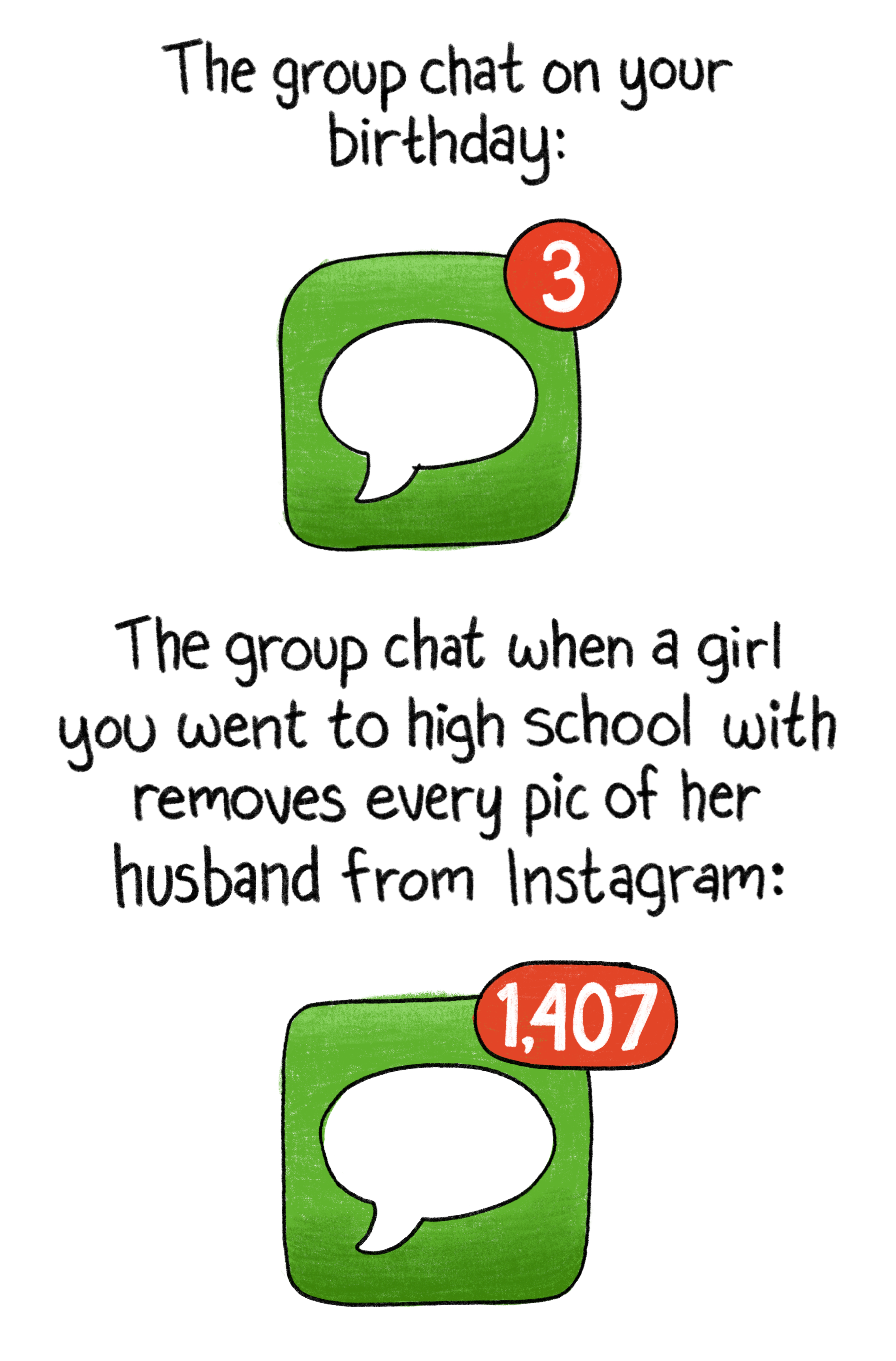
I am responsible for like 1,350 of those messages, so this is not a judgment. Back to the advice!
Dear Stephen,
I had a falling out with a friend group about two years ago. It stemmed from a conflict with my best friend at the time, who was cheating on her husband and I was the only one who knew about it.
I kept her secret, they got divorced, and when, during their breakup, he asked her if she had cheated, she lied to him. It should also be noted that the husband was also a close friend of mine and part of a very close-knit group of friends we all shared. I was present for a lot of “processing” of the breakup among our group, all based on the lie — comments about how “both of you are doing things the right way and handling this with such care”, etc. It really got to me.
I didn’t know what to do at the time and I was also going through some pretty major things in my own life and I just completely removed myself from the group and went no-contact. The other friends in the group were understandably confused and hurt by this. Now I’m wondering how to apologize. I’m not interested in going into the details of the cheating and lying. Should I even reach out? I’m not expecting to rekindle friendships, although I wouldn’t be opposed to it.
—Ghosted The Group

Dear Ghosted The Group,
I’d try to rekindle all but one of these friendships — it seems wise to leave the lying, cheating friend in the past. But the rest? Reach out. Good friends are a blessing, and given that these ones haven’t done anything wrong, I think your life would be better off with them.
You say that you don’t want to expose the affair now, so I’ll honor that instinct. I do think that continuing to withhold this info from the ex-husband will limit how close a friendship you can have with him, but that’s a reasonable concession to make to protect your peace. Honestly, I’m not sure how he’d even benefit from learning about this two years post-divorce, so maybe you’re protecting his peace too.
But with the rest of the group, I think you just need a basic explanation of why you went no-contact and an acknowledgment of the hurt this decision caused. Maybe something like:
"Around the time of Joe and Marissa’s divorce, I had some personal differences with Marissa that made it hard for me to be around the group. My solution at the time was to ghost the group entirely. I regret that; I wish I had taken care to preserve my individual friendships even when the group dynamic was no longer comfortable for me. I am really sorry. I’d love to hear about what’s been going on in your life lately."
Be prepared for some follow-up questions! If these friends are anything like me, they’re gonna try to get the tea. But I think you can just stick to the point that actually matters: You regret ghosting, and you’d like to reconnect. Good luck.
Wow, time flies! It seems like just yesterday you clicked on this advice column, and now you are finished reading it. But before you go, I hope you'll subscribe to my newsletter! You'll get each new issue of Stephen Please directly in your inbox — and it's 100% free!

Comments