Read time: 8 mins Background and Research Since 1992, Dr. John Ziker has worked in the Arctic, beginning in Siberia and later expanding to other Arctic communities in Europe and North America. As an anthropologist, Ziker studies how decision-making, the environment, and community resilience intersect in human populations, a perspective that is essential in working… Read more »
Blog & News Items
New Software Features Make Arctic Data Center Portals Easier to Customize
Read time: ~4 mins The Arctic Data Center software development team continues to improve MetacatUI, the software that powers our data repository and customized data portals. The latest release, version 2.41.0, introduces new features for creating interactive 3D maps, naming and finding data portals, and tracking map layer loading. The update also includes improvements to… Read more »
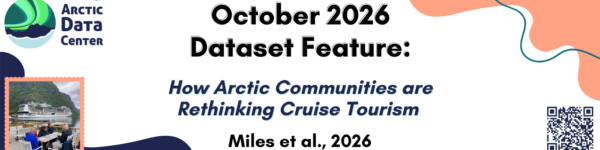
How Arctic Communities are Rethinking Cruise Tourism
14 Minute Read Research and Background As sea ice retreats, cruise ships are reaching Arctic ports and routes that were once difficult to access, and the cruise tourism industry is rapidly growing. In Juneau, Alaska, a city that has roughly 30,000 residents, about 1.4 million cruise passengers arrived each year when this project first began,… Read more »
Connecting Arctic Data to Science and Solutions at the 2026 Navigating the New Arctic Meeting
6 Minute Read How can researchers make sense of the enormous and growing amount of data being collected across the Arctic? And how can that data be made easier to discover, explore, and use to address real-world challenges? These questions were explored during the 2026 Navigating the New Arctic (NNA) Annual Community Meeting, held September… Read more »
Making Dataset Submissions More Reliable at the Arctic Data Center
5 minute read When you upload or update a dataset at the Arctic Data Center, there is a lot happening behind the scenes. Your data files, metadata, and the connections between them all need to be saved correctly and kept in sync. Most of the time, this happens without much thought. But when something goes… Read more »
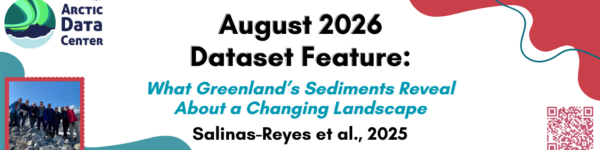
What Greenland’s Sediments Reveal About a Changing Landscape
19 Minute Read From Florida to Greenland: The Researchers Behind the Science The Significance of Ice-loss to Landscapes in the Arctic (SILA) project began in 2020, but builds on an extensive history of collaboration among U.S. and Greenlandic scientists focused on understanding how landscapes, ecosystems, and water systems have changed following the loss of ice… Read more »
New Interactive Experiences in Portal Maps to Support Data Exploration at the Arctic Data Center
We’re excited to announce a new release of the Arctic Data Center’s software platform (Metacat UI 2.37.0), with powerful new ways to explore datasets and create richer data portal experiences. This release presents improvements to dataset version history, interactive mapping capabilities, and overall usability. Embedded Interactive Visualizations in Portal Maps Data portals are more valuable… Read more »
New Dataset Versioning Features to Support Reproducible Research
We’re excited to announce a new release of the Arctic Data Center’s software platform (Metacat UI 2.37.0), with powerful new ways to explore datasets and create richer data portal experiences. This release presents improvements to dataset version history, interactive mapping capabilities, and overall usability. Explore the Complete Version History of a Dataset Research datasets often… Read more »
What Arctic Phytoplankton Tell Us About a Changing Ocean
A Journey into Arctic Research Growing up, Dr. Clare Gaffey viewed the Arctic through a rose-colored lens: a vast, pristine landscape of white and blue ice, thriving ecosystems, and minimal human influence. Yet, her path into Arctic research was anything but direct. After earning a Bachelor’s degree in Environmental Science and a Master’s degree in… Read more »
NSF Reaffirms Commitment to Long-Term Preservation and Access of Arctic Research Data
In May 2026, the National Science Foundation (NSF) reaffirmed its commitment to Arctic research, data stewardship, and open science by awarding five additional years of funding for the Arctic Data Center. Led by the National Center for Ecological Analysis and Synthesis (NCEAS) at the University of California Santa Barbara, the Arctic Data Center has become… Read more »