


Abstract
Palm sap, particularly from the palmyra palm (Borassus flabellifer), represents a valuable natural resource with multifaceted applications in nutrition, medicine, and sustainable industries. This study provides a comprehensive bibliometric analysis of research trends related to palm sap, utilizing data from the Web of Science and Scopus databases covering the period of 2015–2025. Analysis reveals that Indonesia, Thailand, and India are leading contributors to the scientific literature in this domain. Research activities have primarily focused on the physicochemical properties, bioactive constituents, fermentation dynamics, preservation techniques, and value-added applications of palm sap and its derivatives. The findings highlight the potential of palm sap to be produced as functional foods, renewable bioethanol, antimicrobial agents, biodegradable composites, and photovoltaic materials. Despite increasing research outputs, significant gaps persist regarding the optimization of processing techniques, quality assurance standards, toxicity evaluation, and commercialization strategies. Additionally, concerns such as acrylamide formation during thermal processing and microbial quality during storage underscore the need for stringent quality control measures. Future research directions should emphasize the integration of biotechnological advancements, such as microbial strain optimization and metabolic engineering, with traditional knowledge systems to enhance product development. Furthermore, interdisciplinary approaches combining food science, material science, biotechnology, and ethnobotany are critical to unlocking the full potential of palm sap. This bibliometric review provides a consolidated foundation for future investigations, aiming to foster innovation, promote sustainable utilization, and support policy development for palm-based resources in the context of global food security, renewable energy, and health care solutions.
Introduction
Palms, comprising trees, shrubs, and perennial lianas, belong to the family Arecaceae and represent an essential component of tropical and subtropical ecosystems. With approximately 2600 known species distributed across the globe, palms are particularly prominent in warm temperate and tropical regions where they contribute significantly to the ecological, cultural, and economic landscapes [1]. Among these, the palmyra palm (Borassus flabellifer), often referred to as the “tree of life,” holds exceptional value due to its multifaceted applications in food, medicine, construction, and traditional crafts. B. flabellifer is a tree that can be prevalent in the semi-arid regions of India and various countries in Southeast Asia [2]. India is home to an estimated 60 million palmyra palms with the southern state of Tamil Nadu hosting the largest concentration [3]. This tree is deeply integrated into the agrarian and traditional lifestyles of South and Southeast Asia. Its various parts including fruit, trunk, leaves, flowers, and especially the inflorescence sap are used for a wide range of purposes. Of particular interest is the sweet, nutrient-rich sap known locally as padhaneer which is harvested from the inflorescence. This sap serves as a base for producing products like palm sugar, jaggery, and fermented beverages and is also consumed fresh for its health-promoting properties [4]. Despite its nutritional and medicinal potential, the consumption of palm sap in urban regions has significantly declined, largely due to negligence, lack of awareness, and absence of modern marketing strategies [5]. Nonetheless, B. flabellifer remains highly valued across South and Southeast Asia for its holistic utility. The tree offers food security through its edible fruits, contributes to sustainable construction with its sturdy trunk, and supports artisanal economies through the use of its fibrous parts for brushes, ropes, and handicrafts [6, 7]. The palmyra palm has also been recognized for its medicinal attributes. Traditional knowledge and emerging scientific evidence highlight its use in treating various ailments. The leaf powder and male flowers of the plant exhibit antimicrobial, anti-inflammatory, and analgesic properties, making them useful in traditional remedies. The diverse pharmacological and economic applications have led to the palmyra being utilized in over 800 documented ways, ranging from nutrition and medicine to fiber and fuel [8]. While numerous studies have explored the nutritional, pharmacological, and socio-economic value of palm sap, there is a notable absence of a systematic bibliometric analysis in this domain. Bibliometric analysis, as a methodological tool, enables researchers to quantitatively assess the academic landscape by identifying key trends, influential publications, prominent authors, research networks, and emerging topics. The bibliometric study will enable organizations and institutions assess the caliber of research on this subject, which can aid in advancing the field and addressing gaps [9,10,11]. Conducting such an analysis for palm sap and its applications can provide valuable insights into the progression of scientific interest, highlight research gaps, and inform future interdisciplinary investigations. The present study aims to perform a comprehensive bibliometric analysis on palm sap research, mapping the evolution of knowledge and uncovering future directions in the field of palm-based nutrition, medicine, and industry.
Bibliometric analysis of palmyra sap
Search strategy
The bibliometric analysis was conducted using data retrieved from the Clarivate Analytics WoS Core Collection database and Scopus database which is widely recognized for its comprehensive coverage of scientific literature. The literature search was conducted using an expanded Boolean query incorporating all major synonymous and related terms recommended for comprehensive retrieval. The revised search query applied across all three databases was as follows: (“Palmyra” OR “Borassus flabellifer” OR “Borassus flabellifer L” OR “Borassus”) AND (“sap” OR “palm sap” OR “neera” OR “toddy” OR “palm wine” OR “padhaneer” OR “palm nectar” OR “palm juice” OR “inflorescence sap”). To ensure the relevance of the results, the search was limited to occurrences of these terms in the titles, abstracts, and keywords of published documents. The search covered publications from the last 10 years, spanning the period from 2015 to 2025.
Inclusion and exclusion criteria
Documents were included if they: (i) were published between 2015 and 2025; (ii) appeared in peer-reviewed journals, conference proceedings, or book chapters indexed in WoS or Scopus; (iii) contained the search terms (“Palmyra” OR “Borassus flabellifer” OR “Borassus flabellifer L” OR “Borassus”) AND (“sap” OR “palm sap” OR “neera” OR “toddy” OR “palm wine” OR “padhaneer” OR “palm nectar” OR “palm juice” OR “inflorescence sap”) in the title, abstract, or keywords; and (iv) were available in English. Documents were excluded if they: (i) were non-English publications without an English abstract; (ii) were retracted articles; (iii) contained the search terms only incidentally without substantive focus on palmyra sap; or (iv) were editorials, letters, or errata.
Data extraction and duplicate removal
The search retrieved 32 documents from WoS (25 original articles, 6 review articles, and 1 proceeding paper) and 41 documents from Scopus (30 articles, 4 conference papers, 5 reviews, and 2 book chapters). Raw data from both databases were exported in CSV and BibTeX formats respectively and imported into the Bibliometrix and analysis tools of Scopus and Web of Science for processing. Duplicate records, defined as documents sharing identical titles, authors, and publication years across both databases, were identified and removed using the built-in deduplication function in Bibliometrix. Following deduplication, 6 records were found to be exclusive to WoS, yielding a final merged dataset for combined analysis. The complete data cleaning and deduplication process was performed prior to any analytical step to ensure dataset integrity. A PRISMA-style flow diagram documenting the complete record retrieval, screening, and inclusion process is depicted in Fig. 1.
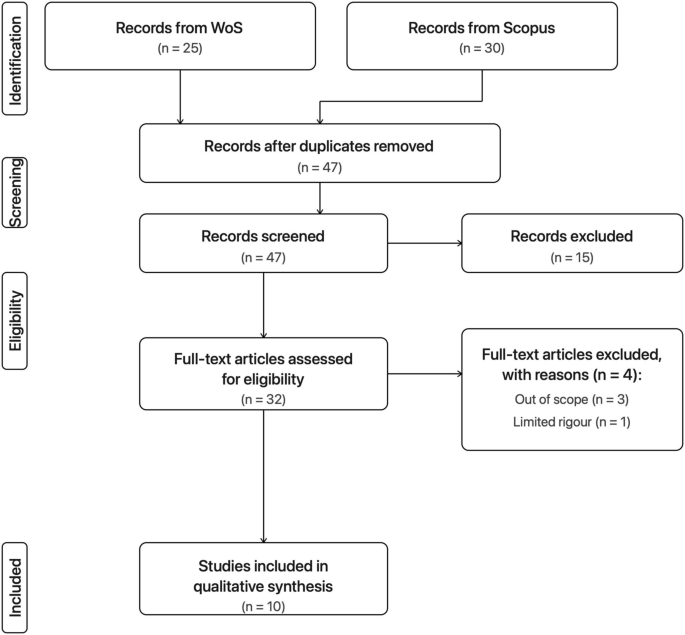
PRISMA 2020 flow diagram illustrating the record retrieval, screening, and inclusion process for the bibliometric analysis
Bibliometric analysis
Bibliometric indicators were systematically extracted and analyzed using Bibliometrix and the native analytical tools of Scopus and WoS. The following indicators were assessed: (i) annual publication output and temporal trends; (ii) geographic distribution of scientific contributions by country; (iii) institutional productivity based on author affiliations; (iv) author productivity and collaboration networks; (v) journal and source analysis; (vi) citation analysis including total citations, average citations per year, and most-cited documents; (vii) keyword co-occurrence analysis for thematic mapping; and (viii) funding sponsor analysis. Thematic maps were constructed using the strategic diagram function in Bibliometrix, which positions research themes based on centrality (relevance to the field) and density (internal development of the theme), providing a visual representation of motor themes, niche themes, emerging themes, and declining themes in the literature. Research trends were shown using a combined analysis of the data collected from WoS and Scopus. This analysis includes the identification of the top 10 countries, top 10 affiliations, most prolific authors, and key journals/sources each publishing research on palmyra palm and its sap. From data obtained from Scopus and WoS for the keywords, the annual scientific production was illustrated in Fig. 2A. The word cloud was created using Bibliometrix for the documents indexed in Scopus and WoS. The generated word cloud for Scopus and WoS was shown in Fig. 2B.

Bibliometric analysis of scientific literature on palmyra sap research. A Annual publication trends retrieved from Scopus (a) and Web of Science (WoS) (b) databases using the assigned keywords. B Keyword co-occurrence word clouds generated from Scopus- (a) and WoS-indexed (b) literature. C Geographic distribution of global scientific output on palmyra sap research as indexed in Scopus (a) and WoS (b). D Top 10 institutional contributors to palmyra sap research identified from Scopus- (a) and WoS-indexed (b) publications
Scientific production of countries from Scopus and WoS has been illustrated in Fig. 2C. Among the work published in Scopus by various countries, Indonesia has the highest of 11 documents out of 29 documents followed by Thailand with 8 documents and India with 4 documents. Indonesian institutions alone provided 9 papers when looking at the document count across the top 10 affiliations. With 5 papers, “Institut Teknologi Sepuluh Nopember” in Indonesia took the lead, closely followed by “Politeknik Pertanian Negeri Payakumbuh” in Indonesia with 4 publications. With eight documents, “Kasetsart University” in Thailand with 3 documents. From the WoS database the documents obtained for the keywords, India tops accounting for 8 documents. Thailand is the second highest country with 6 documents, followed by Australia and Indonesia with 2 documents each. Among affiliations, “Kasetsart University” of Thailand holds 3 documents followed by “Chung Jen College of Nursing Health Science and Management” and “Da-Yeh University” each with 2 documents. Most relevant affiliations indexed in Scopus and WoS were demonstrated in Fig. 2D. Darminto et al. [12], Sarma et al. [5], and Wiboonsirikul [13] remain as top researchers of this field each publishing 2 articles according to WoS. In Scopus, Koni et al. [14] and Widjaja et al. [15] have 3 articles and remain as top researchers. The top 10 authors indexed in Scopus and WoS were illustrated in Fig. 3A. The collaboration network of authors for documents indexed in Scopus and WoS is depicted in Fig. 3B. Based on the WoS findings, Wiley has published the highest number of 5 articles followed by MDPI with 4 documents and Elsevier with 3. The three-field plot relating the country, author, and affiliations indexed in Scopus and WoS is depicted in Fig. 3C. The thematic map generated using Bibliometrix categorizes research themes based on centrality and density, providing insights into the development and relevance of topics in palm sap research. Figure 3D represents the themes of documents indexed under Scopus and WoS. The subject area of Scopus-indexed documents was analyzed. The palm sap research is predominant in the field of agriculture. The subject area analysis results are shown in Fig. 4. The source in which the documents are published is also analyzed using Bibliometrix for both Scopus- and WoS-indexed documents. For Scopus-indexed documents, ARPN Journal of Engineering and Applied Sciences and Journal of Food Processing and Preservation published 2 articles. For WoS-indexed documents, Journal of Food Processing and Preservation tops the source list by publishing 2 documents. The most relevant sources are shown in Fig. 5A for Scopus- and WoS-indexed documents. The most-cited document globally in both Scopus and WoS is by Darminto et al. [12]. The document was cited 19 times in Scopus and 16 times in WoS. The top 10 cited documents in Scopus and WoS are given in Fig. 5B. The co-occurrence of documents in Scopus and co-citation network for documents indexed in WoS were analyzed using Bibliometrix and depicted in Fig. 5C. The average citations for the keywords for the documents indexed in Scopus and WoS were generated using Bibliometrix. The maximum number of citations for documents indexed in both Scopus and WoS was in the year 2020. The average citations over 10 years are given in Fig. 5D.

Author productivity, collaboration patterns, and thematic structure of palmyra sap research. A Top 10 most productive authors based on Scopus- (a) and WoS-indexed (b) publications. B Author collaboration networks derived from Scopus- (a) and WoS-indexed (b) literature. C Three-field plots depicting country–author–affiliation linkages in Scopus- (a) and WoS-indexed (b) documents. D Thematic maps illustrating the intellectual structure of palmyra sap research based on Scopus- (a) and WoS-indexed (b) literature

Subject area distribution of Scopus-indexed documents related to the keywords (“Palmyra” OR “Borassus flabellifer” OR “Borassus flabellifer L” OR “Borassus”) AND (“sap” OR “palm sap” OR “neera” OR “toddy” OR “palm wine” OR “padhaneer” OR “palm nectar” OR “palm juice” OR “inflorescence sap”)

Source relevance, citation impact, and document co-citation structure of palmyra sap research. A Most relevant publication sources identified from Scopus- (a) and WoS-indexed (b) literature. B Highest cited documents retrieved from Scopus- (a) and WoS-indexed (b) publications. C Document co-occurrence (a) and co-citation (b) networks derived from Scopus- and WoS-indexed literature, respectively. D Average annual citation rates for palmyra sap-related documents indexed in Scopus (a) and WoS (b)
The combined retrieval of records from WoS and Scopus reflects the genuine and inherent scarcity of internationally indexed scientific literature specifically focused on palmyra palm sap. Furthermore, palmyra palm sap research is frequently embedded within broader studies on palm species, traditional fermented beverages, or non-centrifugal sugar production without specific indexing terms that would enable targeted retrieval.
Physicochemical stability of palmyra sap
Influence of pH on the physicochemical properties and sugar crystallization potential of Borassus flabellifer Linn. sap
Palm sap obtained from B. flabellifer serves as a key raw material in palm sugar production, with its quality and crystallization potential being significantly influenced by its pH. The pH of the sap affects not only its chemical composition but also its microbial profile and sugar yield during processing. Studies have shown that sap with lower pH values (below 5.0) tends to contain higher levels of reducing sugars, titratable acidity, and lactic acid bacteria (LAB) all of which contribute to increased fermentation activity and hindered crystallization due to excessive acid formation [13]. Conversely, sap with a pH ranging from 6.9 to 7.5 and above has been found to be richer in proteins and amino acids, conditions that are more conducive to effective sugar crystallization. These biochemical components, particularly amino acids, also participate in Maillard reactions during heating, enhancing both the flavor and color of the final sugar product [16]. In addition, the presence of proteins may facilitate nucleation, thereby promoting the crystallization process. The microbial ecology, particularly the abundance of LAB has a considerable impact on the transformation of saccharides and organic acids within the sap. These microbial dynamics alter the chemical profile, often making the sap unsuitable for sugar production if not properly managed [5]. Advanced multivariate techniques, such as principal component analysis (PCA), have been employed to evaluate the relationships between physicochemical parameters, such as pH, sugar concentration, and microbial load and their collective effect on crystallization behavior. These analytical models have proven effective in identifying optimal pH ranges and conditions that enhance sugar yield and quality [17].
Effect of temperature on the physicochemical and processing characteristics of B. flabellifer sap and its derivatives
Temperature plays a critical role in determining the physicochemical stability, fermentation kinetics, and commercial viability of products derived from B. flabellifer sap. Its influence extends from raw sap preservation to the thermal processing of jaggery and syrup, with implications for product quality, shelf life, and consumer safety.
Storage temperature and fermentation kinetics
Sarma et al. investigated the impact of storage temperature on palmyra sap under ambient (30 ± 2 °C) and refrigerated (7 ± 1 °C) conditions, focusing on its fermentation behavior and stability [5]. The sap, analyzed at 10-h intervals, exhibited progressive degradation of major sugars, sucrose, glucose, and fructose under ambient conditions. Sucrose degradation followed a first-order kinetic model and ethanol content increased rapidly, reaching 6.24% within just 10 h, indicating vigorous spontaneous fermentation. In contrast, refrigeration significantly curtailed biochemical transformations, maintaining the integrity of sugar content and effectively preventing alcohol formation. This study is notably the first to apply zero, first, and second order kinetic models to palmyra sap fermentation, offering a scientific basis for optimizing preservation strategies and predicting shelf life [5].
Thermal properties of palmyra jaggery candy
The thermal behavior of palmyra palm jaggery, a value-added confectionery product, is also highly dependent on temperature. Chauhan et al. analyzed the crystalline structure, thermal properties, and textural attributes of palmyra jaggery candy [17]. Scanning electron microscopy (SEM) revealed smooth, heterogeneous crystals, while increased heating temperatures (28 to 108.4 °C) significantly influenced product properties. Total soluble solids rose from 28.8 to 84°Brix. Thermal conductivity, diffusivity, and specific heat showed consistent declines with increasing temperature, critical parameters for processing equipment design. Specifically, thermal conductivity reduced from 0.44 to 0.14 W/m·K, diffusivity from 0.31 × 10⁻⁶ to 0.05 × 10⁻⁶ m2/s, and volumetric specific heat from 1.35 × 10³ to 0.64 × 10³ kJ/m3·K. Concurrently, thermal resistivity increased and the hardness of the candy peaked at 6419 g. Viscosity behavior was best modeled using a power-law model (R2 = 0.93), underscoring its relevance for standardizing jaggery production [17].
Impact of heating on syrup quality and HMF accumulation
Heating conditions also affect the color, antioxidant potential, and safety of palmyra syrup, particularly in relation to 5-hydroxymethylfurfural (HMF), a potential carcinogen regulated by Codex Alimentarius with a maximum limit of 80 mg/kg. A study conducted by Djohan and Meenune demonstrated that slow heating generated a darker syrup with elevated HMF levels (56.34 mg/kg), although still within permissible limits [18]. This method also increased antioxidant capacity (0.28 μmol TE/g) and phenolic content (227.13 mg/L GAE). On the other hand, rapid heating produced lighter syrup with significantly lower HMF (17.54 mg/kg), while preserving acceptable sensory and nutritional qualities. These findings highlight the importance of controlled thermal processing to balance safety and nutritional retention in palmyra syrup production [18].
Industrial and nutritional application
Taken together, physicochemical quality of palmyra sap is highly dynamic and sensitive to multiple interacting variables including pH, temperature, microbial load, and processing method. The work of Wiboonsirikul [13] demonstrates that pH governs both microbial ecology and sugar crystallization potential, while Sarma et al. [5] establish that temperature is the primary determinant of fermentation kinetics and shelf life. Djohan and Meenune [18] further demonstrate that thermal processing conditions simultaneously influence color, antioxidant capacity, and safety-relevant compounds such as HMF. Collectively, these findings suggest that the successful industrial processing of palmyra sap into value-added products including palm sugar, jaggery, and syrup requires an integrated, multi-parameter approach to quality control. For the palm sugar industry specifically, the evidence supports the development of pH-monitoring systems at the point of sap collection and the implementation of rapid cooling protocols to minimize fermentation during transport, two practically feasible interventions that could substantially improve crystallization yield and product consistency [19]. For syrup production, the evidence suggests that rapid rather than slow heating should be adopted as the standard thermal processing protocol to minimize HMF accumulation while preserving acceptable antioxidant and sensory properties [20].
Antioxidant activity, nutritional composition, and functional potential of palmyra-derived products
Impact of processing methods on sap quality
The processing method significantly influences the antioxidant activity, nutritional composition, and Maillard reaction by-products in palmyra palm sap. Huynh Thi Le et al. compared syrup processed via thermal treatment and ultrafiltration. Ultrafiltration improved the visual clarity of the syrup but altered its volatile compound profile, resulting in reduced antioxidant activity. In contrast, heat-treated syrup exhibited darker coloration (lower L*, a*, and b* values) and stronger antioxidant potential. A total of 38 volatile compounds, primarily alcohols, ketones, and acids, were identified along with ten vitamins most notably vitamin E, which was the most abundant [16]. The Maillard reaction, induced during thermal processing, was associated with a reduction in protein content and an increase in total phenolic compounds and HMF. Although the HMF concentration ranged from 0.02 to 14.95 mg/100 g, it remained well within Codex Alimentarius safety thresholds. Ultrafiltration helped reduce HMF content but simultaneously compromised physicochemical stability and the integrity of volatile compounds, indicating trade-offs between clarity and nutritional quality [16].
Nutritional and antioxidant properties of palmyra granulated sugar
In Cambodia, granulated palm sugar is a traditional sweetener widely consumed for its perceived health benefits. Huynh Thi Le et al. investigated the nutritional profile, antioxidant activity, and volatile composition of granulated palm sugar produced through three vacuum-drying conditions (80 °C, 90 °C, and 100 °C for 60, 75, and 90 min). The resulting sugars contained 38 volatile compounds across various chemical classes and exhibited HMF concentrations ranging from 2.18 to 41.92 mg/100 g. Vitamin analysis revealed the presence of ten essential vitamins, with vitamin E being the most abundant (52.15–55.12 mg/100 g) [16]. The antioxidant potential of the sugars was confirmed by multiple assays: FRAP values ranged from 322.68 to 378.23 μmol Fe2+/mL, DPPH radical scavenging activity from 20.15 to 37.88%, and total phenolic content between 2.77 and 8.94 mg GAE/100 g. These findings suggest that granulated palm sugar produced under optimized thermal conditions retains measurable antioxidant activity in vitro, as evidenced by FRAP, DPPH, and total phenolic content assays. However, it is important to note that in vitro antioxidant measurements do not necessarily translate directly to in vivo health benefits [16].
Bioactivity of haustorium-derived functional ingredients
Nutritional and therapeutic value extends beyond palm sap and sugar to other parts of the palmyra palm. A study on the haustorium derived from B. flabellifer (BH) and Cocos nucifera (CH), focusing on its anti-diabetic, antioxidant, and nutritional properties, was conducted, wherein BH demonstrated significantly higher levels of protein, dietary fiber, fat, and polyphenolic compounds than CH. Antioxidant assays revealed greater nitric oxide scavenging activity, inhibition of lipid peroxidation, and radical scavenging capacity in BH [21]. Both BH and CH haustoria exhibited anti-diabetic properties by inhibiting α-amylase and α-glucosidase enzymes, but BH was notably more effective at lower concentrations. These bioactivities, demonstrated under in vitro experimental conditions, suggest that palm haustorium may warrant further investigation as a candidate nutraceutical or functional food ingredient. However, the current evidence is limited to laboratory-based assays, and the concentrations at which anti-diabetic and antioxidant effects were observed may not be readily achievable through dietary intake alone [19].
Antimicrobial potential of palm jaggery
The functional potential of palm jaggery extends to antimicrobial applications. Reddy conducted a metabolomic analysis of palm jaggery using high-resolution electrospray ionization mass spectrometry (HRESIMS) and identified four prominent antimicrobial compounds such as diselane, selenophosphate, and carnosol. These compounds demonstrated significant antibacterial activity against both Gram-positive and Gram-negative bacteria [22]. Carnosol, a well-known phenolic diterpene, exhibited potent antioxidant and antibacterial effects. Selenophosphate, a selenium-containing compound, plays a pivotal role in bacterial metabolic pathways. These findings provide preliminary metabolomic evidence that palm jaggery contains compounds with demonstrable in vitro antibacterial activity [22].
A unifying theme across the work of Huynh Thi Le et al. [16], and Narayanankutty et al. [21] is that thermal processing, while necessary for product stability and safety, introduces trade-offs between bioactive preservation and the formation of potentially harmful compounds such as HMF and acrylamide. The convergence of evidence from multiple studies on the prominence of vitamin E among the vitamins identified in palmyra-derived products is particularly noteworthy, suggesting that palmyra sugar and syrup may represent an underappreciated dietary source of this fat-soluble antioxidant vitamin in populations where palmyra-based foods are traditionally consumed. The anti-diabetic properties demonstrated in palmyra haustorium, combined with the antioxidant and antimicrobial activity documented across multiple palmyra-derived products, collectively suggest that the nutritional value of palmyra sap extends well beyond its role as a sweetener [16, 21].
Microbiological quality of palmyra sap
Regional variation in palm sap quality
The quality of B. flabellifer Linn. sap is inherently influenced by regional and environmental factors, as well as post-harvest processing practices. Variations in physicochemical and microbiological properties of sap harvested from different geographic zones have been reported, underscoring the need for standardized quality control in both traditional and commercial contexts. In a comparative study conducted in Thailand, pasteurized palm sap collected from Bangkok, Phetchaburi, and Ayutthaya was evaluated [23]. Five samples from each location were analyzed to assess visual clarity, color, sugar composition, acidity, and microbial load (Table 1). The results revealed statistically significant differences (p < 0.05) among the samples, demonstrating that geographic origin plays a substantial role in determining sap quality. Optical transmittance ranged from 27.32 to 81.30%, indicating variability in turbidity and suspended particles. The colorimetric parameters varied widely, with L* values ranging from 44.12 to 78.67 (lightness), a* values from 0.40 to 2.61 (red/green axis), and b* values from 10.47 to 19.33 (yellow/blue axis), reflecting both chemical and enzymatic browning effects. Chemical analysis further showed total soluble solids between 14.60 and 24.10°Brix, acidity from 0.01 to 0.23%, and pH values ranging from 5.00 to 8.17. The sugar composition indicated the dominance of sucrose (13.67–19.05%), accompanied by glucose (0.14–4.85%) and fructose (0.17–4.17%). Consequently, total sugar content ranged from 14.23 to 24.10%, with reducing sugars making up 0.25 to 8.47%. The phenolic content, ranging between 0.64 and 1.03 mg/g, highlights the sap’s potential as a source of antioxidants. However, microbial analysis revealed that total viable counts, as well as yeast and mold counts, exceeded the permissible limits outlined by the Thai Community Product Standards. These findings suggest inadequate post-harvest hygiene or temperature control during storage and transport.
Microbial ecology and fermentation potential of palm sap
Palm sap provides a naturally rich and diverse microbiological environment, playing a key role in traditional fermentation processes and emerging bioethanol applications. Studies across Southeast Asia and Africa have revealed a complex community of native yeasts, lactic acid bacteria (LAB), and other microorganisms that influence both the quality and transformation potential of palm sap.
Yeast biodiversity and fermentative capacity
The yeast populations in fresh saps collected from three palm species, coconut, palmyra, and nipa palms, to evaluate their diversity and bioethanol potential, wherein a total of 204 microbial isolates were identified, belonging to 15 species of Ascomycota and one Basidiomycota, confirming a high level of yeast biodiversity [24]. Among these, Saccharomyces cerevisiae emerged as the most dominant species, found in 100% of nipa palm sap samples, 86.7% of palmyra sap, and 76.7% of coconut sap (Table 2). Other notable species included Candida tropicalis and Pichia kudriavzevii, which were exclusive to coconut and palmyra sap, whereas Hanseniaspora guilliermondii and Lachancea thermotolerans were present in all three. The fermentation capacity of 199 isolates was evaluated and Lachancea fermentati YSP383, isolated from nipa palm sap, produced the highest ethanol concentration at 76.74 g/L. Additionally, 26 isolates from various species yielded ethanol levels between 69.57 and 76.74 g/L, highlighting the potential of native yeasts as promising candidates for bioethanol production from palm sap. In West Africa, particularly in Burkina Faso, the sap of Borassus aethiopum Mart. (palmyra palm) naturally ferments due to indigenous microbiota. In another study, 60 yeast strains and 30 lactic acid bacteria (LAB) were isolated from fresh and naturally fermented palm sap [25]. Among LAB, Leuconostoc mesenteroides was the most prevalent (67%), followed by Enterococcus species (23%) and Enterococcus gilvus (10%). E. gilvus was particularly notable, as it was identified for the first time in palm wine. Yeast analysis revealed a dominance of Saccharomyces cerevisiae (63%), with Pichia kudriavzevii comprising the remaining 37%. These findings reinforce the microbial consistency seen in traditional palm-based fermentations and offer insight into their functional properties for alcoholic beverage production and microbial safety assessment [24].
Nutritional and biochemical composition during initial tapping
The early stages of palm sap tapping have also been characterized for the nutritional, biochemical, and microbial profile of fresh B. aethiopum sap over 4 days of collection [25]. The sap remained sweet and low in alcohol content with an average pH of 4.84, total sugars at 11.36%, and reducing sugars at 2.93%. Key sugars identified included sucrose (6.75%), glucose (4.99 g/L), and fructose (7.09 g/L). Although galactose and xylose were absent, the sap was rich in vitamin C (8.93%) and minerals such as potassium, magnesium, calcium, and ammonium, with potassium being the most abundant (13.26 g/L). Organic acids such as lactate, succinate, acetate, and citrate were also present, suggesting active biochemical transformation. The microbial load was substantial, including total aerobic flora (1.23 × 10⁸ cfu/mL), yeasts (7.27 × 10⁵ cfu/mL), LAB (1.86 × 10⁷ cfu/mL), and acetic acid bacteria (3.75 × 10⁵ cfu/mL). These findings indicate that fresh palmyra sap not only has significant nutritional value but also a diverse microbiota, making it suitable for development into fermented beverages, functional foods, syrups, and sugar substitutes [25].
Fermentation dynamics of palm sap-based beverages
Palm sap is widely consumed in the form of mildly alcoholic beverages such as toddy, which is traditionally produced through natural fermentation processes. The dynamics of this fermentation, including microbial succession, biochemical changes, and bioactive compound development, play a significant role in defining the nutritional and sensory properties of the final product.
Microbial succession and biochemical transformation
A recent study conducted in the Indian states of West Bengal and Jharkhand investigated the spontaneous fermentation of toddy derived from B. flabellifer (palmyra) and Phoenix sylvestris (date palm) saps over a 48-h period [26]. Molecular techniques including rep-PCR and DNA sequencing were employed to identify dominant microbial populations. The key fermentative organisms included Enterococcus faecalis, Lactiplantibacillus plantarum, Lacticaseibacillus paracasei, and Saccharomyces cerevisiae. These microbes are instrumental in both alcoholic fermentation and the modulation of flavor and health-promoting bioactives. During the fermentation process, a gradual decline in pH and sugar levels was observed, accompanied by an increase in titratable acidity, alcohol content, ester formation, and protein concentrations. The rise in ester compounds likely contributes to the characteristic aroma of toddy, while the alcohol concentration, though mild, adds to its preservation and sensory profile [26].
Enhancement of nutritional and functional properties
In addition to its alcoholic content, toddy is rich in bioactive compounds, including phenolics and flavonoids which significantly improved its antioxidant activity over the fermentation period. These attributes position toddy not only as a traditional fermented beverage but also as a potential functional food offering health benefit through the scavenging of free radicals. The fermentation dynamics were also found to be influenced by local environmental conditions, such as temperature and sap composition, as well as interactions among indigenous microbial communities, suggesting a high degree of terroir-driven variability in toddy quality and health potential [26].
Controlled fermentation systems using selected native starter cultures could be developed to standardize toddy quality, improve safety, and enhance the concentration of health-promoting bioactives including phenolics, flavonoids, and organic acids across production regions. The collective increase in antioxidant activity over the fermentation period supports the potential repositioning of fermented palmyra sap as a functional fermented beverage rather than a simple alcoholic product [27]. From an industrial perspective, the evidence collectively suggests that controlled fermentation of palmyra sap, using optimized starter cultures, defined fermentation parameters, and hygienic production infrastructure, could yield a standardized functional beverage product with documented bioactive content.
Preservation techniques for palm sap
The high fermentability and nutrient-rich composition of palm sap make it susceptible to rapid microbial spoilage, limiting its shelf life and commercial viability. Effective preservation strategies are therefore essential to extend usability and ensure product safety. Among these, hurdle technology and microbial transformation approaches have shown considerable promise [28, 29] (Table 3).
Preservation of palm sap using hurdle technology
Hurdle technology involves the strategic combination of preservation methods to inhibit microbial growth while maintaining the nutritional and sensory quality of the product. Sarma et al. evaluated the efficacy of three different hurdle treatments, thermal pasteurization (68 °C for 20 min), calcium hydroxide (Ca(OH)2) addition, and Mesua ferrea bark extract, in preserving palmyra sap stored at both ambient (32 ± 2 °C) and refrigerated (7 ± 1 °C) conditions over 28 days [5]. Among the tested samples, TS2, which was treated with calcium hydroxide, demonstrated the most effective preservation performance. It significantly delayed fermentation, retaining low alcohol levels (0.9% under ambient conditions and 0.1% under refrigeration), and maintained organoleptic acceptability. The sap treated with Ca(OH)2 also showed controlled fermentation patterns, characterized by a modest increase in reducing sugars and a gradual pH decline, indicating inhibition of microbial growth. Shelf-life prediction based on zero-order kinetic modeling confirmed reduced microbial activity and alcohol generation in hurdle-treated samples. Refrigerated storage further enhanced preservation outcomes, emphasizing the role of temperature control in prolonging palm sap viability. This approach highlights the potential of mild chemical and thermal treatments in maintaining the freshness and safety of traditional beverages derived from palm sap [22].
Nata de legen: bioconversion approach for value addition
A novel preservation and value-addition method was demonstrated as production of nata de legen, a cellulose-based fermented food product, from palmyra sap (legen) using Acetobacter xylinum [30]. Due to its rapid fermentation, fresh legen typically has a limited shelf life. In this study, additional sugar and food-grade ZA (a fermentation-enhancing agent) were incorporated into the sap to facilitate nata formation. After 7–9 days of fermentation, the inoculated samples yielded nata with desirable characteristics: white, turbid appearance, chewy and fibrous texture, and thickness ranging from 1.05 to 1.55 cm. The final product exhibited a mildly acidic aroma and a mass of 500–700 g. Post-harvest treatment using strong base solutions improved fiber extraction and increased the whiteness and commercial appeal of the nata. This method not only extends the shelf life of palm sap but also creates a functional food product with added commercial value, offering opportunities for diversification in palm-based food products. It demonstrates how controlled microbial transformation can be employed as a preservation technique while enhancing market potential [31]. A critical comparative insight from these studies is that the most effective preservation strategies are those that simultaneously address multiple spoilage mechanisms. Calcium hydroxide addition, for instance, works by raising pH to inhibit LAB-driven fermentation, while refrigeration suppresses the enzymatic and microbial activities responsible for sugar degradation. The bioconversion approach through nata de legen production offers a fundamentally different but complementary strategy, converting the fermentable sap into a structurally stable, shelf-stable cellulose product rather than attempting to inhibit fermentation directly. Together, these approaches collectively suggest that a tiered preservation strategy, combining immediate post-harvest pH adjustment and rapid cooling with downstream bioconversion or hurdle-treated concentration into syrup or sugar, could provide a practically feasible and economically viable solution to the shelf life challenge. Future research should evaluate these strategies in combination, assess their economic feasibility at the small and medium enterprise scale relevant to palmyra farming communities, and explore additional preservation technologies including microencapsulation, membrane filtration, and modified atmosphere packaging that have not yet been evaluated specifically for palmyra sap.
Applications of palmyra palm and its products
Indigenous utilization practices
The palmyra palm has long been a culturally and economically significant species in South and Southeast Asia, particularly in India and Indonesia. Ethnobotanical studies underscore its multifunctional use in traditional agroforestry systems (Table 4). The critical role of ethnobotanical research in preserving indigenous knowledge and promoting the sustainable utilization of this species has been emphasized in literatures, which faces growing pressure from urbanization and industrial development [32]. In India, traditional applications of the palmyra palm span a wide range of domains, including food (sap, fruit, jaggery), fiber (leaf and petiole), construction materials, medicinal preparations, and environmental functions such as irrigation and soil stabilization. In Indonesia, the palm is widely cultivated across East Java, Madura, Bali, and Nusa Tenggara with major plantations concentrated in Sumenep (Madura) and Tuban (East Java) [33]. However, land-use change has contributed to a decline in palm populations, particularly in areas like Gunungsari village, historically noted for sap production. Field observations and interviews have revealed marked regional differences in the ways palmyra sap is managed and utilized. In Gunungsari (Pasuruan), fresh sap (locally known as legen) is primarily consumed directly or processed into vinegar and palm wine (toak), reflecting localized consumption preferences rather than commercial sugar production. The microbial and biochemical dynamics underlying such spontaneous fermentation processes, including the Cambodian tek tnart chu tradition, are addressed in Fermentation dynamics of palm sap-based beverages section, which situates these regional practices within the broader fermentation literature [34]. Such indigenous methods, while deeply rooted in cultural heritage, highlight the diverse biotechnological potential of palmyra sap and the need for adaptive innovations. The physicochemical determinants governing successful crystallization of this converted sap into jaggery, and the resulting nutritional profile of the final product, are already examined in Physicochemical stability of palmyra sap and Antioxidant activity, nutritional composition, and functional potential of palmyra-derived products sections respectively.
Sap utilization practices vary substantially based on local economic conditions, cultural traditions, and available technology, resulting in inconsistent product quality and limited market reach. The use of botanical preservatives such as cashew leaves and gum-lac tree bark in Indonesia, for example, represents an indigenous hurdle technology approach whose active antimicrobial constituents have not yet been systematically characterized. Bridging this traditional knowledge with modern food science and biotechnology therefore represents one of the most promising and practically feasible pathways to enhancing the commercial value and global relevance of palmyra sap products.
Biomedical and cosmetic applications
Cosmetics and dermatology
B. flabellifer L. has garnered attention in the cosmetic and dermatological industries due to its rich profile of bioactive compounds. Extracts from various parts of the plant, notably its sap and male flowers, are abundant in polyphenols, flavonoids, and carotenoids which contribute to its antioxidant, anti-inflammatory, and antimicrobial properties. Flavonoids, such as quercetin and epigallocatechin gallate (EGCG), present in palmyra palm extracts have demonstrated significant antioxidant activities effectively scavenging free radicals and reducing oxidative stress in skin cells. These properties are beneficial in mitigating skin aging and inflammatory conditions [35]. Phenolic compounds, including gallic acid and coumarin, contribute to the plant’s anti-inflammatory effects by inhibiting pro-inflammatory mediators, making them valuable in treating conditions like acne and dermatitis [36]. These properties have demonstrated activity in cell-based and biochemical assays, suggesting a mechanistic basis for potential applications in managing skin aging and inflammatory conditions [37].
Beyond dermatological applications, the antimicrobial and anti-inflammatory properties of palmyra palm bioactives hold peripheral relevance to oral health. Phenolic compounds including gallic acid and flavonoids such as quercetin, identified in palmyra extracts, have demonstrated inhibitory activity against oral pathogens including Streptococcus mutans and Candida albicans, which are implicated in dental caries and oral candidiasis respectively [38]. The fermented sap, known as toddy, has also been reported to exhibit antifungal activity that may be relevant in the context of oral fungal infections [19]. Furthermore, the anti-inflammatory properties attributed to palmyra male flower extracts, mediated through inhibition of pro-inflammatory mediators, suggest potential utility in managing gingival inflammation. However, these observations are largely preliminary and are derived from in vitro studies. Dedicated clinical or in vivo investigations specifically evaluating the application of palmyra sap or its derivatives in oral medicine remain absent from the published literature and represent a significant gap for future research.
Spice-infused palmyra syrup boosts immunity
Drawing from Ayurvedic principles, a study has investigated the immunomodulatory effects of Trikatu syrup (TS), a formulation comprising palmyra palm neera, black pepper, long pepper, and ginger, in Wistar albino rats. It aimed to explore the therapeutic potential of this traditional blend beyond its culinary use, particularly in the context of rising interest in natural immune boosters during the COVID-19 era. The experimental design included administration of TS to rats followed by standard immunological assays, such as the carbon clearance test, neutrophil adhesion test, and SRBC-induced delayed-type hypersensitivity (DTH) response. Results demonstrated a dose-dependent enhancement in cell-mediated immunity in Wistar albino rats, evidenced by a significant increase in footpad thickness in the delayed-type hypersensitivity test group [39]. A key finding was the isolation and quantification of piperine, a bioactive alkaloid primarily derived from black and long pepper, which is known for its anti-inflammatory, antioxidant, and immunostimulatory properties. This suggests that the observed immunological effects may be attributed, at least in part, to the presence of piperine in the TS formulation.
Across the domains of dermatology, immunomodulation, and cosmetic application, the same classes of bioactive compounds, particularly polyphenols, flavonoids, and alkaloids such as piperine, appear repeatedly as the putative mediators of observed biological effects. This chemical convergence across multiple biological activities suggests that palmyra palm represents a chemically rich source of multi-target bioactives rather than a source of compounds with narrow, application-specific activity. From a drug discovery and natural product development perspective, this breadth of activity is scientifically valuable and justifies systematic phytochemical characterization and bioactivity-guided fractionation studies to identify the most potent and selective compounds for specific therapeutic applications.
Food and feed applications
Bioethanol production from palmyra palm sap
Abundance of palm sap in Southeast Asia, particularly Indonesia, positions it as a promising feedstock for sustainable bioethanol production. Recent studies have focused on optimizing fermentation processes using various microbial systems to enhance ethanol yield. S. cerevisiae has been extensively utilized in ethanol production [15]. In a study, authors conducted batch fermentation using S. cerevisiae in a 100-mL system over 80 h. Employing response surface methodology (RSM) and central composite design (CCD), the study identified optimal fermentation conditions: pH 4.77, inoculum concentration of 12.74 million cells/mL, and sugar concentration of 110 g/L. Under these parameters, a maximum ethanol yield of 0.2368 g/g was achieved. Statistical analysis indicated a significant interaction effect among the variables (p < 0.005), validating the optimization approach [15]. In a related study, the same authors have explored co-cultivation of S. cerevisiae and Pichia stipitis under similar batch fermentation conditions. The experimental ethanol yield reached 0.2221 g/g, with a theoretical maximum of 0.2368 g/g. RSM and CCD were again employed to optimize pH, inoculum size, and sugar concentration, confirming that co-culture strategies may enhance ethanol productivity while still requiring fine-tuned parameter control [40]. A larger-scale investigation further evaluated ethanol production in a 1.8-L bioreactor (1 L working volume), comparing S. cerevisiae with Zymomonas mobilis. The maximum ethanol concentration obtained with S. cerevisiae was 85.68 g/L, achieved at pH 5.05 and an inoculum concentration of 3.97 million cells/mL. The model was statistically significant (R2 = 0.9201) with a yield of 0.49 g/g. For Z. mobilis, the ethanol concentration peaked at 12.75 g/L under optimal conditions (pH 5.57, 2.66 million cells/mL), also corresponding to a yield of 0.49 g/g. However, the model for Z. mobilis was not statistically significant (R2 = 0.9290). Despite lower ethanol concentration, Z. mobilis showed better predictive accuracy with a lower error margin (0.65%) between actual and predicted values [40]. Optimized ethanol production from palmyra sap using Z. mobilis through RSM and CCD has led to a conclusion that maximum ethanol concentration of 58.97 g/L with an ethanol yield of 0.3039 g/g can be achieved under optimal conditions: sugar concentration of 206.01 g/L, urea concentration of 3.16 g/L, and inoculum concentration of 23.05% (v/v). The high similarity between predicted and experimental results reflected the accuracy and applicability of RSM in optimizing the fermentation process [41].
Fermentation of rice bran for poultry feed
Rice bran, though rich in energy and nutrients, has limited application in non-ruminant poultry diets due to its high crude fiber and phytic acid content. To address this limitation, various fermentation strategies have been investigated using palmyra palm sap as a fermentation agent, given its rich microbial and sugar content which facilitates microbial activity [14]. The authors examined the effect of fermentation duration (0, 3, 6, and 9 days) on dry matter, crude fiber, and ash content of rice bran using a completely randomized design (CRD) with four treatments and five replications. Results indicated that fermentation significantly reduced crude fiber and ash content, without significantly affecting dry matter. The lowest crude fiber content was observed at 3 days of fermentation, suggesting early-stage microbial activity may be optimal for fiber breakdown. Additionally, when fermentation durations of 0, 6, and 12 days were compared, phytic acid content significantly decreased, while phosphorus levels remained unaffected. In a related experiment, anaerobic fermentation was employed to enhance the nutritive value of rice bran using four treatments over 6 days: (T0) control, (T1) 2% urea, (T2) 10% palmyra sap, and (T3) 2% urea + 10% palmyra sap. The treatments were evaluated for fermentation parameters (pH, NH3, lactic acid) and nutritional composition (dry matter, crude protein, crude fiber, neutral detergent fiber [NDF], acid detergent fiber [ADF], lignin) using ANOVA followed by Duncan’s multiple range test (DMRT). Results showed that palmyra sap alone (T2) significantly lowered pH and increased lactic acid concentration, while the combined treatment (T3) showed the greatest improvement in nutritional quality, marked by elevated crude protein and reductions in crude fiber, NDF, and lignin [14]. This synergistic effect suggests that palmyra sap enhances microbial activity, while urea serves as a nitrogen source for protein synthesis. Further research using a CRD with four treatments and three replications to assess the influence of palmyra sap on fermentation kinetics and nutrient composition of rice bran over 6 days were also performed, wherein the addition of 10% palmyra sap led to a decrease in pH and NH3 levels, and an increase in lactic acid concentration, indicating improved fermentation quality. Nutritionally, fermented rice bran showed increased crude protein content and reduced levels of dry matter, crude fiber, crude fat, phosphorus, NDF, and ADF, confirming the effectiveness of palmyra sap in enhancing the digestibility and nutritional profile of rice bran.
Food safety implications in palmyra palm syrups
While the formation of acrylamide, a probable human carcinogen, has been extensively studied in processed and high-temperature foods, its presence in non-centrifugal sugars (NCSs), such as palm-based syrups, remains underexplored. A comprehensive study assessing acrylamide concentrations in 32 commercial NCS products, including syrups derived from coconut, sugarcane, and palmyra palm, was carried out. The analysis revealed wide variability in acrylamide content, ranging from < 15 to 4011 µg/kg, with the highest levels observed in sugarcane-based products. Notably, palmyra palm syrups exhibited elevated acrylamide levels, averaging 1564 µg/kg, implicating them as significant sources of acrylamide among natural sweeteners. The study attributed this to the amino acid composition of palmyra sap, particularly the high concentrations of ornithine and asparagine which act as key precursors in acrylamide synthesis [42]. Additionally, the Maillard reaction which is accelerated by prolonged heating and mildly acidic pH levels (5.14–5.66) was identified as the primary mechanism of acrylamide formation in these syrups. The findings suggest that palmyra palm sap, although naturally rich in nutrients, poses potential health risks if processed under inappropriate thermal conditions [42]. The need for optimized production protocols and stringent monitoring is called for, particularly in artisanal or small-scale NCS manufacturing, to minimize acrylamide formation and ensure consumer safety.
Identification of adulterated and non-adulterated palm sap
Adulteration in commercially available palm sap poses a challenge for food authenticity and safety. Canonical discriminant analysis (CDA) combined with physical and chemical profiling have been employed to differentiate between authentic and adulterated palm sap samples [13]. Among the nine variables examined during the study, six, total soluble solids (TSS), reducing sugars, titratable acidity, pH, L*, and b*, were identified as significant discriminators. The CDA model, based on a single discriminant function, achieved 100% correct classification of 14 tested samples into adulterated and non-adulterated categories [43]. The results have shown that reducing sugar content, titratable acidity, and pH were reliable indicators of authentic (non-adulterated) sap, whereas L* and b* color values and elevated TSS levels were strong predictors of adulteration. These findings suggest that simple physicochemical assays combined with multivariate statistical techniques offer an effective method for authenticity verification in palm sap products.
Bioethanol production from palmyra sap has been the most extensively studied application in this section, with multiple studies employing response surface methodology and central composite design to systematically optimize fermentation parameters across different microbial systems. The convergence of findings from S. cerevisiae-, Z. mobilis-, and P. stipitis-based fermentations collectively suggests that palmyra sap is a chemically suitable bioethanol feedstock with yields comparable to other sugar-based substrates. However, the critical limitation across all reported studies is that bioethanol production has been evaluated only at laboratory and small bioreactor scales, with the largest reported working volume being 1 L. Scale-up to pilot and industrial scale introduces engineering challenges related to mass transfer, heat management, contamination control, and continuous sap supply that have not been addressed. Furthermore, a comparative techno-economic assessment of palmyra sap bioethanol against competing feedstocks such as sugarcane and corn has not been conducted, making it premature to conclude that palmyra sap is a commercially competitive bioethanol source. For poultry feed applications, the evidence collectively demonstrates that palmyra sap enhances the fermentative degradation of crude fiber and phytic acid in rice bran, improving nutritional quality in a practically relevant and low-cost manner that aligns well with the small-scale farming context in which palmyra sap is produced. This application may therefore represent a more immediately feasible and economically accessible route to value addition than large-scale bioethanol production, particularly in rural agricultural communities where both palmyra sap and rice bran are locally available. The acrylamide data collectively highlight a food safety dimension that must be addressed before palmyra sap syrups can be positioned as health-promoting natural sweeteners, and underscore the necessity of processing optimization as a prerequisite to any nutritional positioning of these products.
Technological and industrial applications
Photovoltaic applications for efficiency enhancement
Recent laboratory-scale investigations have explored the synthesis of amorphous carbon (a-C) films derived from palmyra sap as biomass-derived candidates for photovoltaic (PV) material development.. These films, when deposited on indium tin oxide (ITO) substrates, have shown significant improvements in PV efficiency. Notably, the coupling of resonant excitons and correlated plasmons within these films enhances charge carrier generation and transfer, crucial for solar cell performance. Spectroscopic analyses have confirmed the presence of graphene-like characteristics in the a-C films, contributing to their enhanced electrical properties. Furthermore, doping with nitrogen (N) and boron (B) has been employed to fine-tune the electronic properties of these films, effectively modifying their band structures and improving their photovoltaic performance [44]. Nitrogen-doped amorphous carbon homojunctions derived from palmyra sugar fabricated using a nano-spraying method exhibited photovoltaic behavior under visible light, indicating the creation of electron–hole pairs during exposure. The study reported a maximum efficiency of 0.0013% under AM 1.5 conditions, highlighting the feasibility of using biomass-derived carbon materials in solar cell applications [44]. Additionally, research has shown that boron doping in amorphous carbon films can act as a fluxing agent, promoting the formation of sp2 clusters at lower energies. This structural modification leads to a narrowing of the optical bandgap, thereby enhancing the light absorption capabilities of the films [45]. However, the photovoltaic efficiencies reported for palmyra sap-derived a-C films remain extremely low. The maximum efficiency is several orders of magnitude below the efficiencies achieved by commercially deployed photovoltaic technologies. The transition from laboratory-scale thin film deposition to commercially viable large-area photovoltaic modules would involve substantial engineering, materials science, and manufacturing challenges. Future research in this area should focus on improving photovoltaic efficiency through advanced doping strategies, evaluating alternative abundant substrates to replace ITO, conducting stability and durability testing, and performing life cycle assessments to rigorously evaluate the environmental sustainability of the proposed synthesis routes.
Solar cells as an alternative to fossil fuels
The global pursuit of sustainable energy solutions has spotlighted the potential of biomass-derived amorphous carbon (a-C) films in photovoltaic (PV) applications. Recent studies have explored the synthesis of a-C from palmyra sap, a renewable resource, to develop eco-friendly solar cell components [46]. a-C synthesized from palmyra wine and brown sugar through a two-step process involving carburization at 250 °C followed by calcination at 400 °C and 600 °C have been reported. The resulting carbon materials were dissolved in solvents like aquades and DMSO, exfoliated ultrasonically, and spin-coated onto indium tin oxide (ITO) substrates. Characterization techniques such as X-ray diffraction (XRD) confirmed the amorphous nature of the films, while Fourier-transform infrared spectroscopy (FTIR) identified functional groups including O–H, C = C, C–C, C–H, C–O, C–N, and N–H. Scanning electron microscopy (SEM) revealed distinct surface morphologies, indicating the influence of precursor types and solvents on film structure [46]. Further advancements were also reported, wherein fabricated nitrogen-doped amorphous carbon (a-C:N) homojunctions were prepared using palmyra sugar as the carbon source. Employing a nano-spraying deposition method, the study achieved a maximum photovoltaic efficiency of 0.0013% under AM 1.5 illumination conditions. The doping process, utilizing ammonium hydroxide, effectively modified the electronic properties of the a-C films, enhancing their semiconducting behavior [44]. Complementing these findings, the role of resonant excitons and correlated plasmons in a-C films derived from palmyra sap was also investigated. The research demonstrated that the coupling of these quantum phenomena significantly boosts charge carrier generation and transfer, leading to a three-order-of-magnitude improvement in photovoltaic efficiency compared to previous biomass-derived a-C films [12].
Mechanical properties of palmyra bract fiber composites
Palmyra bract fiber has garnered attention as a sustainable reinforcement in polymer composites due to its biodegradability, availability, and eco-friendly profile. Recent studies have focused on incorporating this natural fiber into polyester resin matrices, assessing both mechanical and thermal properties under various treatments and filler conditions [47, 48]. Polyester composites were reinforced with chemically treated palmyra bract fibers and supplemented with chalk powder and the composites were fabricated at varying fiber contents ranging from 0.5 to 5.5 g, and both thermal conductivity, specific heat, and thermal diffusivity were measured. At the highest loading (5.5 g), the composite showed enhanced thermal stability. Mechanical tests revealed progressive increases in tensile strength, tensile modulus, flexural strength, and impact strength up to an optimal fiber loading, after which performance plateaued or slightly declined. Graphical analyses were used to predict and model mechanical behavior, suggesting practical applications in lightweight structural materials [49, 50]. Complementary work by researchers at Saurashtra University [51] examined epoxy methacrylate composites reinforced with various natural fibers including jute (treated and untreated), coir, bamboo, betel nut, wild almond, and palmyra fiber. All fiber composites demonstrated good impact resistance and Barcol hardness, with treated jute exhibiting superior tensile and flexural strength. Palmyra fiber composites displayed strong mechanical integrity but a higher water absorption tendency, which, although a limitation in some contexts, supports their suitability in moisture-prone environments such as insulation panels, marine structures, and low-cost housing [52, 53]. These findings underscore the potential of palmyra bract fiber composites as sustainable alternatives to petroleum-based materials, with tailored applications in sectors prioritizing biodegradability, cost-effectiveness, and renewable sourcing.
Genetic and biotechnological research
Sex determination in palmyra palm (B. flabellifer L.)
The Asian palmyra palm (B. flabellifer L.) is a dioecious species with a notably long juvenile phase, presenting a significant challenge in early sex identification. In recent years, researchers have aimed to identify sex-linked molecular markers using an integrated approach that included PCR-based DNA fingerprinting, suppression subtractive hybridization (SSH), and transcriptome sequencing. Despite comprehensive screening of 1204 primer pairs, analysis of over 10,000 SSH clones, and the assembly of 32 million transcriptome reads (yielding 187,083 transcripts), no sex-linked marker could be conclusively identified. This result may suggest for the presence of a small, complex, and potentially non-coding sex-determining region within the palmyra genome and would need more scientific evidence for proving the same. Several of the identified transcripts were found to be linked to sucrose metabolism, aligning with the high-sucrose sap characteristic of palmyra palm. These transcriptomic resources could represent a valuable foundation for future research into sexual differentiation, marker-assisted selection, and sap biosynthesis pathways in palms [7].
Future prospects
B. flabellifer (palmyra palm), often celebrated as the “tree of life,” holds tremendous untapped potential across multiple sectors, ranging from food technology and renewable energy to biomedicine and materials science. In an era increasingly defined by the need for sustainable, natural resources, the palmyra palm offers a unique intersection of ecological adaptability, cultural heritage, and scientific relevance. A major bottleneck in the commercialization of palm sap products lies in its short shelf life. Future research should prioritize novel preservation strategies, including hurdle technology, vacuum-assisted pasteurization, membrane filtration, and microencapsulation of sensitive nutrients. The development of ambient-stable palm sap concentrates and syrups could open new global markets, especially in functional beverage and health food sectors. Emerging tools in synthetic biology and metabolic engineering present exciting opportunities to enhance the biochemical profile and productivity of palm sap. Future studies could employ genomic mapping for traits like high-sucrose content or resistance to sap fermentation, CRISPR-based editing to optimize sap flow and sugar metabolism, engineered microbial consortia for tailored fermentation, expanding beyond ethanol to organic acids, bioactive molecules, or synbiotics. The antioxidant, antimicrobial, and immunomodulatory properties of palmyra-based products, including Trikatu syrup and fermented toddy, warrant preclinical and clinical trials. These products could be developed into nutraceuticals, natural preservatives, or therapeutic adjuncts, aligning with the growing consumer demand for plant-based wellness solutions. Palmyra-derived amorphous carbon films and biodegradable composites show early promise in photovoltaic applications, packaging materials, and eco-construction. Future directions may involve enhancing film conductivity using nano-doping techniques, scaling up biopolymer blends for sustainable building components, and conducting life cycle assessments (LCA) to evaluate environmental impact [54]. The antimicrobial, anti-inflammatory, and antifungal properties of palmyra palm bioactives also warrant systematic investigation in the context of oral health, including their potential application in the development of natural mouthwashes, anti-caries agents, and adjunctive treatments for periodontal and mucosal conditions. The future of palmyra palm research lies in integrating traditional ecological knowledge with cutting-edge disciplines like biochemistry, materials engineering, and computational modeling. A systems-level approach will be key to unlocking scalable innovations that are both socially inclusive and environmentally sustainable.
Conclusion
This bibliometric and thematic analysis underscores both the richness and fragmentation of existing research on the palmyra palm. The objective of this analysis was to provide a quantitative summary of global research trends in palmyra sap science, identify thematic gaps in the existing literature, and propose future directions across the multidisciplinary domains of food technology, nutrition, microbiology, preservation, biomedical applications, sustainable materials, and biotechnology. While the plant has been utilized for centuries in food, medicine, and construction across South and Southeast Asia, modern scientific inquiry into its properties and applications remains relatively diffuse. Our analysis reveals a steady increase in scholarly interest, yet also highlights critical gaps in standardization, scale-up, and global accessibility. A particularly underexplored aspect is the microbial and biochemical dynamics of palm sap fermentation. With native yeasts such as S. cerevisiae and L. fermentati showing strain-specific benefits, future research should emphasize controlled fermentation systems, strain selection, and metabolomic profiling to optimize product quality and yield. The role of pH as a process control parameter is another key insight from this review. A moderately alkaline environment favors microbiological safety and sugar crystallization, important for palm sugar industries. Advances in sensor-based pH monitoring, closed-loop fermentation, and temperature-pH interaction models could significantly boost production efficiency. Furthermore, geographical and cultural variations in sap processing techniques, from Cambodia’s fermentation rituals to India’s jaggery-making, reveal valuable biocultural diversity. Harnessing this diversity through participatory research, local innovation hubs, and capacity-building could transform the palmyra palm from a regional subsistence crop into a globally significant multipurpose species. Finally, to fully realize the potential of palmyra palm in addressing food security, energy sustainability, and public health, it is imperative to foster policy frameworks, value-chain investments, and institutional support. Bridging traditional practices with scientific validation is not merely about modernization, it is about ensuring that the palmyra palm continues to thrive as a future-resilient resource with relevance in a changing world.
Data availability
The datasets used and/or analysed during the current study are available from the corresponding author on reasonable request.
Abbreviations
- WoS:
-
Web of Science
- LAB:
-
Lactic acid bacteria
- PCA:
-
Principal component analysis
- HMF:
-
5-Hydroxymethylfurfural
- BH:
-
B. flabellifer
- CH:
-
Cocos nucifera
- HRESIMS:
-
High-resolution electrospray ionization mass spectrometry
- EGCG:
-
Epigallocatechin gallate
- TS:
-
Trikatu syrup
- DTH:
-
Delayed-type hypersensitivity
- RSM:
-
Response surface methodology
- CCD:
-
Central composite design
- CRD:
-
Completely randomized design
- NDF:
-
Neutral detergent fiber
- ADF:
-
Acid detergent fiber
- DMRT:
-
Duncan’s multiple range test
- NCSs:
-
Non-centrifugal sugars
- CDA:
-
Canonical discriminant analysis
- TSS:
-
Total soluble solids
- ITO:
-
Indium tin oxide
References
Olotu P, Olotu I, Datok T, Famojuro T. A study on 74 varieties of palm trees used around the world as food and ornaments. J Pharmacogn Phytochem. 2024;13(1):102–19. https://doi.org/10.22271/phyto.2024.v13.i1b.14819.
Govindaraj BB, Palsamy G, Senthil Kumar P, Mariyappan R, Govindaraj MP, Rangasamy G. Application of nitric acid modified palmyra palm male inflorescence activated carbon for effective removal of methylene blue dye from the aquatic environment. Adsorpt Sci Technol. 2024;42:02636174241256850. https://doi.org/10.1177/02636174241256850.
Vengaiah PC, Prasad KR, Murthy GN, Sumitha S, Jerard BA. Palmyrah (Borassus flabellifer L) tuber in India: present status and scope. AJOCR. 2024;9(2):73–80. https://doi.org/10.56557/ajocr/2024/v9i28596.
Sivasankar GA, Moorthy CB, Kaliappan S, Sathyamurthy R, Sathish T, Saravanan R, et al. Sustainable nano-added biofuel production from Borassus flabellifer oil for conventional internal combustion engines. Energy. 2023;282:128381. https://doi.org/10.1016/j.energy.2023.128381.
Sarma C, Mummaleti G, Sivanandham V, Kalakandan S, Rawson A, Anandharaj A. Anthology of palm sap: the global status, nutritional composition, health benefits & value added products. Trends Food Sci Technol. 2022;119:530–49. https://doi.org/10.1016/j.tifs.2021.12.002.
Pc V, Gn M, M S, Hp M. Vale added food products from palmyrah palm (Borassus flabellifer L). J Nutr Health Sci. 2017. https://doi.org/10.15744/2393-9060.4.105.
Pipatchartlearnwong K, Juntawong P, Wonnapinij P, Apisitwanich S, Vuttipongchaikij S. Towards sex identification of Asian palmyra palm (Borassus flabellifer L.) by DNA fingerprinting, suppression subtractive hybridization and de novo transcriptome sequencing. PeerJ. 2019;7:e7268. https://doi.org/10.7717/peerj.7268.
Das R, Rajkumar DK, Abdul AA, Narayanan M, Saravana Kumar P. Revolutionizing the synergistic effect of filtration, pasteurization and bio-preservative on quality and microbiological shelf life of palm sap. Food Hum. 2025;4:100588. https://doi.org/10.1016/j.foohum.2025.100588.
Das R, Suryawanshi N, Burnase N, Barapatre A, Dharshini RS, Kumar B, et al. Classification and bibliometric analysis of hydrogels in periodontitis treatment: trends, mechanisms, advantages, and future research directions. Dent Mater. 2025;41(1):81–99. https://doi.org/10.1016/j.dental.2024.10.017.
Gopalakrishnan U, R S, Felicita S, K M, Selvaraj V. Bibliometric analysis on microbial corrosion in dentistry. IJOrthoR. 2022;13(3):22–33. https://doi.org/10.56501/intjorthodrehabil.v13i3.482
Hassan W, Mehta V, Singdha NT, Karobari MI. AI in root canal morphology: a detailed bibliometric analysis of research trends and global contributions. Clin Exp Dent Res. 2025;11(6):e70269. https://doi.org/10.1002/cre2.70269.
Darminto D, Asih R, Priyanto B, Baqiya MA, Ardiani IS, Nadiyah K, et al. Unrevealing tunable resonant excitons and correlated plasmons and their coupling in new amorphous carbon-like for highly efficient photovoltaic devices. Sci Rep. 2023;13(1):7262. https://doi.org/10.1038/s41598-023-31552-5.
Wiboonsirikul J. Characterization of palmyra palm (Borassus flabellifer Linn.) sap after harvest across different pH ranges for production of palm sugar. Appl Food Res. 2024;4(2):100531.
Koni TNI, Soi R, Foenay TAY. Content of dry matter, crude fiber, and ash in fermented rice bran with palmyra sap at different length of fermentation. Nurgiartiningsih VMA, Lee JJW, Alimon AR, Jantasin W, Widodo E, Marjuki, editors. BIO Web of Conferences. 2023;81:00035. https://doi.org/10.1051/bioconf/20238100035
Widjaja T, Altway A, Nury DF, Iswanto T. Optimization of fermentation to enhance ethanol production from palmyra sap (Borassus flabellifer) using Saccharomyces cerevisiae. ARPN Journal of Engineering and Applied Sciences. 2019;14(5):967–73.
Huynh Thi Le D, Lu WC, Li PH. Sustainable processes and chemical characterization of natural food additives: palmyra palm (Borassus flabellifer Linn.) granulated sugar. Sustainability. 2020;12(7):2650. https://doi.org/10.3390/su12072650.
Chauhan L, Prakash KS, Srivastav PP, Bashir K. Physicochemical and thermal properties of candy crystals prepared from palmyra-palm jaggery. J Food Process Eng. 2017;40(1):e12337. https://doi.org/10.1111/jfpe.12337.
Djohan YA, Meenune M. Effect of heating conditions on physical and chemical characteristics of sugar syrup. Asia-Pac J Sci Technol. 2021;26(1):1–9.
DebMandal M, Mandal S. Coconut (Cocos nucifera L.: Arecaceae): in health promotion and disease prevention. Asian Pac J Trop Med. 2011;4(3):241–7. https://doi.org/10.1016/S1995-7645(11)60078-3.
Shetty P, D’Souza A, Poojari S, Narayana J, Rajeeva P. Study of fermentation kinetics of palm sap from Cocos nucifera. Int J Appl Sci Biotechnol. 2017;5(3):375–81. https://doi.org/10.3126/ijasbt.v5i3.18297.
Narayanankutty A, Job JT, Moothakoottil Kuttithodi A, Sasidharan A, Benil PB, Ramesh V, et al. Proximate composition, antioxidant, anti-inflammatory and anti-diabetic properties of the haustorium from coconut (Cocos nucifera L.) and palmyra palm (Borassus flabellifer L.). J King Saud Univ Sci. 2023;35(1):102404. https://doi.org/10.1016/j.jksus.2022.102404.
Reddy KR. High-resolution mass spectrometry study of palm jaggery components with an emphasis on anti-microbial properties. Asian Journal of Pharmaceutics (AJP). 2024;18(04).
Naknaen P, Meenune M. Quality profiles of pasteurized palm sap (Borassus flabellifer Linn.) collected from different regions in Thailand. Walailak J Sci Tech (WJST). 2016;13(3):165–76.
Limtong S, Am-In S, Kaewwichian R, Kaewkrajay C, Jindamorakot S. Exploration of yeast communities in fresh coconut, palmyra, and nipa palm saps and ethanol-fermenting ability of isolated yeasts. Antonie Van Leeuwenhoek. 2020;113(12):2077–95. https://doi.org/10.1007/s10482-020-01479-2.
Zongo O, Tapsoba F, Leray F, Bideaux C, Guillouet S, Traoré Y, et al. Nutritional, biochemical and microbiological composition of Borassus aethiopum Mart. sap in Burkina Faso. J Food Sci Technol. 2020;57(2):495–504. https://doi.org/10.1007/s13197-019-04078-w.
Das S, Tamang JP. Fermentation dynamics of naturally fermented palm beverages of West Bengal and Jharkhand in India. Fermentation (Basel). 2023;9(3):301. https://doi.org/10.3390/fermentation9030301.
Gunawan W, Maulani RR, Hati EP, Awaliyah F, Afif AH, Albab RG. Evaluation of palm sap (neera) quality (Arenga pinnata Merr) in processing of house hold palm sugar (case study on aren farmers in Gunung Halu Village, Gunung Halu District, West Bandung Regency). IOP Conf Ser Earth Environ Sci. 2020;466(1):012001. https://doi.org/10.1088/1755-1315/466/1/012001.
Fei S, Yang X, Xu W, Zhang J, Li J, Chen H, et al. Insights into proteomics reveal mechanisms of ethanol-enhanced bacterial cellulose biosynthesis by Komagataeibacter nataicola. Fermentation. 2023;9(6):575. https://doi.org/10.3390/fermentation9060575.
Hebbar KB, Pandiselvam R, Manikantan MR, Arivalagan M, Beegum S, Chowdappa P. Palm sap—quality profiles, fermentation chemistry, and preservation methods. Sugar Tech. 2018;20(6):621–34. https://doi.org/10.1007/s12355-018-0597-z.
Asri MT, Ducha N, Ratnasari E, Bashri A. Application of Acetobacter xylinum in the production of nata de legen from palmyra palm neera. J Phys Conf Ser. 2018;1108:012098. https://doi.org/10.1088/1742-6596/1108/1/012098.
Hendrianie N, Putri SN, Satria YI. The effect of legen treatment on fermentation process in production of nata de legen. IOP Conf Ser Mater Sci Eng. 2021;1053(1):012037. https://doi.org/10.1088/1757-899X/1053/1/012037.
Saidi IA, Efendi N, Azara R, Hudi L. Indigenous technology in utilizations and handlings of palmyra palm (Borassus flabellifer L.) sap and its quality from two regions of East Java. IOP Conference Series: Materials Science and Engineering. 2018;420:012067. https://doi.org/10.1088/1757-899X/420/1/012067
Universitas Muhammadiyah Sidoarjo, Jalan Mojopahit 666 B, Sidoarjo 61215, East Java, Indonesia, Saidi IA, Efendi N, Universitas Muhammadiyah Sidoarjo, Jalan Mojopahit 666 B, Sidoarjo 61215, East Java, Indonesia, Azara R, Universitas Muhammadiyah Sidoarjo, Jalan Mojopahit 666 B, Sidoarjo 61215, East Java, Indonesia, et al. Uses of palmyra palm plant parts in three regions of East Java, Indonesia. Afr J Food Agric Nutr Dev. 2021;21(05):18055–65. https://doi.org/10.18697/ajfand.100.18100
Yamamoto S. Ethnic fermented foods and beverages of Cambodia. In: Tamang JP, editor. Ethnic fermented foods and alcoholic beverages of Asia. New Delhi: Springer India; 2016. pp. 237–62. https://doi.org/10.1007/978-81-322-2800-4_10.
Sayanhika S, Selvakumar PM. An insight into the cosmetic and dermatologic applications of the molecules of palmyra palm. Cosmetics. 2024;11(6):196. https://doi.org/10.3390/cosmetics11060196.
Tunit P, Thammarat P, Okonogi S, Chittasupho C. Hydrogel containing Borassus flabellifer L. male flower extract for antioxidant, antimicrobial, and anti-inflammatory activity. Gels. 2022;8(2):126. https://doi.org/10.3390/gels8020126.
Natarajan M, Elizabeth AA. Borassus flabellifer seed coat: an in vitro exploration of its antibacterial and antifungal properties with preliminary phytochemical screening. IJPS. 2024;86(4). https://doi.org/10.36468/pharmaceutical-sciences.1389
Natarajan M, Elizabeth AA. Borassus flabellifer seed coat: an in vitro exploration of its antibacterial and antifungal properties with preliminary phytochemical screening. IJPS. 2024. https://doi.org/10.36468/pharmaceutical-sciences.1389.
Somasekharan Nair Rajam S, Neenthamadathil Mohandas K, Vellolipadikkal H, Viswanathan Leena S, Kollery Suresh V, Natakkakath Kaliyathan R, et al. Spice-infused palmyra palm syrup improved cell-mediated immunity in Wistar Albino rats. J Food Biochem. 2020. https://doi.org/10.1111/jfbc.13466.
Widjaja T, Iswanto T, Agustiani E, Altway A, Silaban BMJ, Yuwono LF. Optimization of palmyra palm sap fermentation using co-culture of Saccharomyces cerevisiae and Pichia stipitis. ARPN J Eng, Appl, Sci. 2017;12(23):6817–24.
Chrisnasari R, Krisna Wardani A, Murdiyatmo U. Optimization of ethanol production from palmyra sap by Zymomonas mobilis using response surface methodology (RSM). MI. 2011. https://doi.org/10.5454/mi.5.2.3.
Phaeon N, Chapanya P, Mueangmontri R, Pattamasuwan A, Lipan L, Carbonell-Barrachina ÁA, et al. Acrylamide in non-centrifugal sugars and syrups. J Sci Food Agric. 2021;101(11):4561–9. https://doi.org/10.1002/jsfa.11098.
Wiboonsirikul J. Differentiation between adulterated and non-adulterated palm sap using physical and chemical properties combined with discriminant analysis. Int Food Res J. 2016;23(1):61.
Priyanto B, Khambali I, Ardiani IS, Nadhiyah K, Laila AZ, Hasani MC, et al. Nitrogen-doped amorphous carbon homojunction from palmyra sugar as a renewable solar cell. J Renew Mater. 2024;12(1):57–69. https://doi.org/10.32604/jrm.2023.028619.
Zhu R, Tao Q, Lian M, Feng X, Liu J, Ye M, et al. Modulating band gap of boron doping in amorphous carbon nano-film. Materials (Basel). 2019;12(11):1780. https://doi.org/10.3390/ma12111780.
Mukarromah, Pamungkas DI, Darminto. Structural characterization of amorphous carbon films from palmyra sap. In. Malang, Indonesia; 2019 p. 050011. Available from: https://pubs.aip.org/aip/acp/article/1024717https://doi.org/10.1063/1.5115687. Cited 2025 Feb 28.
Balakrishnan N, Kumar Subramanian A. Comparative analysis of antimicrobial efficacy: harnessing Cocos nucifera extracts in novel toothpaste formulations. TIJPH. 2024. https://doi.org/10.21522/TIJPH.2013.SE.24.01.Art025.
Mishra S. Test investigation on mechanical properties of palmyra bract fiber composite. Journal of Polymer & Composites. 2015;3(1):33–6.
Kiran V, Girigoswami K, Girigoswami A. Nipah virus: transmission dynamics of a zoonotic outbreak and therapeutic challenges. Biomed Res Ther. 2025;12(5):7350–71. https://doi.org/10.15419/bmrat.v12i5.975.
Ramachandran S, R S, Priya C S, P P, Dhairiyasamy R. Synergistic utilization of industrial, agricultural, and plastic wastes in brick production through statistical modeling. CLEAN Soil Air Water. 2025;53(12):e70080. https://doi.org/10.1002/clen.70080
Department of Chemistry, Saurashtra University, Rajkot-360 005, Gujarat, India., D. Bhatt R, P. Patel J, Department of Chemistry, Saurashtra University, Rajkot-360 005, Gujarat, India., H. Parsania P, Department of Chemistry, Saurashtra University, Rajkot-360 005, Gujarat, India. Fabrication and comparative properties of sustainable epoxy methacrylate of bisphenol-C-jute/treated jute-natural fibers sandwich composites: part-1. J Polym Mater. 2023;39(3–4):205–21. https://doi.org/10.32381/JPM.2022.39.3-4.3
R G, A L, P K, G V. Experimental investigation of wastewater by using novel Borassus flabellifer fiber and Cocos nucifera fiber. AJWEP. 2024;21(6):39. https://doi.org/10.3233/ajw240071.
Thiruvengadam M, Kim JT, Kim WR, Kim JY, Jung BS, Choi HJ, et al. Safeguarding public health: advanced detection of food adulteration using nanoparticle-based sensors. Crit Rev Anal Chem. 2025;55(8):1702–22. https://doi.org/10.1080/10408347.2024.2399202.
Sriariyanun M, Koppiahraj K, Baranitharan P, Venkatesh S, Rajeshkumar K, Kavimani V. Manufacturing and mechanical characterization of alkali-treated Borassus fruit natural fiber with cellulose acetate synthetic fiber reinforced polymer composite: selection of optimum configuration using CRITIC-integrated EDAS soft computing techniques. J Mater Cycles Waste Manag. 2025;27(2):880–97. https://doi.org/10.1007/s10163-024-02142-y
Acknowledgements
The authors also wish to thank management of Saveetha Dental College and Hospitals, Saveetha University Dr. APJ Abdul Kalam Centre of Excellence of Innovation and Entrepreneurship, and Dr. MGR Educational and Research Institute for providing essential requirements for carrying out the study.
Funding
RD wish to acknowledge Department of Science and Technology, Government of India, for providing financial assistance vide sanction order no. SP/YO/2021/2222 (SEED).
Author information
Authors and Affiliations
Contributions
Mahalakshmi Senthil Kumar (MSK), Reena Das (RD) Pachaiyappan Saravana Kumar (PSK). RD and PSK- Conceptualization, Formal analysis, Review & editing, Funding Acquisition and Supervision.
Corresponding author
Ethics declarations
Ethics approval and consent to participate
Not applicable.
Consent for publication
Not applicable.
Competing interests
The authors declare no competing interests.
Additional information
Publisher’s Note
Springer Nature remains neutral with regard to jurisdictional claims in published maps and institutional affiliations.
Rights and permissions
Open Access This article is licensed under a Creative Commons Attribution-NonCommercial-NoDerivatives 4.0 International License, which permits any non-commercial use, sharing, distribution and reproduction in any medium or format, as long as you give appropriate credit to the original author(s) and the source, provide a link to the Creative Commons licence, and indicate if you modified the licensed material. You do not have permission under this licence to share adapted material derived from this article or parts of it. The images or other third party material in this article are included in the article's Creative Commons licence, unless indicated otherwise in a credit line to the material. If material is not included in the article's Creative Commons licence and your intended use is not permitted by statutory regulation or exceeds the permitted use, you will need to obtain permission directly from the copyright holder. To view a copy of this licence, visit http://creativecommons.org/licenses/by-nc-nd/4.0/.
About this article

Cite this article
Das, R., Kumar, M.S. & Kumar, P.S. Palm sap beyond sweeteners: mapping research trends and future sustainable directions. Biotechnol. Food Future 1, 4 (2026). https://doi.org/10.1186/s44496-026-00007-5
Received:
Revised:
Accepted:
Published:
Version of record:
DOI: https://doi.org/10.1186/s44496-026-00007-5