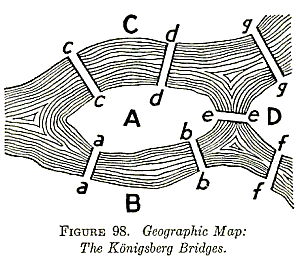
The Königsberg bridge problem asks if the seven bridges of the city of Königsberg (left figure; Kraitchik 1942), formerly in Germany but now known as Kaliningrad and
part of Russia, over the river Preger can all be traversed in a single trip without
doubling back, with the additional requirement that the trip ends in the same place
it began. This is equivalent to asking if the multigraph
on four nodes and seven edges (right figure) has an Eulerian
cycle. This problem was answered in the negative by Euler (1736), and represented
the beginning of graph theory.
On a practical note, J. Kåhre observes that bridges and no longer exist and that and are now a single bridge passing above with a stairway in the middle leading down to . Even so, there is still no Eulerian
cycle on the nodes ,,,
and
using the modern Königsberg bridges, although there is an Eulerian
path (right figure). An example Eulerian path is illustrated in the right figure
above where, as a last step, the stairs from to can be climbed to cover not only all bridges but all steps
as well.




 and
 no longer exist and that
 and
 are now a single bridge passing above
 with a stairway in the middle leading down to
 . Even so, there is still no Eulerian
cycle on the nodes
 ,
 ,
 ,
and
 using the modern Königsberg bridges, although there is an Eulerian
path (right figure). An example Eulerian path is illustrated in the right figure
above where, as a last step, the stairs from
 to
 can be climbed to cover not only all bridges but all steps
as well.
