


Every day, GPU cloud providers face something of a devil’s bargain. Sitting on fortunes in NVIDIA silicon, they stand to make enormous profits renting out compute on-demand, by the hour. Yet time and again, neoclouds forgo this upside, committing their capacity to long-term contracts at substantial discounts. The lenders financing their hardware, after all, demand predictable revenue to cover the debt, and hourly rentals offer no such assurance. This is the fundamental paradox of AI infrastructure: to finance the asset, you must first give away much of its upside.
Just how much upside neoclouds are surrendering, however, is remarkably difficult to determine. A contract that looks sensible today could prove ruinously cheap if compute remains scarce, or exceptionally lucrative if rental prices collapse. Much depends on what GPUs will earn over the next five years, and on this, opinions differ wildly. Michael Burry has called 5-6 year long hyperscaler depreciation schedules “one of the more common frauds of the modern era,” arguing that the industry is dramatically understating how fast its GPUs lose value. Elon Musk, meanwhile, suggested on a SpaceX call this week that a six-month payback on compute next year was “not impossible.”
How much revenue are neoclouds sacrificing to make their fleets financeable, and has the trade-off been worth it? Ornn’s GPU pricing data helps us examine what we call the compute certainty tax.
What is the Compute Certainty Tax, and Why Does it Exist?
Contrary to conventional wisdom, technological obsolescence is not the principal risk associated with financing GPUs. Ornn’s previous research on open-weight inference shows that older GPUs can remain economically useful long after newer generations arrive. Many workloads do not require the latest hardware, and as compute becomes more interchangeable across providers and GPU generations, price-sensitive customers have greater freedom to seek out the cheapest capacity capable of doing the job. The A100, now two generations old, still rents for about a dollar an hour and supports a remarkably durable forward curve.
However, lenders understand that staying useful is not the same as earning predictable revenue. An H100 might still have plenty of customers in 2030, but what will they actually pay to rent it? And how many hours will it sit idle between customers? A lender can be completely confident that demand for compute will keep growing and still have little idea how much revenue a particular fleet will generate, or whether it will generate enough to repay the loan. Price and utilization risk are the two uncertainties at the heart of financing on-demand compute.
Of course, neither price nor utilization risk is unique to GPUs. These are age-old problems in asset finance, which mature industries have spent decades developing tools to manage. For instance, power producers sell their future output through forward and futures markets, locking in prices years before the electricity is generated. Aircraft lenders draw on long leasing histories and deep secondary markets to estimate what a plane might earn and what it would fetch if they had to repossess it. In both sectors, lenders can assess the risks of financing an asset without relying solely on the borrower’s optimistic revenue projections.
The compute market, still in its infancy, has yet to develop this financial infrastructure. A lender can look up what an H100 rents for today on Ornn Data, but there is no mature, liquid futures market to establish what it might earn in 2030 or to hedge that exposure. Lenders have, as a result, largely opted for long-term customer contracts rather than rely on uncertain future GPU revenues. A multiyear take-or-pay agreement provides predictable payments against which a loan can be sized, replacing uncertainty over future prices and utilization with the more familiar question of whether the customer will honor its obligations.
Long-term, take-or-pay contracts make GPU hardware financeable. However, in solving the lender’s problem, they create two costly complications for the cloud provider.
First, the need to satisfy lenders pushes cloud providers toward investment-grade customers. A five-year commitment from Microsoft carries far more weight with creditors than the same promise from OpenAI or Anthropic, despite their scale and extraordinary fundraising abilities. As for smaller AI labs and application-layer startups… good luck.
Second, providers must offer substantial discounts to secure long-term commitments. A customer buying five years of compute risks being locked into an expensive contract if compute prices fall or its own demand dries up, and expects compensation for taking that risk. The provider, dependent on that same contract to unlock financing, has little room to resist.
Once those discounts are counted, cloud providers effectively pay for financing twice: once in interest to their lenders, and again in discounts to the customers whose contracts make those loans possible. How much revenue do those discounts cost them? As it turns out, quite a lot.
Quantifying the Certainty Tax
To measure the discounts associated with long-term commitments, we used Ornn’s on-demand index and forward pricing curves to compare what the same GPU commands on demand versus under contracts ranging from one month to five years.
Consider the H100. On October 15, 2026, it rented for $3.12 an hour on demand, while a five-year commitment was marked at just $1.58, a discount of roughly 49%. The difference is even larger on newer hardware, reaching 61% on the B200, 68% on the B300, and nearly 70% on the H200. Curiously, the six-year-old A100 shows almost the opposite pattern, with its five-year rental rate sitting only 14% below its prevailing on-demand price.

The divergence reveals how differently the market prices commitments across GPU generations. Newer GPUs command substantial premiums for their performance and relative scarcity, both of which are likely to diminish as supply expands and subsequent generations arrive. The A100, by contrast, has already lived through several such transitions, and much of the adjustment is reflected in its current rental price. The market appears to demand considerably more compensation for committing to today's premium hardware than for committing to older capacity whose remaining economic role is better established.
However, a 49% discount to today’s H100 rental price does not necessarily mean an operator is surrendering 49% of its potential revenue. The customer signing a five-year contract is betting that compute will become substantially cheaper over that period, while the cloud provider is accepting a lower fixed price in exchange for predictable revenue and utilization. If rental rates collapse, the commitment may turn out to be a rather good deal. If prices hold up and the GPUs remain occupied, the operator could find itself having sold five years of compute far more cheaply than it needed to.
The question, then, is whether the discounts embedded in today’s term curves are proportionate to the risks they are supposed to compensate for. One way to investigate this is to examine what operators would actually have earned by selling compute on demand over the past few years, rather than locking in a fixed rate. The H100 now has nearly 850 days of observed rental-price history, giving us a useful starting point for assessing whether the certainty tax has, so far, been worth paying.
Has the Certainty Tax Paid Off?
An H100 rented for $3.15 an hour in June 2024, gradually declined through 2025, and eventually bottomed at $1.63 in February 2026, a drawdown of nearly 48%. For lenders concerned about the future earning power of GPU fleets, this was precisely the sort of decline that made long-term customer commitments attractive in the first place. Yet the downturn proved temporary. By May, rental prices had recovered above $3, and they remained near that level in October, leaving an operator selling on demand exposed to a painful decline but also able to participate in the recovery.

To put a number on the value of certainty, consider an H100 renting for $3 an hour at the beginning of the year. Suppose that over the following twelve months, it earns an average of just $2 per available hour after accounting for periods when the hardware sits idle. A customer willing to commit to paying $2 for every hour would have generated exactly the same gross revenue. The operator could therefore have accepted a 33% discount to the initial on-demand rate without earning any less. A smaller discount would have favored the contract; a larger one would have favored selling on demand.
We call this the break-even discount, and calculate it across different starting dates and holding periods in the H100’s rental history, assuming 80% on-demand occupancy.
Our break-even discount analysis clearly favors cloud providers selling on demand. Across 669 rolling six-month periods, the median break-even discount was 24.3%, rising to 29.7% over one year and 36.8% over two years. In other words, over a typical one-year period, an operator could have accepted a discount of roughly 30% before earning less than it would have by selling on demand.
What if the operator had accepted a larger discount, closer to those available in today’s term market? At a hypothetical 40% discount to the on-demand price at the beginning of each period, selling on demand would have generated more revenue in every six-month period, 96.7% of one-year periods, and 76.5% of two-year periods. For much of the H100’s history, locking in revenue at such a discount would have been a costly decision.
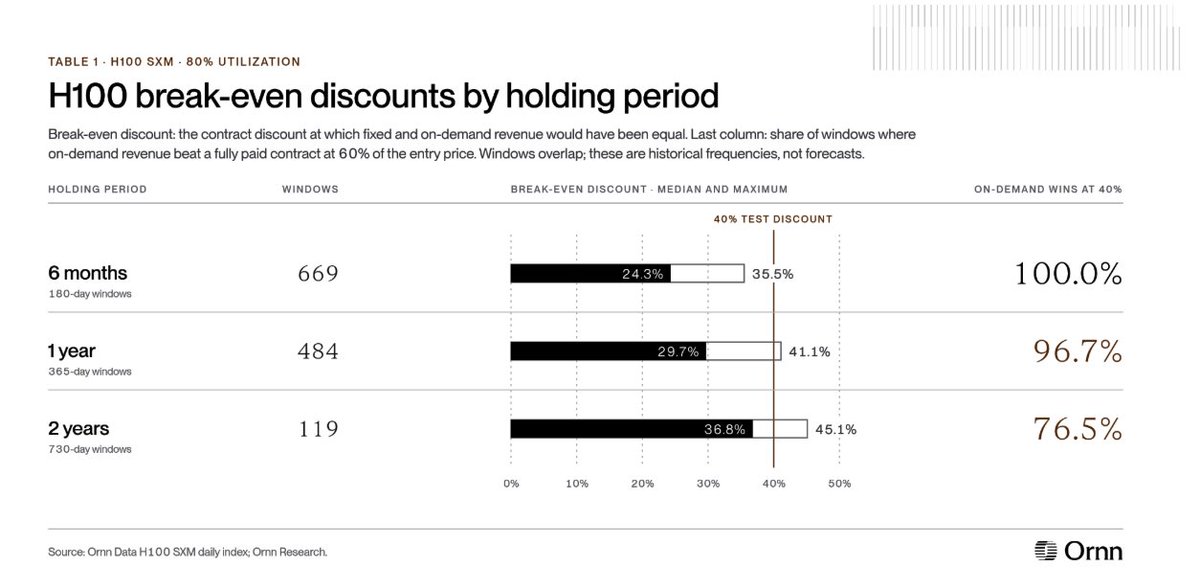
There is, however, an important complication. Across the full 850-day H100 price history, the break-even discount rises to 42.7%, much closer to the roughly 49% discount on today’s five-year contracts. An operator who locked in a fixed rate in June 2024 would have avoided much of the subsequent decline in rental prices, making the decision considerably more attractive than the shorter backtests suggest. Whether today’s five-year discounts will prove similarly worthwhile depends on what GPUs earn over the coming years, something the historical record cannot yet tell u
A Market for Certainty
In partnership with Intercontinental Exchange (ICE), Ornn is launching the first exchange-traded futures contracts based on the Ornn Compute Price Index, initially covering H100 and B200 GPUs. These contracts will settle financially against observed rental prices, meaning neither side needs to buy, sell, or take delivery of an actual GPU-hour.
Implications for infrastructure finance will be quite profound. An operator worried about H100 rental rates in 2028 could hedge future price exposure on an exchange while continuing to rent its hardware on demand. Rather than surrendering years of potential upside through a fixed-price customer agreement, it could choose how much price risk to retain and how much to transfer to the market.
Trillions of dollars are being committed to building the infrastructure of artificial intelligence, yet the financial risks underlying those investments remain largely negotiated behind closed doors. Open markets cannot eliminate uncertainty, nor can they guarantee that the resulting prices will be favorable, but can make them visible, subject them to competition, and allow anyone willing to bear the risk to participate.
For an industry being built at this scale, that is how the price of certainty ought to be discovered.
Research: Charlie Sheiner. Follow us on X or get in touch to learn more.


