Thank you for visiting nature.com. You are using a browser version with limited support for CSS. To obtain
the best experience, we recommend you use a more up to date browser (or turn off compatibility mode in
Internet Explorer). In the meantime, to ensure continued support, we are displaying the site without styles
and JavaScript.
This collection celebrates the 30th anniversary of the detection of the first planet outside our Solar System orbiting a main sequence star. Experts reflect on the impact of various milestones in exoplanetary science and trace the way forward.
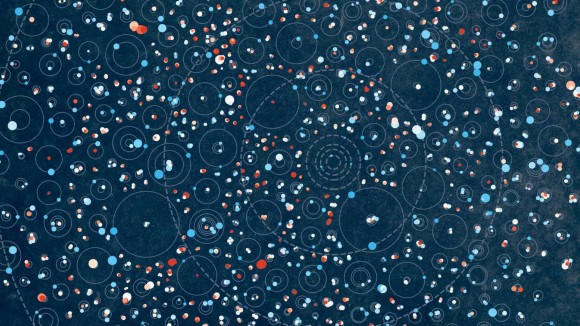
Thirty years after the discovery of 51 Pegasi b — the first planet found around another Sun-like star — astronomers are still grappling with its implications. Hot Jupiters and other planets with unanticipated properties have upended theory and revealed a rich diversity of planetary systems.
Water is ubiquitous in the atmospheres of hot and warm exoplanets. Detecting, quantifying and mapping atmospheric water has revealed a great deal about dynamical and chemical processes on distant worlds.
Are we alone in the Universe? Humans have asked this question for as long as our ancestors have stared up at the night sky. Discovering the first possibly Earth-like world has brought us closer to the answer.
The TRAPPIST-1 system — seven Earth-sized worlds around a tiny star — reshaped exoplanet science, proving that faint low-mass M-dwarfs are prime targets in the search for habitable planets and life beyond Earth.
Since its discovery in 2018, PDS 70 is one of the two youngest known exoplanetary systems, still surrounded by its parental protoplanetary disk — an environment where planet formation can be studied in action and that may mirror the first million years of our own Solar System.
The recent launch of JWST has allowed us to reach new milestones in the understanding of exoplanet characterization — starting off with the first detection of carbon dioxide in an exoplanet atmosphere.
The Habitable Worlds Observatory will look for inhabited worlds beyond our Solar System in the 2040s and scientists are dreaming of what else it might do.
Earlier this month we celebrated the 30th anniversary of the detection of the first planet outside our Solar System orbiting a Sun-like star. This discovery triggered the birth of a field in astronomy that hasn’t stopped growing or producing surprises.
To understand how life began on Earth billions of years ago, a global community must work collaboratively to study the emergence of the necessary molecular building blocks and how they evolved into complex life in different environments.
K2-18 b is the only habitable-zone exoplanet with a detectable atmosphere — initially associated with water vapour, now accepted as being due to methane. Recent observations suggest possible biomarkers. This Comment assesses these shifting conclusions.
Exoplanetary atmosphere studies rely on the quality of laboratory spectroscopy and observational astronomy. This Technical Review highlights the power of high-resolution cross-correlation spectroscopy for advancing the field for all stakeholders.
A report of recent observations of the close-in extrasolar giant planet (hot Jupiter) HD 189733b taken during the transit, where the planet passed in front of its parent star. Absorption by water vapour is the most likely cause of the wavelength-dependent variations in the effective radius of the planet.
Last year, three Earth-sized planets were discovered to be orbiting the nearby Jupiter-sized star TRAPPIST-1; now, follow-up photometric observations from the ground and from space show that there are at least seven Earth-sized planets in this star system, and that they might be the right temperature to harbour liquid water on their surfaces.
Orbital parameters for the seventh Earth-sized transiting planet around star TRAPPIST-1 are reported, along with an investigation into the complex three-body resonances linking every member of this planetary system.
A small planet of at least 1.3 Earth masses is orbiting Proxima Centauri with a period of about 11.2 days, with the potential for liquid water on its surface.
Two Hα emission peaks are detected within the disk of the T Tauri star PDS 70: one corresponds to protoplanet PDS 70 b, and the other is associated with a second accreting planet of few Jupiter masses at ~35 au. The two protoplanets are near 2:1 mean motion resonance, supporting migration scenarios of giant planets during planetary formation.
Transmission spectroscopy observations from the James Webb Space Telescope show the detection of carbon dioxide in the atmosphere of the gas giant exoplanet WASP-39b.
JWST Transiting Exoplanet Community Early Release Science Team
A combined analysis of datasets across four JWST instrument modes provides a benchmark transmission spectrum for the Saturn-mass WASP-39 b. The broad wavelength range and high resolution constrain orbital and stellar parameters to below 1%.
Michel Mayor and Didier Queloz, who discovered the first extrasolar planet orbiting a Sun-like star, share award with theoretical cosmologist James Peebles.