


Abstract
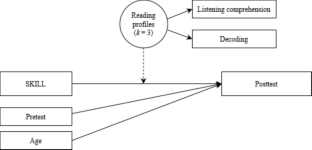
Many children with oral language difficulties also experience challenges with word reading, as evidenced in the high comorbidity rate between developmental language disorders and dyslexia. The current study investigated a sample of students (n = 357) with language and literacy difficulties classified into latent classes based on pre-intervention performance on word reading and listening comprehension measures. Specifically, this study sought to determine the extent to which latent classes responded to an evidence-based, narrative language program at immediate post-test and a five-month follow-up time point, and whether performance varied as a function of class membership. Findings revealed that students in all latent profiles showed statistically significant improvements in narrative language at post-test, a primary target of the intervention. However, intervention effects varied at a five-month follow-up time point, with students with the greatest listening comprehension and word reading difficulties showing the most notable gains. Instructional response also varied according to performance on a narrative writing measure. These findings suggest that assessing initial performance on key variables may be able to help educators predict student response and adapt intervention plans to more effectively meet individual needs.
Data availability
The data that support the findings of this study are not publicly available, but deidentified data are available from the corresponding author on reasonable request and with appropriate institutional approvals.
References
Adlof, S. M., & Hogan, T. P. (2018). Understanding dyslexia in the context of developmental language disorders. Language, Speech, and Hearing Services in Schools, 49(4), 762–773. https://doi.org/10.1044/2018_LSHSS-DYSLC-18-0049
Alt, M., Gray, S., Hogan, T. P., Schlesinger, N., & Cowan, N. (2019). Spoken word learning differences among children with dyslexia, concomitant dyslexia and developmental language disorder, and typical development. Language, Speech, and Hearing Services in Schools, 50(4), 540–561. https://doi.org/10.1044/2019_LSHSS-VOIA-18-0138
Aro, T., Koponen, T., Peura, P., Räikkönen, E., Viholainen, H., & Aro, M. (2024). Do cognitiveand non-cognitive factors predict responses to reading fluency interventions? The Journal of Experimental Education. https://doi.org/10.1080/00220973.2024.2358501
Asparouhov, T., & Muthén, B. (2014). Auxiliary variables in mixture modeling: Three-step approaches using M plus. Structural Equation Modeling: A Multidisciplinary Journal, 21(3), 329–341. https://doi.org/10.1080/10705511.2014.915181
Bauer, D. J., & Curran, P. J. (2004). The integration of continuous and discrete latent variablemodels: Potential problems and promising opportunities. Psychological Methods, 9(1), 3–29. https://doi.org/10.1037/1082-989X.9.1.3
Bender, R., & Lange, S. (2001). Adjusting for multiple testing—When and how? Journal of Clinical Epidemiology, 54(4), 343–349. https://doi.org/10.1016/S0895-4356(00)00314-0
Bishop, D. V. M., Snowling, M. J., Thompson, P. A., Greenhalgh, T., Adams, C., Archibald, L., Baird, G., Bauer, A., Bellair, J., Boyle, C., Brownlie, E., Carter, G., Clark, B., Clegg, J., Cohen, N., Conti‐Ramsden, G., Dockrell, J., Dunn, J., Ebbels, S., & House, A. (2017). Phase 2 of CATALISE: A multinational and multidisciplinary Delphi consensus study of problems with language development: Terminology. Journal of Child Psychology and Psychiatry, and Allied Disciplines, 58(10), 1068–1080. https://doi.org/10.1111/jcpp.12721
Boerma, T., ter Haar, S., Ganga, R., Wijnen, F., Blom, E., & Wierenga, C. J. (2023). What risk factors for developmental language disorder can tell us about the neurobiological mechanisms of language development. Neuroscience & Biobehavioral Reviews, 154, Article 105398. https://doi.org/10.1016/j.neubiorev.2023.105398
Brasseur-Hock, I. F., Hock, M. F., Kieffer, M. J., Biancarosa, G., & Deshler, D. D. (2011). Adolescent struggling readers in urban schools: Results of a latent class analysis. Learning and Individual Differences, 21(4), 438–452. https://doi.org/10.1016/j.lindif.2011.01.008
Capin, P., Gillam, S. L., Fall, A.-M., Roberts, G., Dille, J. T., & Gillam, R. B. (2022). Understanding the nature and severity of reading difficulties among students with language and reading comprehension difficulties. Annals of Dyslexia, 72(2), 249–275. https://doi.org/10.1007/s11881-022-00255-3
Capin, P., Vaughn, S., Miller, J. E., Miciak, J., Fall, A.-M., Roberts, G., Cho, E., Barth, A. E., Steinle, P. K., & Fletcher, J. M. (2024). Investigating the reading profiles of middle school emergent bilinguals with significant reading comprehension difficulties. Scientific Studies of Reading, 28(2), 190–213. https://doi.org/10.1080/10888438.2023.2254871
Catts, H. W., & Petscher, Y. (2022). A cumulative risk and resilience model of dyslexia. Journal of Learning Disabilities, 55(3), 171–184. https://doi.org/10.1177/00222194211037062
Catts, H. W., Adlof, S. M., Hogan, T., & Weismer, S. E. (2005). Are specific language impairment and dyslexia distinct disorders? Journal of Speech, Language, and Hearing Research, 48(6), 1378–1396. https://doi.org/10.1044/1092-4388(2005/096)
Cho, E., Roberts, G. J., Capin, P., Roberts, G., Miciak, J., & Vaughn, S. (2015). Cognitive attributes, attention, and self-efficacy of adequate and inadequate responders in a fourth grade reading intervention. Learning Disabilities Research & Practice: A Publication of the Division for Learning Disabilities, Council for Exceptional Children, 30(4), 159–170. https://doi.org/10.1111/ldrp.12088
Clegg, J., Hollis, C., Mawhood, L., & Rutter, M. (2005). Developmental language disorders – A follow-up in later adult life. Cognitive, language and psychosocial outcomes. Journal of Child Psychology and Psychiatry, 46(2), 128–149. https://doi.org/10.1111/j.1469-7610.2004.00342.x
Clemens, N. H., Simmons, D., Simmons, L. E., Wang, H., & Kwok, O. (2017). The prevalence of reading fluency and vocabulary difficulties among adolescents struggling with reading comprehension. Journal of Psychoeducational Assessment, 35(8), 785–798. https://doi.org/10.1177/0734282916662120
Compton, D. L., Fuchs, D., Fuchs, L. S., Elleman, A. M., & Gilbert, J. K. (2008). Tracking children who fly below the radar: Latent transition modeling of students with late-emerging reading disability. Learning and Individual Differences, 18(3), 329–337. https://doi.org/10.1016/j.lindif.2008.04.003
Connor, C. M., Morrison, F. J., Fishman, B. J., Schatschneider, C., & Underwood, P. (2007). Algorithm-guided individualized reading instruction. Science, 315(5811), 464–465. https://doi.org/10.1126/science.1134513
Conti-Ramsden, G., & Durkin, K. (2008). Language and independence in adolescents with and without a history of specific language impairment (SLI). Journal of Speech, Language, and Hearing Research, 51(1), 70–83. https://doi.org/10.1044/1092-4388(2008/005)
Coyne, M. D., McCoach, D. B., Ware, S., Austin, C. R., Loftus-Rattan, S. M., & Baker, D. L. (2019). Racing against the vocabulary gap: Matthew effects in early vocabulary instruction and intervention. Exceptional Children, 85(2), 163–179. https://doi.org/10.1177/0014402918789162
Diepeveen, F. B., De Kroon, M. L. A., Dusseldorp, E., & Snik, A. F. M. (2013). Among perinatal factors, only the Apgar score is associated with specific language impairment. Developmental Medicine & Child Neurology, 55(7), 631–635. https://doi.org/10.1111/dmcn.12133
Dubois, P., St-Pierre, M.-C., Desmarais, C., & Guay, F. (2020). Young adults with developmental language disorder: A systematic review of education, employment, and independent living outcomes. Journal of Speech, Language, and Hearing Research, 63(11), 3786–3800. https://doi.org/10.1044/2020_JSLHR-20-00127
Duff, D. M., Hendricks, A. E., Fitton, L., & Adlof, S. M. (2023). Reading and math achievement in children with Dyslexia, developmental language disorder, or typical development: Achievement gaps persist from second through fourth grades. Journal of Learning Disabilities, 56(5), 371–391. https://doi.org/10.1177/00222194221105515
Ferguson, S. L., G. Moore, E. W., & Hull, D. M. (2020). Finding latent groups in observed data: A primer on latent profile analysis in Mplus for applied researchers. International Journal of Behavioral Development, 44(5), 458–468. https://doi.org/10.1177/0165025419881721
Fletcher, J. M., Stuebing, K. K., Barth, A. E., Denton, C. A., Cirino, P. T., Francis, D. J., & Vaughn, S. (2011). Cognitive correlates of inadequate response to reading intervention. School Psychology Review, 40(1), 3–22. https://doi.org/10.1080/02796015.2011.12087725
Gibson, W. A. (1959). Three multivariate models: Factor analysis, latent structure analysis, and latent profile analysis. Psychometrika, 24(3), 229–252. https://doi.org/10.1007/BF02289845
Gillam, R. B., & Pearson, N. A. (2017). Test of narrative language. Pro-Ed.
Gillam, S. L, Gillam, R. B., Fargo, J. D., Olszewski, A., & Segura, H. (2017). Monitoring indicators of scholarly language. Communication Disorders Quarterly, 38(2), 96–106. https://doi.org/10.1177/1525740116651442 https://doi.org/10.1177/1525740116651442
Gillam, S. L., Gillam, R. B., Magimairaj, B. M., Capin, P., Israelsen-Augenstein, M., Roberts, G., & Vaughn, S. (2024). Contextualized, Multicomponent Language Instruction: From Theory to Randomized Controlled Trial. Language, Speech, and Hearing Services in Schools, 55(3), 661–682. https://doi.org/10.1044/2024_LSHSS-23-00171 https://doi.org/10.1044/2024_LSHSS-23-00171
Gillam, S. L., Gillam, R. B., & Laing, C. (2018). SKILL narrative: Supporting knowledge in language and literacy (3rd ed.). Utah State University.
Gillam,S. L., Vaughn, S., Roberts, G., Capin, P., Fall, A. M., Israelsen-Augenstein, M., ... & Gillam, R. B. (2023). Improving oral and written narration and reading comprehension of children at-risk for language and literacy difficulties: Results of a randomized clinical trial. Journal of Educational Psychology, 115(1), 99. https://doi.org/10.1037/edu0000766
Gutiérrez, N., Rigobon, V. M., Marencin, N. C., Edwards, A. A., Steacy, L. M., & Compton, D. L. (2023). Early prediction of reading risk in fourth grade: A combined latent class analysis and classification tree approach. Scientific Studies of Reading, 27(1), 21–38. https://doi.org/10.1080/10888438.2022.2121655
Hall, C., Dahl-Leonard, K., Cho, E., Solari, E. J., Capin, P., Conner, C. L., Henry, A. R., Cook, L., Hayes, L., Vargas, I., Richmond, C. L., & Kehoe, K. F. (2023). Forty years of reading intervention research for elementary students with or at risk for Dyslexia: A systematic review and meta-analysis. Reading Research Quarterly, 58(2), 285–312. https://doi.org/10.1002/rrq.477
Hulme, C., & Snowling, M. J. (2009). Developmental disorders of language and cognition. Wiley-Blackwell.
James, E., Thompson, P. A., Bowes, L., & Nation, K. (2023). Heterogeneity in children’s reading comprehension difficulties: A latent class approach. JCPP Advances, 3(4), Article e12177. https://doi.org/10.1002/jcv2.12177
Jöreskog, K. G. (1971). Simultaneous factor analysis in several populations. Psychometrika, 36(4), 409–426.
Kintsch, W. (2018). Revisiting the construction—integration model of text comprehension and its Implications for Instruction. In D. E. Alvermann, N. J. Unrau, M. Sailors, & R. B. Ruddell (Eds.), Theoretical models and processes of literacy (pp. 178–203). Routledge.
Kulesz, P. A., Roberts, G. J., Francis, D. J., Cirino, P., Walczak, M., & Vaughn, S. (2024). Latent profiles as predictors of response to instruction for students with reading difficulties. Journal of Educational Psychology, 116(3), 363–376. https://doi.org/10.1037/edu0000832
Law, J., Rush, R., Schoon, I., & Parsons, S. (2009). Modeling developmental language difficulties from school entry into adulthood: Literacy, mental health, and employment outcomes. Journal of Speech, Language, and Hearing Research, 52(6), 1401–1416. https://doi.org/10.1044/1092-4388(2009/08-0142)
Lazarsfeld, P. F., & Henry, N. W. (1968). Latent Structure Analysis. Houghton Mifflin.
Leonard, L. B. (2014). Specific language impairment across languages. Child Development Perspectives, 8(1), 1–5. https://doi.org/10.1111/cdep.12053
Lesaux, N. K., & Kieffer, M. J. (2010). Exploring sources of reading comprehension difficulties among language minority learners and their classmates in early adolescence. American Educational Research Journal, 47(3), 596–632. https://doi.org/10.3102/0002831209355469
Li, M., Truong, D. T., DeMille, M., Malins, J. G., Lovett, M. W., Bosson-Heenan, J., Gruen, J. R., & Frijters, J. C. (2020). Effect of READ1 on latent profiles of reading disorder and comorbid attention and language impairment subtypes. Child Neuropsychology, 26(2), 145–169. https://doi.org/10.1080/09297049.2019.1648642
Lyon, G. R., Shaywitz, S. E., & Shaywitz, B. A. (2003). A definition of dyslexia. Annals of Dyslexia, 53(1), 1–14. https://doi.org/10.1007/s11881-003-0001-9
MacGinitie, W. H., MacGinitie, R. K., Maria, K., Dryer, L. G., & Hughes, K. E. (2002). Gates-MacGinitie Reading Tests (GMRT). Riverside Publishing.
McArthur, G. M., Hogben, J. H., Edwards, V. T., Heath, S. M., & Mengler, E. D. (2000). On the “Specifics” of specific reading disability and specific language impairment. Journal of Child Psychology and Psychiatry, 41(7), 869–874. https://doi.org/10.1111/1469-7610.00674
McGrath, L. M., Peterson, R. L., & Pennington, B. F. (2020). The Multiple Deficit Model: Progress, problems, and prospects. Scientific Studies of Reading: The Official Journal of the Society for the Scientific Study of Reading, 24(1), 7–13. https://doi.org/10.1080/10888438.2019.1706180
Muthén, B., & Muthén, L. (2000). Integrating person‐centered and variable‐centered analyses: Growth mixture modeling with latent trajectory classes. Alcoholism: Clinical and Experimental Research, 24(6), 882–891. https://doi.org/10.1111/j.1530-0277.2000.tb02070.x
Nylund-Gibson, K., Garber, A. C., Singh, J., Witkow, M. R., Nishina, A., & Bellmore, A. (2023). The utility of latent class analysis to understand heterogeneity in youth coping strategies: A methodological introduction. Behavioral Disorders, 48(2), 106–120. https://doi.org/10.1177/01987429211067214
O’Brien, B. A., Tan, C. S., & Mohamed, M. B. H. (2023). Response and non-response to intervention for reading difficulties: What role do cognitive correlates play? Asia Pacific Journal of Developmental Differences. https://doi.org/10.3850/s2345734123000880
Pastor, D. A., Barron, K. E., Miller, B. J., & Davis, S. L. (2007). A latent profile analysis of college students’ achievement goal orientation. Contemporary Educational Psychology, 32(1), 8–47. https://doi.org/10.1016/j.cedpsych.2006.10.003
Peng, P., Fuchs, D., Fuchs, L. S., Cho, E., Elleman, A. M., Kearns, D. M., Patton, S., & Compton, D. L. (2020). Is “Response/no response” too simple a notion for RTI frameworks? Exploring multiple response types with latent profile analysis. Journal of Learning Disabilities, 53(6), 454–468. https://doi.org/10.1177/0022219420931818
Pennington, B. F. (2006). From single to multiple deficit models of developmental disorders. Cognition, 101(2), 385–413. https://doi.org/10.1016/j.cognition.2006.04.008
Peterson, A. K., Fox, C. B., & Israelsen, M. (2020). A Systematic Review of Academic Discourse Interventions for School-Aged Children With Language-Related Learning Disabilities. Language, Speech & Hearing Services in Schools, 51(3), 866–881. https://doi.org/10.1044/2020_LSHSS-19-00039
Psyridou, M., Tolvanen, A., Patel, P., Khanolainen, D., Lerkkanen, M.-K., Poikkeus, A.-M., & Torppa, M. (2023). Reading difficulties identification: A comparison of neural networks, linear, and mixture models. Scientific Studies of Reading, 27(1), 39–66. https://doi.org/10.1080/10888438.2022.2095281
Richmond, C. L., Daucourt, M. C., Hart, S. A., & Solari, E. J. (2024). Examining the word-level skill and reading comprehension profiles of adolescents with and without specific learning disabilities. Learning Disability Quarterly, 47(3), 167–181. https://doi.org/10.1177/07319487231182133
Rinaldi, S., Caselli, M. C., Cofelice, V., D’Amico, S., De Cagno, A. G., Della Corte, G., Di Martino, M. V., Di Costanzo, B., Levorato, M. C., Penge, R., Rossetto, T., Sansavini, A., Vecchi, S., & Zoccolotti, P. (2021). Efficacy of the Treatment of Developmental Language Disorder: A Systematic Review. Brain Sciences, 11(3), 407. https://doi.org/10.3390/brainsci11030407
Snowling, M. J., Nash, H. M., Gooch, D. C., Hayiou-Thomas, M. E., & Hulme, C. (2019). Developmental Outcomes for Children at High Risk of Dyslexia and Children With Developmental Language Disorder. Child Development, 90(5), e548–e564. https://doi.org/10.1111/cdev.13216
Solís, M., Vaughn, S., & Scammacca, N. (2015). The effects of an intensive reading intervention for ninth graders with very low reading comprehension. Learning Disabilities Research & Practice, 30(3), 104–113. https://doi.org/10.1111/ldrp.12061
Sörbom, D. (1974). A General Method for studying differences in factor means and factor structure between groups. British Journal of Mathematical and Statistical Psychology, 27, 229–239. https://doi.org/10.1111/j.2044-8317.1974.tb00543.x
Spurk, D., Hirschi, A., Wang, M., Valero, D., & Kauffeld, S. (2020). Latent profile analysis: A review and “how to” guide of its application within vocational behavior research. Journal of Vocational Behavior, 120, Article 103445. https://doi.org/10.1016/j.jvb.2020.103445
St. Clair, M. C., Pickles, A., Durkin, K., & Conti-Ramsden, G. (2011). A longitudinal study of behavioral, emotional and social difficulties in individuals with a history of specific language impairment (SLI). Journal of Communication Disorders, 44(2), 186–199. https://doi.org/10.1016/j.jcomdis.2010.09.004
Stein, N. L., & Glenn, C. G. (1979). An analysis of story comprehension in elementary school children. New Directions in Discourse Processing, 2(1979), 53–120.
Stuebing, K. K., Barth, A. E., Trahan, L. H., Reddy, R. R., Miciak, J., & Fletcher, J. M. (2015). Are child cognitive characteristics strong predictors of responses to intervention? A meta-analysis. Review of Educational Research, 85(3), 395–429. https://doi.org/10.3102/0034654314555996
Swanson, H. L., Kong, J., & Petcu, S. D. (2023). Stability of learning disabilities, cognitive growth, and L1 in English learners: A latent class and transition analysis. Journal of Educational Psychology, 115(3), 379–404. https://doi.org/10.1037/edu0000771
Tambyraja, S. R., Schmitt, M. B., Farquharson, K., & Justice, L. M. (2015). Stability of language and literacy profiles of children with language impairment in the public schools. Journal of Speech, Language, and Hearing Research, 58(4), 1167–1181. https://doi.org/10.1044/2015_JSLHR-L-14-0197
Tarvainen, S., Launonen, K., & Stolt, S. (2021). Oral language comprehension interventions in school-age children and adolescents with developmental language disorder: A systematic scoping review. Autism & Developmental Language Impairments, 6, Article 23969415211010423. https://doi.org/10.1177/23969415211010423
Torgesen, J. K., Wagner, R. K., & Rashotte, C. A. (2012). Test of Word Reading Efficiency–2. Pro-Ed.
Vaughn, S., Roberts, G., Capin, P., Miciak, J., Cho, E., & Fletcher, J. M. (2019). How initial word reading and language skills affect reading comprehension outcomes for students with reading difficulties. Exceptional Children, 85(2), 180–196. https://doi.org/10.1177/0014402918782618
Vaughn, S., Capin, P., Scammacca, N., Roberts, G., Cirino, P., & Fletcher, J. M. (2020). The critical role of word reading as a predictor of response to intervention. Journal of Learning Disabilities, 53(6), 415–427. https://doi.org/10.1177/0022219419891412
Wanzek, J., Petscher, Y., Otaiba, S. A., Rivas, B. K., Jones, F. G., Kent, S. C., Schatschneider, C., & Mehta, P. (2017). Effects of a year long supplemental reading intervention for students with reading difficulties in fourth grade. Journal of Educational Psychology, 109(8), 1103–1119. https://doi.org/10.1037/edu0000184
Wanzek, J., Roberts, G., Vaughn, S., Swanson, E., & Sargent, K. (2019). Examining the role of pre-instruction academic performance within a text-based approach to improving student content knowledge and understanding. Exceptional Children, 85(2), 212–228. https://doi.org/10.1177/0014402918783187
What Works Clearinghouse. (2022 ). What Works Clearinghouse Standards Handbook, Version 5.0 . U.S. Department of Education, Institute of Education Sciences, National Center for Education Evaluation and Regional Assistance. https://ies.ed.gov/ncee/wwc/handbooks
Whitehouse, A. J. O., Watt, H. J., Line, E. A., & Bishop, D. V. M. (2009). Adult psychosocial outcomes of children with specific language impairment, pragmatic language impairment and autism. International Journal of Language & Communication Disorders, 44(4), 511–528. https://doi.org/10.1080/13682820802708098
Yew, S. G. K., & O’Kearney, R. (2013). Emotional and behavioural outcomes later in childhood and adolescence for children with specific language impairments: Meta-analyses of controlled prospective studies. Journal of Child Psychology and Psychiatry, 54(5), 516–524. https://doi.org/10.1111/jcpp.12009
Young, A. R., Beitchman, J. H., Johnson, C., Douglas, L., Atkinson, L., Escobar, M., & Wilson, B. (2002). Young adult academic outcomes in a longitudinal sample of early identified language impaired and control children. Journal of Child Psychology and Psychiatry, 43(5), 635–645. https://doi.org/10.1111/1469-7610.00052
Funding
This research was supported by grant R324A240182 from the Department of Education’s Institute of Education Sciences. However, the content is solely the responsibility of the authors and does not necessarily represent the official views of U.S. Department of Education.
Author information
Authors and Affiliations
Contributions
Philip Capin contributed to the conception and design of the study and led the manuscript writing. Laura Mesite led the data analysis, and supported the drafting and revising of the manuscript. Anna-Mari Fall contributed to the data analysis and reviewed and revised the manuscript. Ryan Sainsbury contributed to the writing of the manuscript. Sandra L. Gillam contributed to the data collection and reviewed and revised the manuscript. Colby Hall contributed to the interpretation of findings, and manuscript revisions. Ronald B. Gillam contributed to the data collection, overall study design, and reviewed and revised the manuscript. All authors approved the final version of the manuscript and agree to be accountable for all aspects of the work.
Corresponding author
Ethics declarations
Conflicts of interest
Ronald B. Gillam receives royalties from the sale of the Test of Narrative Language, which was included in this study. Ronald and Sandra Gillam also receive royalties from the sale of the SKILL intervention. No other authors have conflicts of interests to disclose.
Additional information
Publisher's Note
Springer Nature remains neutral with regard to jurisdictional claims in published maps and institutional affiliations.
Rights and permissions
Springer Nature or its licensor (e.g. a society or other partner) holds exclusive rights to this article under a publishing agreement with the author(s) or other rightsholder(s); author self-archiving of the accepted manuscript version of this article is solely governed by the terms of such publishing agreement and applicable law.
About this article

Cite this article
Capin, P., Mesite, L., Fall, AM. et al. Using latent profiles to evaluate response to a language-based intervention. Ann. of Dyslexia 76, 364–388 (2026). https://doi.org/10.1007/s11881-026-00372-3
Received:
Accepted:
Published:
Version of record:
Issue date:
DOI: https://doi.org/10.1007/s11881-026-00372-3